Routledge/University of Tokyo Series – serie
Visar alla böcker i serien Routledge/University of Tokyo Series. Handla med fri frakt och snabb leverans.
6 produkter
6 produkter
2 119 kr
Skickas inom 10-15 vardagar
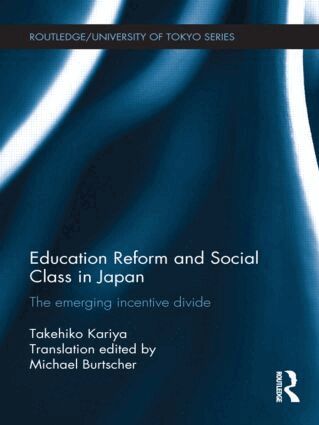
Until the early 1990s, Japanese education was widely commended for achieving outstanding outcomes in global comparison. At the same time, it was frequently criticized for failing to cultivate 'individuality' and 'creativity' in students. Wide-ranging education reforms were enacted during the 1990s to remedy these perceived failings. However, as this book argues, the reforms produced a different outcome than intended, contributing to growing disparity in learning motivation and educational aspiration of students from different class backgrounds instead.Takehiko Kariya demonstrates by way of empirical sociological analysis that educational inequality in Japan has been expanding, and that a new mechanism of educational selection has begun to operate, which he calls the 'incentive divide'. Casting light on recent changes in Japanese society to critically reassess educational policy choices, this book's quantitative and qualitative analyses of the 'mass education society' in post-war Japan offer important insights also for understanding similar problems faced in other parts of the world at present.Translated into English for the first time, the Japanese language version of Education Reform and Social Class in Japan won the first Osaragi Jirō Prize for Commentary sponsored by the Asahi shinbun. This book will be of interest to students and scholars in the fields of Asian studies, Japanese studies, education, sociology and social policy.

2 181 kr
Skickas inom 10-15 vardagar
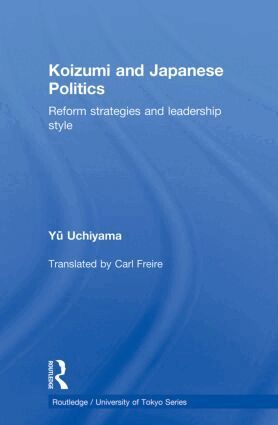
This book offers an empirical and theoretical study of the Koizumi administration, covering such issues as the characteristics of its political style, its domestic and foreign policies, and its larger historical significance. The key questions that guide its approach are: what enabled Koizumi to exercise unusually strong leadership, and what structural transformations of Japanese politics did he achieve?Uchiyama looks at policy-making processes, newly created institutional arenas such as the Council on Economic and Fiscal Policy, Koizumi’s populist strategy, foreign policy, and neo-liberal convictions to assess the historical significance of his administration and seek out the basis for its wide public support. Finally, the book undertakes a normative evaluation of the merits and demerits of the Koizumi administration’s political style, and compares it with the Abe and Fukuda administrations that came after. This book will be of interest to scholars and students with an interest in comparative politics, administrative reform, and contemporary Japan.
2 181 kr
Skickas inom 10-15 vardagar
The present study analyzes the livelihood security system of contemporary Japan in international comparison from a historical and gender perspective. It posits ‘livelihood security systems’ rather than ‘welfare states’ or ‘welfare regimes’ as its object of analysis to enter the role of non-governmental institutions and of governmental policies reaching beyond income transfers into vision.Based on rich statistical materials, the evolution of Japan’s livelihood security system in recent decades is traced to reveal a rigid male breadwinner orientation increasingly out of step with social realities. The need for remedying the gender bias built into Japan’s social insurance schemes has been politically highlighted since the late 1990s, but legislative action has continued to be deferred.The author argues that at present the livelihood security system of Japan is not only dysfunctional, but actually functioning in reverse, in a sense of furthering social exclusion. The study concludes with suggestions for a possible reconstruction of Japan’s social security system, arguing for an increased role of the ‘third sector’ or ‘social economy’ in livelihood security and care provision.This book will appeal to scholars and students with an interest in social policy, welfare economics and gender studies, as well as Japanese politics and society.
578 kr
Skickas inom 10-15 vardagar
This book offers an empirical and theoretical study of the Koizumi administration, covering such issues as the characteristics of its political style, its domestic and foreign policies, and its larger historical significance. The key questions that guide its approach are: what enabled Koizumi to exercise unusually strong leadership, and what structural transformations of Japanese politics did he achieve?Uchiyama looks at policy-making processes, newly created institutional arenas such as the Council on Economic and Fiscal Policy, Koizumi’s populist strategy, foreign policy, and neo-liberal convictions to assess the historical significance of his administration and seek out the basis for its wide public support. Finally, the book undertakes a normative evaluation of the merits and demerits of the Koizumi administration’s political style, and compares it with the Abe and Fukuda administrations that came after. This book will be of interest to scholars and students with an interest in comparative politics, administrative reform, and contemporary Japan.
578 kr
Skickas inom 10-15 vardagar
The present study analyzes the livelihood security system of contemporary Japan in international comparison from a historical and gender perspective. It posits ‘livelihood security systems’ rather than ‘welfare states’ or ‘welfare regimes’ as its object of analysis to enter the role of non-governmental institutions and of governmental policies reaching beyond income transfers into vision.Based on rich statistical materials, the evolution of Japan’s livelihood security system in recent decades is traced to reveal a rigid male breadwinner orientation increasingly out of step with social realities. The need for remedying the gender bias built into Japan’s social insurance schemes has been politically highlighted since the late 1990s, but legislative action has continued to be deferred.The author argues that at present the livelihood security system of Japan is not only dysfunctional, but actually functioning in reverse, in a sense of furthering social exclusion. The study concludes with suggestions for a possible reconstruction of Japan’s social security system, arguing for an increased role of the ‘third sector’ or ‘social economy’ in livelihood security and care provision.This book will appeal to scholars and students with an interest in social policy, welfare economics and gender studies, as well as Japanese politics and society.
733 kr
Skickas inom 10-15 vardagar
Until the early 1990s, Japanese education was widely commended for achieving outstanding outcomes in global comparison. At the same time, it was frequently criticized for failing to cultivate 'individuality' and 'creativity' in students. Wide-ranging education reforms were enacted during the 1990s to remedy these perceived failings. However, as this book argues, the reforms produced a different outcome than intended, contributing to growing disparity in learning motivation and educational aspiration of students from different class backgrounds instead.Takehiko Kariya demonstrates by way of empirical sociological analysis that educational inequality in Japan has been expanding, and that a new mechanism of educational selection has begun to operate, which he calls the 'incentive divide'. Casting light on recent changes in Japanese society to critically reassess educational policy choices, this book's quantitative and qualitative analyses of the 'mass education society' in post-war Japan offer important insights also for understanding similar problems faced in other parts of the world at present.Translated into English for the first time, the Japanese language version of Education Reform and Social Class in Japan won the first Osaragi Jirō Prize for Commentary sponsored by the Asahi shinbun. This book will be of interest to students and scholars in the fields of Asian studies, Japanese studies, education, sociology and social policy.