Selected Writings of James Fitzjames Stephen – serie
Visar alla böcker i serien Selected Writings of James Fitzjames Stephen. Handla med fri frakt och snabb leverans.
6 produkter
6 produkter
2 992 kr
Skickas inom 5-8 vardagar
James Fitzjames Stephen (1829-1894) is still highly valued as a judge, as the historian of the criminal law of England, and as the author of Liberty, Equality, Fraternity, a forthright disagreement with John Stuart Mill. Stephen's weekly journalism established him as a vigorous cross-examiner in the controversies—cultural, social, religious, political, moral, and philosophical—of his time (and duly, of our time). Collected here now are his essays on the novel and journalism, the co-operation and collusion of these two, their responsibilities and irresponsibilities. Written between 1855 and 1867, while Stephen prosecuted twin careers as barrister and journalist, these reviews bring to bear his formidable powers of mind and of phrasing, scrutinizing many deep and disconcerting novelists—Dickens and Thackeray, Harriet Beecher Stowe and E. C. Gaskell, Flaubert and Balzac. His work also weighs journalism in the scales: from Addison's The Spectator to the Crimean war correspondence of William Howard Russell; from the scabrously detailed law-reports in The Times to the phenomenon of Letters to its Editor; from the high culture of Matthew Arnold to the mass market of 'Railroad Bookselling'.
3 846 kr
Skickas inom 3-6 vardagar
James Fitzjames Stephen was a distinguished jurist, a codifier of the law in England and India, and the judge in the ill-fated Maybrick case; a serious and prolific journalist, a pillar of the Saturday Review and the Pall Mall Gazette. This is the first critical edition of his major work Liberty, Equality, Fraternity, a systematic attack on J. S. Mill's later social and political philosophy. The text originated in a series of twenty letters to the Pall Mall Gazette following Stephen's return from India as the Legal Member of the Viceroy's council in 1872. It was published as a book in 1873 and revised the following year in response to its critics, particularly Frederic Harrison and John Morley. It is the second edition of 1874 that forms the basis of this new edition. Stephen's abrasive style matched his disdain for what he regarded as Mill's enthusiasm for 'abstract' ideals such as liberty and equality--particularly sexual equality. Against Mill's emphasis on freedom of discussion as the most effective means of addressing differences of thought and belief, Stephen argued that conflict could only be resolved by the exercise of force--physical and legal. Rejecting Mill's faith in human improvement through the exercise of reason, he emphasised the importance of revealed religion to morality and to the maintenance of political order. Liberty, Equality, and Fraternity raises significant questions concerning the limits of tolerance, the relationship between liberty to individuality and between temporal and spiritual power in modern society. It was memorably described by Sir Ernest Barker as 'the finest flowering of conservative thought in the latter half of the nineteenth century'. However, the book sought not so much to abandon liberalism as to situate it firmly within the realm of 'experience'.
Selected Writings of James Fitzjames Stephen
The Story of Nuncomar and the Impeachment of Sir Elijah Impey
Inbunden, Engelska, 2013
2 992 kr
Skickas inom 7-10 vardagar
The Story of Nuncomar and the Impeachment of Sir Elijah Impey (1885) examines some of the most controversial events of 18th century English colonial legal history from the point of view of Victorian England's most important legal authority. An experienced barrister, journalist, Legal Member of the Governor-General's Council in India, author of the inaugurative and consolidatory History of the Criminal Law of England (1883), and, finally, a justice on the Queen's Bench, Sir James Fitzjames Stephen argues that far from being the victim of a judicially-engineered execution, Nuncomar (a powerful Indian accused of forgery and conspiracy) received a fair trial from Sir Elijah Impey, Chief Justice of the newly-formed Supreme Court in Bengal, and from his brethren. In mounting this argument, Stephen explicitly challenges the long-held judgments of Nuncomar, Impey, and Warren Hastings that had been pronounced earlier in the century by Stephen's mentor, the influential historian Thomas Babington Macaulay, and accepted thereafter. This new edition of Stephen's text (the first since the work was published more than a hundred years ago) includes a detailed introduction, table of dates, glossary, and a fully augmented index, as well as extensive explanatory notes. This apparatus offers important contextual information that not only supports scholars who undertake work on this historical period but also allows a wider readership to understand more fully Stephen's complex and provocative text.
Selected Writings of James Fitzjames Stephen
The Life of Sir James Fitzjames Stephen, by his brother Leslie Stephen
Inbunden, Engelska, 2017
4 214 kr
Skickas inom 3-6 vardagar
James Fitzjames Stephen was a distinguished jurist, a codifier of the law in England and India, and the judge in the ill-fated Maybrick case; a serious and prolific journalist, a pillar of the Saturday Review and the Pall Mall Gazette; and in Liberty, Equality, Fraternity (1873) the hard-hitting assailant of John Stuart Mill. Fitzjames's younger brother Leslie was founding editor of the Dictionary of National Biography and father of Virginia Woolf. The Life of Sir James Fitzjames Stephen, by his brother Leslie Stephen (1895) is the biography of one eminent Victorian by another. It is a lucid and affectionate portrait, yet far from uncritical, as revealing of its author as its subject. With a narrative that embraces legal history, the government of India, the Victorian press, the crisis of religious faith, and the 'paradise lost' of political liberalism, the biography is also an indispensable source for the history of the Stephen family, which belonged to what Noel Annan called the 'intellectual aristocracy' of the nineteenth century, connecting the Clapham Sect to the Bloomsbury group. This first modern edition of The Life of Sir James Fitzjames Stephen is a volume in the OUP series Selected Writings of James Fitzjames Stephen. It includes an introductory essay by Hermione Lee, extensive notes, four appendices of additional documents (many previously unpublished), and a bibliography of Fitzjames Stephen's articles and reviews by Thomas E. Schneider.
Selected Writings of James Fitzjames Stephen
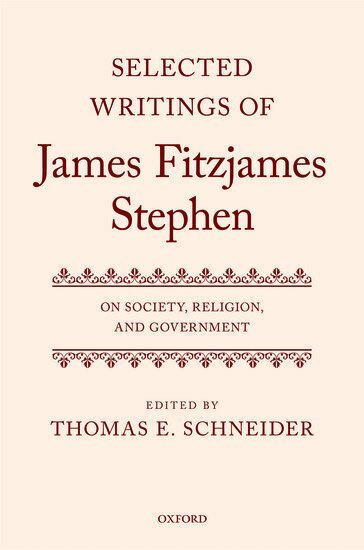
On Society, Religion, and Government
Inbunden, Engelska, 2015
3 127 kr
Skickas inom 3-6 vardagar
James Fitzjames Stephen (1829-1894) is remembered as a judge, legal historian, and the author of Liberty, Equality, Fraternity, a reply to J. S. Mill's late works. He is less well remembered for his journalism, though it earned him a reputation among his contemporaries as one of the most trenchant writers on topics ranging across the social, religious, political, moral, and philosophical questions debated in his time. It was largely in his journalistic writing that Stephen set forth his views on these questions. Despite such a reputation, however, only a small proportion of this writing was collected during his lifetime, and very little has been republished since his death.Selected Writings of James Fitzjames Stephen: On Society, Religion, and Government includes thirty-five essays expressing Stephen's views on the questions of his day, which have not lost their interest in ours. He wrote at a time when much of the finest writing in English was published in periodicals, often anonymously. The essays in this volume are drawn mostly from Stephen's unsigned contributions to the Saturday Review, with additions, both signed and unsigned, from other periodicals, extending from the 1850s to the 1880s.
Selected Writings of James Fitzjames Stephen
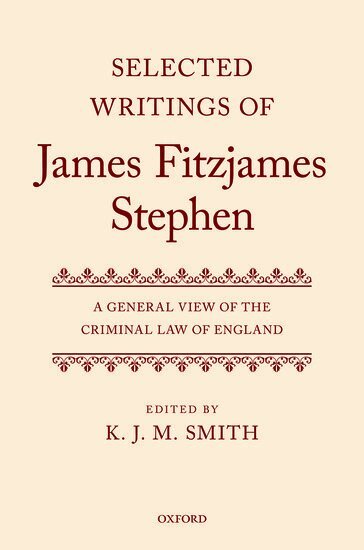
A General View of the Criminal Law of England
Inbunden, Engelska, 2014
3 526 kr
Skickas inom 7-10 vardagar
Published in the summer of 1863, A General View of the Criminal Law is a highly original account of the fundamental nature, substance and functioning of the criminal law in mid-Victorian England. Written with the assurance and facility of one whose active interests extended well beyond the law into politics, literature, philosophy, and religion, Fitzjames Stephen's General View has three broad objectives: to expose the workings of the institution of criminal law to the scrutiny of both lawyers and non-lawyers; to locate the criminal law in its appropriate political and social context; and to elevate the study of criminal law to a level which would qualify it to be 'an interesting part of a liberal education' - in effect, for it to be recognised as one of the emerging social sciences. While in general holding to the book's expressed aims and seeking to offer a balanced analysis, in the many contentious areas of the criminal law examined there is rarely much doubt about Stephen's own position. Characteristically, as in his earlier and later works, in the General View analytical acuity operates in combination with an emphatic - frequently no holds barred - polemical style of argument. Although often fiercely critical of certain procedural and substantive elements of England's criminal law, ultimately Stephen viewed its core features as a worthy source of national pride.