Short Oxford History of Germany – serie
Visar alla böcker i serien Short Oxford History of Germany. Handla med fri frakt och snabb leverans.
6 produkter
6 produkter
455 kr
Skickas inom 5-8 vardagar
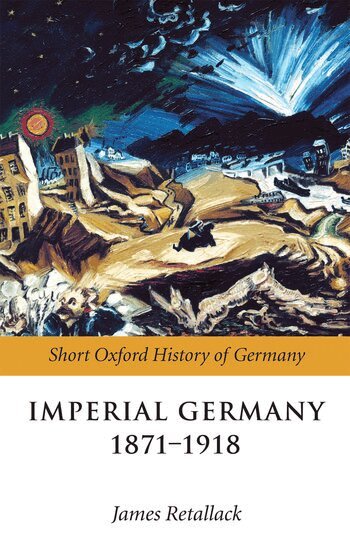
The German Empire was founded in January 1871 not only on the basis of Chancellor Otto von Bismarck's 'blood and iron' policy but also with the support of liberal nationalists. Under Bismarck and Kaiser Wilhelm II, Germany became the dynamo of Europe. Its economic and military power were pre-eminent; its science and technology, education, and municipal administration were the envy of the world; and its avant-garde artists reflected the ferment in European culture. But Germany also played a decisive role in tipping Europe's fragile balance of power over the brink and into the cataclysm of the First World War, eventually leading to the empire's collapse in military defeat and revolution in November 1918.With contributions from an international team of twelve experts in the field, this volume offers an ideal introduction to this crucial era, taking care to situate Imperial Germany in the larger sweep of modern German history, without suggesting that Nazism or the Holocaust were inevitable endpoints to the developments charted here.
1 810 kr
Skickas inom 5-8 vardagar
The German Empire was founded in January 1871 not only on the basis of Chancellor Otto von Bismarck's 'blood and iron' policy but also with the support of liberal nationalists. Under Bismarck and Kaiser Wilhelm II, Germany became the dynamo of Europe. Its economic and military power were pre-eminent; its science and technology, education, and municipal administration were the envy of the world; and its avant-garde artists reflected the ferment in European culture. But Germany also played a decisive role in tipping Europe's fragile balance of power over the brink and into the cataclysm of the First World War, eventually leading to the empire's collapse in military defeat and revolution in November 1918.With contributions from an international team of twelve experts in the field, this volume offers an ideal introduction to this crucial era, taking care to situate Imperial Germany in the larger sweep of modern German history, without suggesting that Nazism or the Holocaust were inevitable endpoints to the developments charted here.
1 738 kr
Skickas inom 5-8 vardagar
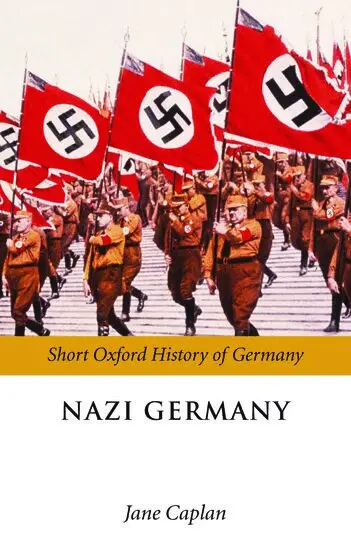
The history of National Socialism as movement and regime remains one of the most compelling and intensively studied aspects of twentieth-century history, and one whose significance extends far beyond Germany or even Europe alone. This volume presents an up-to-date and authoritative introduction to the history of Nazi Germany, with ten chapters on the most important themes, each by an expert in the field. Following an introduction which sets out the challenges this period of history has posed to historians since 1945, contributors explain how Nazism emerged as ideology and political movement; how Hitler and his party took power and remade the German state; and how the Nazi 'national community' was organized around a radical and eventually lethal distinction between the 'included' and the 'excluded'. Further chapters discuss the complex relationship between Nazism and Germany's religious faiths; the perverse economic rationality of the regime; the path to war laid down by Hitler's foreign policy; and the intricate and intimate intertwining of war and genocide, with a final chapter on the aftermath of National Socialism in postwar German history and memory.
478 kr
Skickas inom 5-8 vardagar
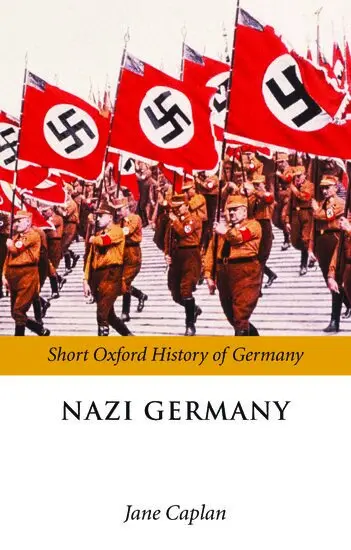
The history of National Socialism as movement and regime remains one of the most compelling and intensively studied aspects of twentieth-century history, and one whose significance extends far beyond Germany or even Europe alone. This volume presents an up-to-date and authoritative introduction to the history of Nazi Germany, with ten chapters on the most important themes, each by an expert in the field. Following an introduction which sets out the challenges this period of history has posed to historians since 1945, contributors explain how Nazism emerged as ideology and political movement; how Hitler and his party took power and remade the German state; and how the Nazi 'national community' was organized around a radical and eventually lethal distinction between the 'included' and the 'excluded'. Further chapters discuss the complex relationship between Nazism and Germany's religious faiths; the perverse economic rationality of the regime; the path to war laid down by Hitler's foreign policy; and the intricate and intimate intertwining of war and genocide, with a final chapter on the aftermath of National Socialism in postwar German history and memory.
1 810 kr
Skickas inom 5-8 vardagar
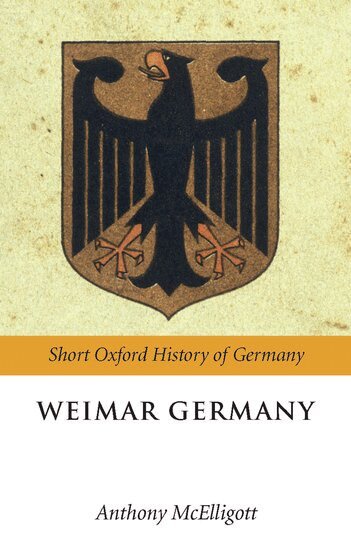
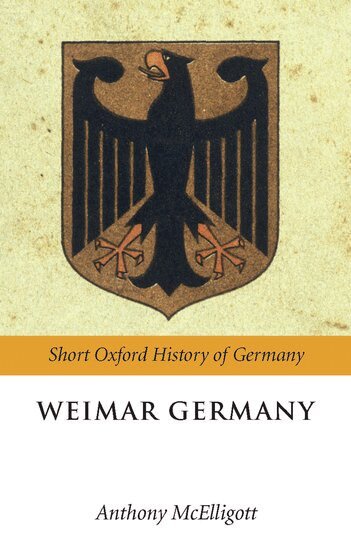
The Weimar Republic was born out of Germany's defeat in the First World War and ended with the coming to power of Hitler and his Nazi Party in 1933. In many ways, it is a wonder that Weimar lasted as long as it did. Besieged from the outset by hostile forces, the young republic was threatened by revolution from the left and coups d'états from the right. Plagued early on by a wave of high-profile political assassinations and a period of devastating hyper-inflation, its later years were dominated by the onset of the Great Depression. And yet, for a period from the mid-1920s it looked as if the Weimar system would not only survive but even flourish, with the return of economic stability and the gradual reintegration of the country into the international community. With contributions from an international team of ten experts, this volume in the Short Oxford History of Germany series offers an ideal introduction to Weimar Germany, challenging the reader to rethink preconceived ideas of the republic and throwing new light on important areas, such as military ideas for reshaping society after the First World War, constitutional and social reform, Jewish life, gender, and culture.
473 kr
Skickas inom 5-8 vardagar
The Weimar Republic was born out of Germany's defeat in the First World War and ended with the coming to power of Hitler and his Nazi Party in 1933. In many ways, it is a wonder that Weimar lasted as long as it did. Besieged from the outset by hostile forces, the young republic was threatened by revolution from the left and coups d'états from the right. Plagued early on by a wave of high-profile political assassinations and a period of devastating hyper-inflation, its later years were dominated by the onset of the Great Depression. And yet, for a period from the mid-1920s it looked as if the Weimar system would not only survive but even flourish, with the return of economic stability and the gradual reintegration of the country into the international community. With contributions from an international team of ten experts, this volume in the Short Oxford History of Germany series offers an ideal introduction to Weimar Germany, challenging the reader to rethink preconceived ideas of the republic and throwing new light on important areas, such as military ideas for reshaping society after the First World War, constitutional and social reform, Jewish life, gender, and culture.