Special Issues of Social Neuroscience - Böcker
Visar alla böcker i serien Special Issues of Social Neuroscience. Handla med fri frakt och snabb leverans.
11 produkter
11 produkter
578 kr
Skickas inom 10-15 vardagar
This Special Issue showcases some of the latest and best research in an important emerging field, developmental social neuroscience, which is focused on the nature and development of the mechanisms involved in socially relevant human behavior. Recent work on the neural correlates of empathy, prosocial and antisocial behavior, and inter-personal communication, for example, is transforming our view of human development by revealing complex interactions among genes and environment, including culture, that are shaping brain and behavior throughout life. This work, like research in social neuroscience more generally, is also causing scientists to reassess longstanding assumptions about the meaning of constructs and (false) dichotomies such as cognition versus emotion, and behavior versus brain. What emerges is a more holistic view of human beings as dynamic, multidimensional phenomena that are simultaneously cognitive and emotional, behavioral and neural, social and individual, depending on how you approach the phenomena and how you measure them.A prominent feature of this new research is the use of multiple methods in order to make measurements at multiple levels of analysis. What distinguishes the studies included here from other recent work in social neuroscience is the adoption of a developmental approach. From a developmental perspective, human beings are viewed as dynamic organisms, continually in flux; an effort is made to document the ontogenetic time series. The hope is that a developmental approach will provide a more comprehensive—and hence, more complete—description of human social function; namely, one that includes an understanding of the actual causal mechanisms by which this function emerges.
693 kr
Skickas inom 10-15 vardagar
Social Neuroscience of Psychiatric Disorders is about the role of the Social Brain in neuropsychiatry. The need to belong to social groups and interact with others has driven much of the evolution of the human brain. The relatively young field of social neuroscience has made impressive strides towards clarifying the neural correlates of the Social Brain, but, until recently, has not focused on mental and neurological disorders. Yet, the Social Brain underlies all brain-behaviour disorders, and nearly every neuropsychiatric illness involves social behavioural disturbances. This unique and ground-breaking volume is a major step forward in deciphering the impact of the Social Brain on neuropsychiatric disorders. Investigators evaluate neuropsychiatric disorders in the context of recent advances in social neuroscience to reveal the impact of social brain mechanisms on neuropsychiatric disorders and allow readers to glimpse the exciting potential advances in this field in the years to come. This book was originally published as a special issue of Social Neuroscience.
733 kr
Skickas inom 10-15 vardagar
Investigations of the neural basis of theory of mind - the ability to think about other people's thoughts - only recently became feasible; now, the number of such investigations and the sophistication of the results are accelerating dramatically.The articles in this special issue use a wide range of techniques (including fMRI, EEG, TMS, and psychophisiology) and subject populations (including children, twins, and patients with developmental or acquired neural damage) to address fundamental questions about the cognitive and neural structure of theory of mind.Topics include: (1) the relationship between theory of mind and other, perhaps "precursor", social cognitive processes, such as empathy and the perception of biological motion; (2) the relationship between theory of mind and domain-general cognitive functions, such as executive function and language; and (3) how theory of mind is deployed in real social contexts, such as social exchange.
Interpersonal Sensitivity: Entering Others’ Worlds
A Special Issue of Social Neuroscience
Häftad, Engelska, 2019
680 kr
Skickas inom 10-15 vardagar
Interpersonal sensitivity refers to our ability to perceive and respond with care to the internal states of other people, understand the antecedents of those states, and predict the subsequent events that will result. Guest editors neuroscientist Jean Decety and social psychologist Dan Batson bring together in this special issue of Social Neuroscience new research findings from empirical studies, including work with adults and children, genetics, functional neuroimaging, individual differences, and behavioral measures, which examine how we process and respond to information about our fellow individuals. By combining biological and psychological approaches, this special issue of Social Neuroscience sheds new light on the complex and multi-faceted phenomenon of interpersonal sensitivity, including empathy and sympathy.
673 kr
Skickas inom 10-15 vardagar
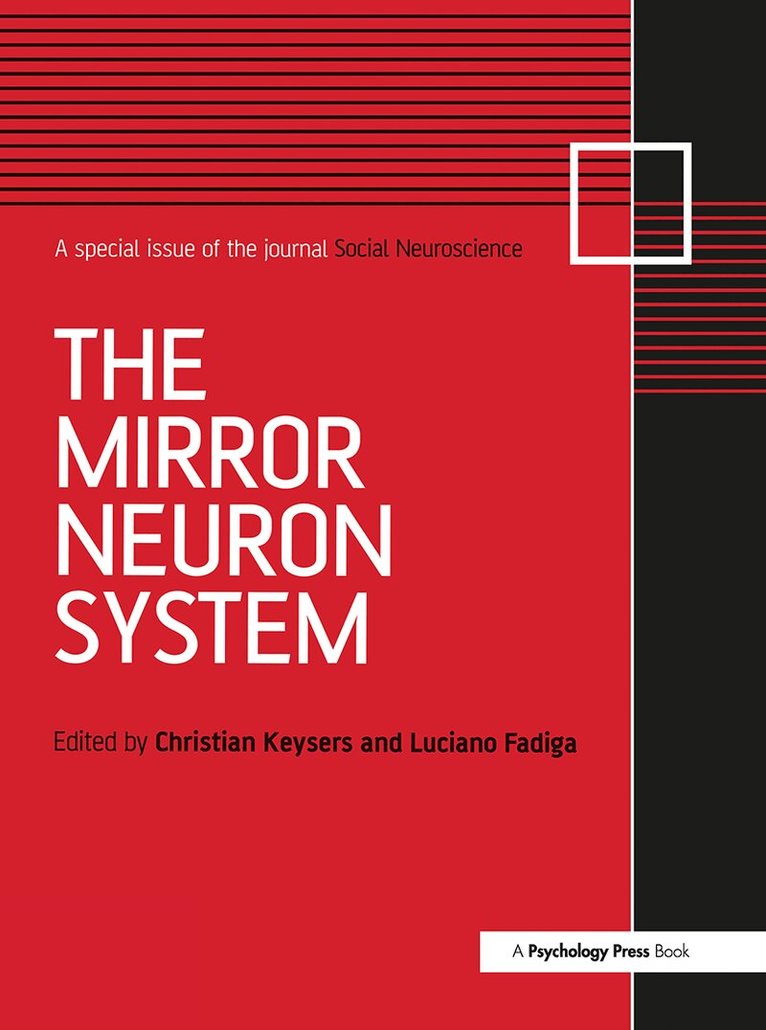
Mirror neurons are premotor neurons, originally discovered in the macaque brain , that discharge both during execution of goal-directed actions and during the observation of similar actions executed by another individual. They therefore ‘mirror’ others’ actions on the observer's motor repertoire. In the last decade an impressive amount of work has been devoted to the study of their properties and to investigate if they are present also in our species. Neuroimaging and electrophysiological techniques have shown that a mirror-neuron system does exist in the human brain as well. Among ‘mirror’ human areas, Broca’s area (the frontal area for speech production) is almost constantly activated by action observation. This suggests a possible evolutionary link between action understanding and verbal communication. In the most recent years, mirror-like phenomena have been demonstrated also for domains others than the pure motor one. Examples of that are the somatosensory and the emotional systems, possibly providing a neurophysiological basis to phenomena such as embodiment and empathy. This special issue collects some of the most representative works on the mirror-neuron system to give a panoramic view on current research and to stimulate new experiments in this exciting field.
2 053 kr
Skickas inom 10-15 vardagar
Investigations of the neural basis of theory of mind - the ability to think about other people's thoughts - only recently became feasible; now, the number of such investigations and the sophistication of the results are accelerating dramatically.The articles in this special issue use a wide range of techniques (including fMRI, EEG, TMS, and psychophisiology) and subject populations (including children, twins, and patients with developmental or acquired neural damage) to address fundamental questions about the cognitive and neural structure of theory of mind.Topics include: (1) the relationship between theory of mind and other, perhaps "precursor", social cognitive processes, such as empathy and the perception of biological motion; (2) the relationship between theory of mind and domain-general cognitive functions, such as executive function and language; and (3) how theory of mind is deployed in real social contexts, such as social exchange.
Interpersonal Sensitivity: Entering Others’ Worlds
A Special Issue of Social Neuroscience
Inbunden, Engelska, 2007
866 kr
Tillfälligt slut
Interpersonal sensitivity refers to our ability to perceive and respond with care to the internal states of other people, understand the antecedents of those states, and predict the subsequent events that will result. Guest editors neuroscientist Jean Decety and social psychologist Dan Batson bring together in this special issue of Social Neuroscience new research findings from empirical studies, including work with adults and children, genetics, functional neuroimaging, individual differences, and behavioral measures, which examine how we process and respond to information about our fellow individuals. By combining biological and psychological approaches, this special issue of Social Neuroscience sheds new light on the complex and multi-faceted phenomenon of interpersonal sensitivity, including empathy and sympathy.
2 113 kr
Skickas inom 10-15 vardagar
Mirror neurons are premotor neurons, originally discovered in the macaque brain , that discharge both during execution of goal-directed actions and during the observation of similar actions executed by another individual. They therefore ‘mirror’ others’ actions on the observer's motor repertoire. In the last decade an impressive amount of work has been devoted to the study of their properties and to investigate if they are present also in our species. Neuroimaging and electrophysiological techniques have shown that a mirror-neuron system does exist in the human brain as well. Among ‘mirror’ human areas, Broca’s area (the frontal area for speech production) is almost constantly activated by action observation. This suggests a possible evolutionary link between action understanding and verbal communication. In the most recent years, mirror-like phenomena have been demonstrated also for domains others than the pure motor one. Examples of that are the somatosensory and the emotional systems, possibly providing a neurophysiological basis to phenomena such as embodiment and empathy. This special issue collects some of the most representative works on the mirror-neuron system to give a panoramic view on current research and to stimulate new experiments in this exciting field.
1 909 kr
Skickas inom 10-15 vardagar
Deception, also known as "lying", is a pervasive and fundamental social behavior in which a person attempts to persuade another to accept as true what the deceiver believes to be untrue. Because of its essential role in our social life, it is important for social neuroscience to reveal the inner workings of deception. This special issue provides a representative sample of new empirical research on the cognitive and neural processes associated with producing deceptive responses. Eight contributions report studies employing a variety of paradigms and techniques (behavioral, functional magnetic resonance imaging, event-related potentials, and transcranial magnetic stimulation) that address several theoretical and methodological issues for deception research. Numerous questions are raised by these studies. First, is deception a unitary phenomenon, and are all lies the same? If there are different types of lies and there are individual differences in deception, can lies be detected reliably in single individuals? Second, are deception processes special in any way or do they depend only on a set of general-purpose cognitive and neural processes? Third, is it valid to study deception in the laboratory, and to what extent can laboratory studies be designed to resemble real-life deception situations? Fourth, are different cognitive and neural measures associated with deception affected equally by different factors? Can we devise reliable methods to detect deception by exploiting this knowledge? These questions provide important directions for future research. Establishing the brain correlates of deception behaviour will be challenging, but already we have made great strides.
1 298 kr
Skickas inom 10-15 vardagar
This Special Issue showcases some of the latest and best research in an important emerging field, developmental social neuroscience, which is focused on the nature and development of the mechanisms involved in socially relevant human behavior. Recent work on the neural correlates of empathy, prosocial and antisocial behavior, and inter-personal communication, for example, is transforming our view of human development by revealing complex interactions among genes and environment, including culture, that are shaping brain and behavior throughout life. This work, like research in social neuroscience more generally, is also causing scientists to reassess longstanding assumptions about the meaning of constructs and (false) dichotomies such as cognition versus emotion, and behavior versus brain. What emerges is a more holistic view of human beings as dynamic, multidimensional phenomena that are simultaneously cognitive and emotional, behavioral and neural, social and individual, depending on how you approach the phenomena and how you measure them.A prominent feature of this new research is the use of multiple methods in order to make measurements at multiple levels of analysis. What distinguishes the studies included here from other recent work in social neuroscience is the adoption of a developmental approach. From a developmental perspective, human beings are viewed as dynamic organisms, continually in flux; an effort is made to document the ontogenetic time series. The hope is that a developmental approach will provide a more comprehensive—and hence, more complete—description of human social function; namely, one that includes an understanding of the actual causal mechanisms by which this function emerges.
2 166 kr
Skickas inom 7-10 vardagar
Social Neuroscience of Psychiatric Disorders is about the role of the Social Brain in neuropsychiatry. The need to belong to social groups and interact with others has driven much of the evolution of the human brain. The relatively young field of social neuroscience has made impressive strides towards clarifying the neural correlates of the Social Brain, but, until recently, has not focused on mental and neurological disorders. Yet, the Social Brain underlies all brain-behaviour disorders, and nearly every neuropsychiatric illness involves social behavioural disturbances. This unique and ground-breaking volume is a major step forward in deciphering the impact of the Social Brain on neuropsychiatric disorders. Investigators evaluate neuropsychiatric disorders in the context of recent advances in social neuroscience to reveal the impact of social brain mechanisms on neuropsychiatric disorders and allow readers to glimpse the exciting potential advances in this field in the years to come. This book was originally published as a special issue of Social Neuroscience.