Giorgio Ganis - Böcker
Visar alla böcker från författaren Giorgio Ganis. Handla med fri frakt och snabb leverans.
3 produkter
3 produkter
1 240 kr
Skickas inom 7-10 vardagar
Mental imagery has always been a controversial topic in psychology. The major problem has been the inherently private nature of mental images, which has traditionally prevented objective assessment of their structure and function. Between researchers in cognitive psychology and computer-science, a debate, now commonly called 'the imagery debate' arose about what exactly constitutes a mental image. Although the imagery researchers in cognitive psychology assumed that mental images were in fact images, and hence often compared them to pictures, the computer-science researchers relied on language-like internal representations that are easy to implement in programming languages. On the side of the computer-science researchers, Zenon Pylyshyn has argued that the picture metaphor underlying theoretical discussions of visual mental imagery is seriously misleading, particularly because it suggests that an image is an entity to be perceived. Pylyshyn has claimed that to describe what we know adequately, we must posit mental structures that describe, that are conceptual and propositional in nature, rather than sensory or pictorial-symbolic descriptions, rather than images. On the side of the mental-imagery researchers, Stephen Kosslyn has argued that the idea that mental depict, as opposed to describe, is not only defensible, but most consistent with the emerging body of data about imagery. In this volume, Stephen Kosslyn revisits the debate some 30 years later, when it has evolved to bear on a much more general concern: the relation between mental phenomena and underlying natural substrates. Kosslyn summarises the arguments and positions, puts them in context, and shows how modern neuroscientific methods can illustrate the representational nature of mental imagery.
536 kr
Skickas inom 7-10 vardagar
"This volume is the most important if not the final word on the great imagery debate. It examines issues critical to all cognition. For example, whether the brain is a general purpose computer and if the brain's structure imposes limits on what can be represented in our minds." Michael I. Posner, Prof. Emeritus University of Oregon |k No"The Case for Mental Imagery is destined to be a classic text in psychology. [the authors] present an in-depth, philosophically sophisticated, and empirically supported argument that clarifies and settles many of the most contentious issues in the longstanding, decades-long 'imagery debate'...This is an impressive achievement and an outstanding example of the way controversies can be addressed through a combination of sophisticated theoretical concepts paired with expertly conducted scientific research programs."--PsycCRITIQUES |k No"This is an outstanding book that presents a roadmap of the psychological and neural mechanisms underlying mental imagery. The field of mental imagery has a long and somewhat dark history and the study of the critical cognitive ability has only been considered scientifically legitimate relatively recently. In this book, Kosslyn and colleagues not only summarize the wealth of their own recent scientific findings but elegantly place these findings and their theoretical perspective in the larger historical and contemporary context of studies on mental imagery. The book distills a rich, complicated domain into a series of accessible topics and will serve as an invaluable guide to those entering the field, a refresher for those with passing knowledge, and a major reference for the cognoscenti."--Marlene Behrmann, Professor of Psychology, Carnegie Mellon University"For centuries, mental imagery has been recognized as one of the keys to understanding human intelligence, emotion, and creativity. Stephen Kosslyn developed the first comprehensive theory of this faculty of mind, and for three decades has explored it with theoretical depth, experimental ingenuity, and a relentless drive to get to the bottom of puzzles and controversies. Kosslyn has now given us a magisterial account of this crucial aspect of mental life. A seamless synthesis of mind and brain, The Case for Mental Imagery is a case of cognitive neuroscience at its finest."--Steven Pinker, Johnstone Family Professor of Psychology, Harvard University"The definitive treatment of mental imagery from a pictorialist point of view."--Ned Block, Silver Professor of Philosophy and Psychology, New York University
1 900 kr
Skickas inom 10-15 vardagar
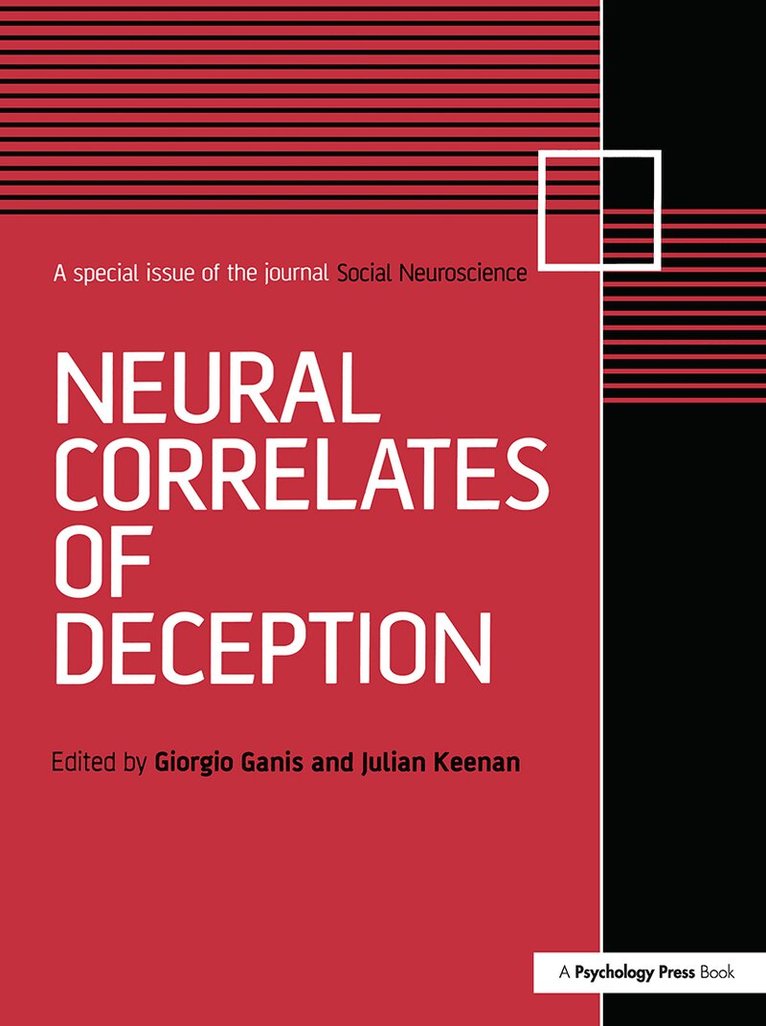
Deception, also known as "lying", is a pervasive and fundamental social behavior in which a person attempts to persuade another to accept as true what the deceiver believes to be untrue. Because of its essential role in our social life, it is important for social neuroscience to reveal the inner workings of deception. This special issue provides a representative sample of new empirical research on the cognitive and neural processes associated with producing deceptive responses. Eight contributions report studies employing a variety of paradigms and techniques (behavioral, functional magnetic resonance imaging, event-related potentials, and transcranial magnetic stimulation) that address several theoretical and methodological issues for deception research. Numerous questions are raised by these studies. First, is deception a unitary phenomenon, and are all lies the same? If there are different types of lies and there are individual differences in deception, can lies be detected reliably in single individuals? Second, are deception processes special in any way or do they depend only on a set of general-purpose cognitive and neural processes? Third, is it valid to study deception in the laboratory, and to what extent can laboratory studies be designed to resemble real-life deception situations? Fourth, are different cognitive and neural measures associated with deception affected equally by different factors? Can we devise reliable methods to detect deception by exploiting this knowledge? These questions provide important directions for future research. Establishing the brain correlates of deception behaviour will be challenging, but already we have made great strides.