Spirit of the Laws – serie
Visar alla böcker i serien Spirit of the Laws. Handla med fri frakt och snabb leverans.
8 produkter
8 produkter
691 kr
Skickas inom 3-6 vardagar
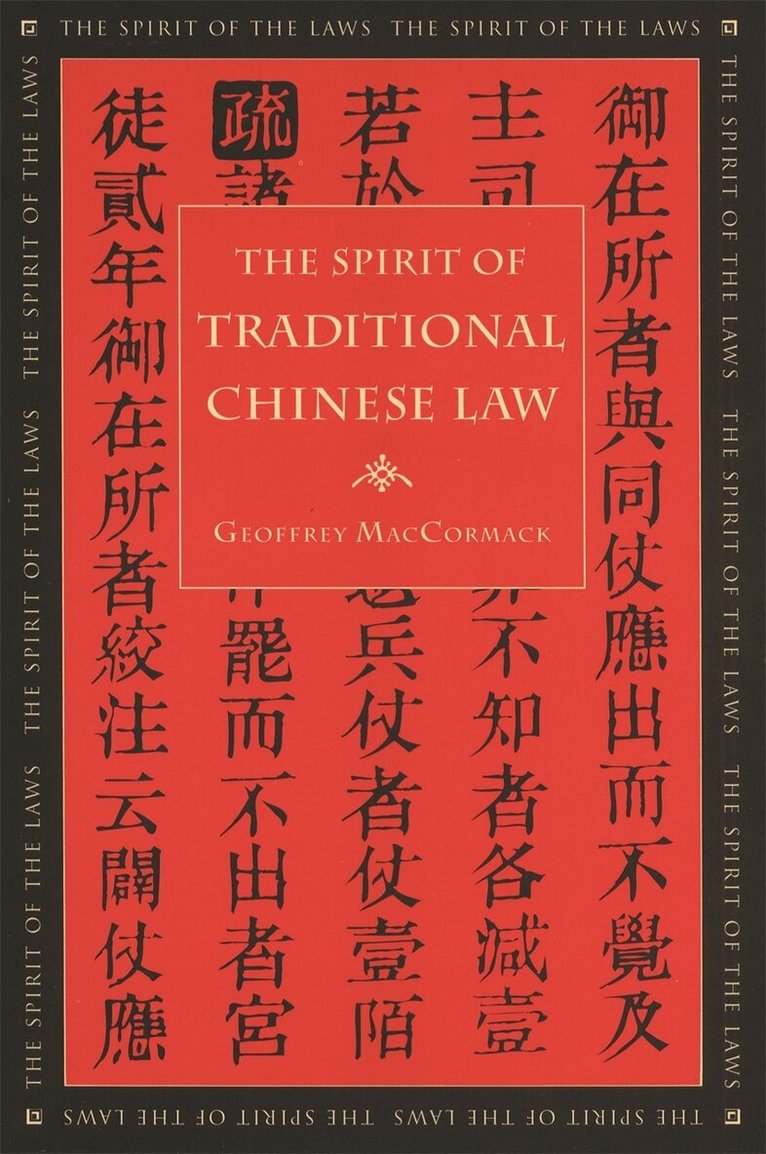
By the end of the eighth century A.D., imperial China had established a system of administrative and penal law, the main institutions of which lasted until the collapse of the Ch'ing dynasty in 1911. The Spirit of Traditional Chinese Law studies the views held throughout the centuries by the educated elite on the role of law in government, the relationship between law and morality, and the purpose of punishment.Geoffrey MacCormack's introduction offers a brief history of legal development in China, describes the principal contributions to the law of the Confucian and Legalist schools, and identifies several other attributes that might be said to constitute the "spirit" of the law. Subsequent chapters consider these attributes, which include conservatism, symbolism, the value attached to human life, the technical construction of the codes, the rationality of the legal process, and the purposes of punishment.A study of the "spirit" of the law in imperial China is particularly appropriate, says MacCormack, for a number of laws in the penal codes on family relationships, property ownership, and commercial transactions were probably never meant to be enforced. Rather, such laws were more symbolic and expressed an ideal toward which people should strive. In many cases even the laws that were enforced, such as those directed at the suppression of theft or killing, were also regarded as an emphatic expression of the right way to behave.Throughout his study, MacCormack distinguishes between "official," or penal and administrative, law, which emanated from the emperor to his officials, and "unofficial," or customary, law, which developed in certain localities or among associations of merchants and traders. In addition, MacCormack pays particular attention to the law's emphasis on the hierarchical ordering of relationships between individuals such as ruler and minister, ruler and subject, parent and child, and husband and wife. He also seeks to explain why, over nearly thirteen centuries, there was little change in the main moral and legal prescriptions, despite enormous social and economic changes.
406 kr
Skickas inom 5-8 vardagar
This study focuses on a Muslim legal science known in Arabic as usul al-fiqh. Whereas the kindred science of fiqh is concerned with the articulation of actual rules of law, this science elaborates the theoretical and methodological foundations of the law.The Spirit of Islamic Law outlines the prominent features of Muslim juristic thought: espousal of divine sovereignty; a fixation on divine texts; an uncompromisingly intentionalist approach to the interpretation of those texts; a frank acknowledgment of the fallibility of human endeavor to capture divine intent; a toleration of legal diversity; a moralistic bent grounded in a particular social vision; and finally, a preoccupation with the affairs of private individuals—especially family relations and contracts—coupled with a concern to define the limits of governmental power.The Spirit of Islamic Law is the fifth book in Georgia's Spirit of Laws series, which illuminates the nature of legal systems throughout the world.
448 kr
Skickas inom 5-8 vardagar
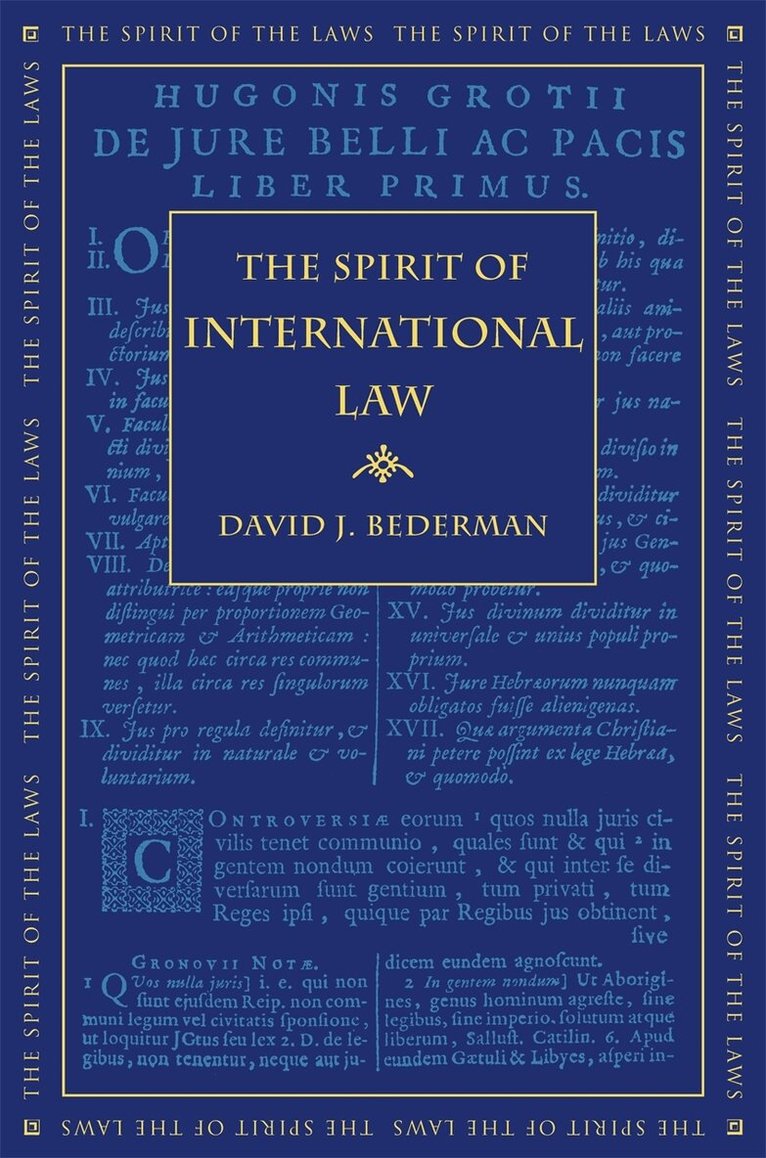
As our society becomes more global, international law is taking on an increasingly significant role, not only in world politics but also in the affairs of a striking array of individuals, enterprises, and institutions. In this comprehensive study, David J. Bederman focuses on international law as a current, practical means of regulating and influencing international behavior. He shows it to be a system unique in its nature—nonterritorial but secular, cosmopolitan, and traditional. Part intellectual history and part contemporary review, The Spirit of International Law ranges across the series of cyclical processes and dialectics in international law over the past five centuries to assess its current prospects as a viable legal system.After addressing philosophical concerns about authority and obligation in international law, Bederman considers the sources and methods of international lawmaking. Topics include key legal actors in the international system, the permissible scope of international legal regulation (what Bederman calls the "subjects and objects" of the discipline), the primitive character of international law and its ability to remain coherent, and the essential values of international legal order (and possible tensions among those values). Bederman then measures the extent to which the rules of international law are formal or pragmatic, conservative or progressive, and ignored or enforced. Finally, he reflects on whether cynicism or enthusiasm is the proper attitude to govern our thoughts on international law.Throughout his study, Bederman highlights some of the canonical documents of international law: those arising from famous cases (decisions by both international and domestic tribunals), significant treaties, important diplomatic correspondence, and serious international incidents. Distilling the essence of international law, this volume is a lively, broad, thematic summation of its structure, characteristics, and main features.
448 kr
Skickas inom 5-8 vardagar
The Spirit of Japanese Law focuses on the century following the Meiji Constitution, Japan's initial reception of continental European law. As John Owen Haley traces the features of contemporary Japanese law and its principal actors, distinctive patterns emerge. Of these none is more ubiquitous than what he refers to as the law's "communitarian orientation."While most westerners may view judges as Japanese law's least significant actors, Haley argues that they have the last word because their interpretations of constitution and codes define the authority and powers they and others hold. Based on a "sense of society," the judiciary confirms bonds of village, family, and firm, and "abuse of rights" and "good faith" similarly affirms community. The Spirit of Japanese Law concludes with constitutional cases that help explain the endurance of community in contemporary Japan.
448 kr
Skickas inom 5-8 vardagar
This book is not about the rules or concepts of Roman law, says Alan Watson, but about the values and approaches, explicit and implicit, of those who made the law. The scope of Watson's concerns encompasses the period from the Twelve Tables, around 451 B.C., to the end of the so-called classical period, around A.D. 235. As he discusses the issues and problems that faced the Roman legal intelligentsia, Watson also holds up Roman law as a clear, although admittedly extreme, example of law's enormous impact on society in light of society's limited input into law.Roman private law has been the most admired and imitated system of private law in the world, but it evolved, Watson argues, as a hobby of gentlemen, albeit a hobby that carried social status. The jurists, the private individuals most responsible for legal development, were first and foremost politicians and (in the Empire) bureaucrats; their engagement with the law was primarily to win the esteem of their peers. The exclusively patrician College of Pontiffs was given a monopoly on interpretation of private law in the mid fifth century B.C. Though the College would lose its exclusivity and monopoly, interpretation of law remained one mark of a Roman gentleman. But only interpretation of the law, not conceptualization or systematization or reform, gave prestige, says Watson. Further, the jurists limited themselves to particular modes of reasoning: no arguments to a ruling could be based on morality, justice, economic welfare, or what was approved elsewhere. No praetor (one of the elected officials who controlled the courts) is famous for introducing reforms, Watson points out, and, in contrast with a nonjurist like Cicero, no jurist theorized about the nature of law. A strong characteristic of Roman law is its relative autonomy, and isolation from the rest of life. Paradoxically, this very autonomy was a key factor in the Reception of Roman Law—the assimilation of the learned Roman law as taught at the universities into the law of the individual territories of Western Europe.
549 kr
Skickas inom 5-8 vardagar
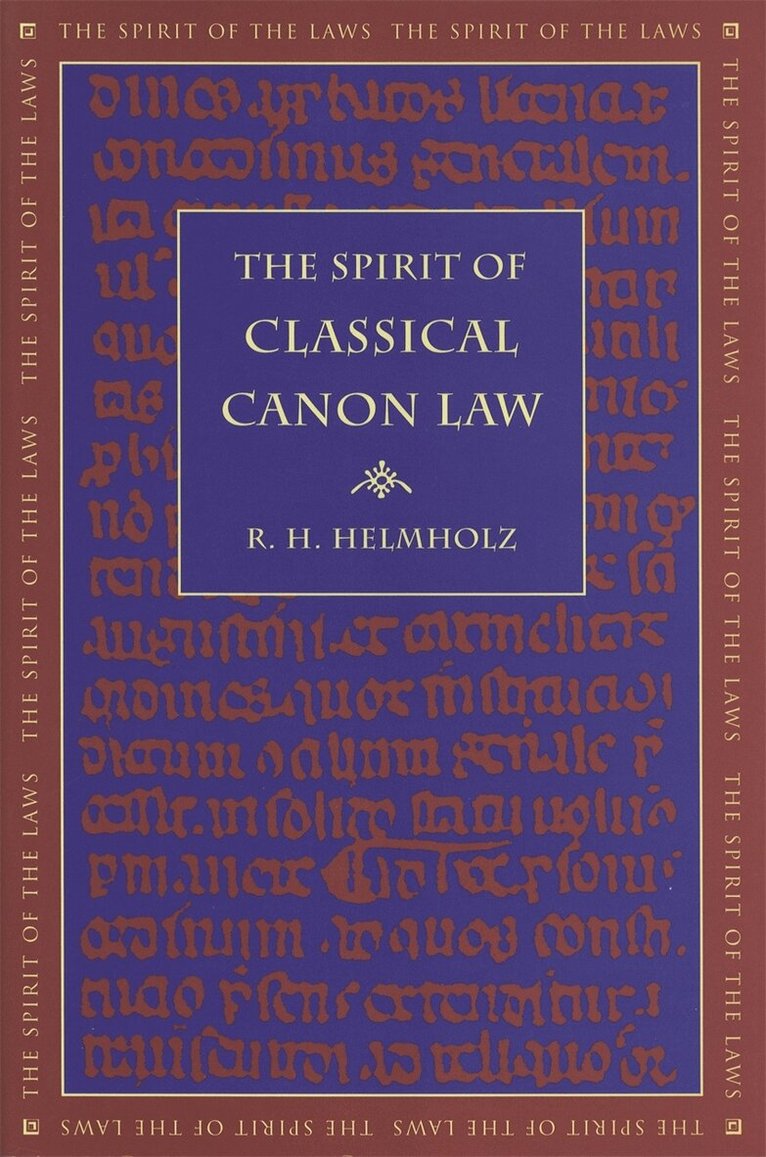
Despite the long reach of classical canon law—across Europe, well into modern times, and into such secular subjects as theft, wills, and the sale of goods—it has been the subject of far too few general studies in English. Illuminating the basic nature of the canon, this work explores the roles of moral, social, political, and religious values in the laws' development through the seventeenth century. At the same time, R. H. Helmholz makes relevant the attitudes and formal techniques of the laws' authors, practitioners, and interpreters.Helmholz first discusses the origins of the canon law; the collection of texts, known as the Corpus iuris canonici, which form its foundation; the basic sources on which the Corpus draws, including the Bible and Roman law; and the body of juristic commentary on the Corpus. He then considers, in turn, fourteen of the major areas affected by the laws such as the governance of the Church (in particular the law of election of bishops), the sacraments (baptism), and legal sanctions (the law of excommunication).In conclusion, Helmholz points to three common themes that characterize the laws and their implementation: their close connection with the goals and ideals of the Gregorian reform movement, a concern for the spiritual health of all concerned parties, and an interest in securing justice and protection for the unfortunate. Helmholz also comments on the lawyerly skill of the men who devoted their careers to the canon law and the law's ambitious goals. He does not shrink from describing its unpalatable aspects, such as its acceptance of slavery, its restrictions on religious freedom, and its use as an instrument of the clergy's agenda.The size and complexity of the body of church law and its jurisprudence have kept historians in many fields from appreciating how this topic might enrich their studies. The Spirit of Classical Canon Law provides them with the ideal entree.
1 246 kr
Skickas inom 5-8 vardagar
As our society becomes more global, international law is taking on an increasingly significant role, not only in world politics but also in the affairs of a striking array of individuals, enterprises, and institutions. In this comprehensive study, David J. Bederman focuses on international law as a current, practical means of regulating and influencing international behavior. He shows it to be a system unique in its nature—nonterritorial but secular, cosmopolitan, and traditional. Part intellectual history and part contemporary review, The Spirit of International Law ranges across the series of cyclical processes and dialectics in international law over the past five centuries to assess its current prospects as a viable legal system.After addressing philosophical concerns about authority and obligation in international law, Bederman considers the sources and methods of international lawmaking. Topics include key legal actors in the international system, the permissible scope of international legal regulation (what Bederman calls the "subjects and objects" of the discipline), the primitive character of international law and its ability to remain coherent, and the essential values of international legal order (and possible tensions among those values). Bederman then measures the extent to which the rules of international law are formal or pragmatic, conservative or progressive, and ignored or enforced. Finally, he reflects on whether cynicism or enthusiasm is the proper attitude to govern our thoughts on international law.Throughout his study, Bederman highlights some of the canonical documents of international law: those arising from famous cases (decisions by both international and domestic tribunals), significant treaties, important diplomatic correspondence, and serious international incidents. Distilling the essence of international law, this volume is a lively, broad, thematic summation of its structure, characteristics, and main features.
557 kr
Skickas inom 3-6 vardagar
By the end of the eighth century A.D., imperial China had established a system of administrative and penal law, the main institutions of which lasted until the collapse of the Ch'ing dynasty in 1911. The Spirit of Traditional Chinese Law studies the views held throughout the centuries by the educated elite on the role of law in government, the relationship between law and morality, and the purpose of punishment.Geoffrey MacCormack's introduction offers a brief history of legal development in China, describes the principal contributions to the law of the Confucian and Legalist schools, and identifies several other attributes that might be said to constitute the "spirit" of the law. Subsequent chapters consider these attributes, which include conservatism, symbolism, the value attached to human life, the technical construction of the codes, the rationality of the legal process, and the purposes of punishment.A study of the "spirit" of the law in imperial China is particularly appropriate, says MacCormack, for a number of laws in the penal codes on family relationships, property ownership, and commercial transactions were probably never meant to be enforced. Rather, such laws were more symbolic and expressed an ideal toward which people should strive. In many cases even the laws that were enforced, such as those directed at the suppression of theft or killing, were also regarded as an emphatic expression of the right way to behave.Throughout his study, MacCormack distinguishes between "official," or penal and administrative, law, which emanated from the emperor to his officials, and "unofficial," or customary, law, which developed in certain localities or among associations of merchants and traders. In addition, MacCormack pays particular attention to the law's emphasis on the hierarchical ordering of relationships between individuals such as ruler and minister, ruler and subject, parent and child, and husband and wife. He also seeks to explain why, over nearly thirteen centuries, there was little change in the main moral and legal prescriptions, despite enormous social and economic changes.