Studies in Philosophy and Health Policy - Böcker
Visar alla böcker i serien Studies in Philosophy and Health Policy. Handla med fri frakt och snabb leverans.
4 produkter
4 produkter
428 kr
Skickas inom 7-10 vardagar
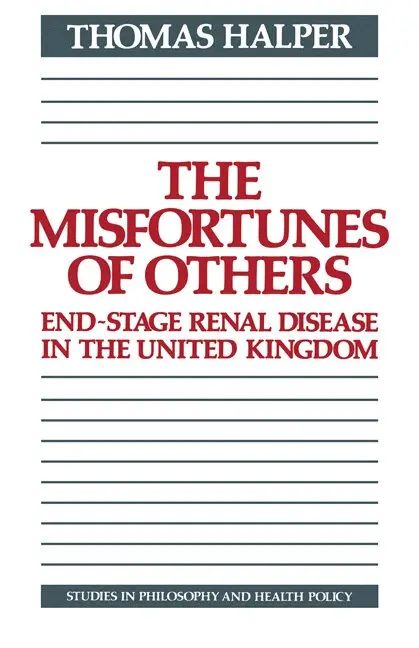
In this important study, first published in 1989, Thomas Halper examines the policies and practices of the British National Health Services in treating kidney disease. Technological advances since the 1960s mean that end-stage renal disease, an otherwise fatal condition, can usually be treated successfully. In Britain, however, the availability of resources necessary for treatment has been limited in past years and many people have gone untreated. Professor Halper discusses a number of issues, both ethical and political, that arise from having to choose who does and does not get treated. These issues include: the right to health care; the interaction between political demands, government agencies, and public policy; the promise of technology in a society where resources are scarce; and duties owed the individual by the community (and vice versa). The book draws on numerous personal accounts, often moving or unintentionally revealing, and should prove interesting to professionals and students with an interest in philosophy (especially medical ethics), health care, public health, public policy and British politics.
573 kr
Skickas inom 7-10 vardagar
This book is the most comprehensive treatment available of one of the most urgent - and yet in some respects most neglected - problems in bioethics: decision-making for incompetents. Part I develops a general theory for making treatment and care decisions for patients who are not competent to decide for themselves. It provides an in-depth analysis of competence, articulates and defends a coherent set of principles to specify suitable surrogate decisionmakers and to guide their choices, examines the value of advance directives, and investigates the role that considerations of cost ought to play in decisions concerning incompetents. Part II applies this theoretical framework to the distinctive problems of three important classes of individuals, many of whom are incompetent: minors, the elderly and psychiatric patients. The authors' approach combines a probing analysis of fundamental issues in ethical theory with a sensitive awareness of the concrete realities of health care institutions and the highly personal and individual character of difficult practical problems. Its broad scope will appeal to health professionals, moral philosophers and lawyers alike.
309 kr
Skickas inom 7-10 vardagar
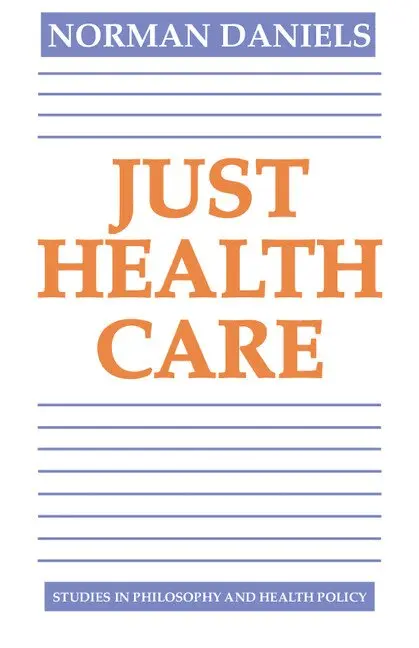
How should medical services be distributed within society? Who should pay for them? Is it right that large amounts should be spent on sophisticated technology and expensive operations, or would the resources be better employed in, for instance, less costly preventive measures? These and others are the questions addreses in this book. Norman Daniels examines some of the dilemmas thrown up by conflicting demands for medical attention, and goes on to advance a theory of justice in the distribution of health care. The central argument is that health care, both preventive and acute, has a crucial effect on equality of opportunity, and that a principle guaranteeing equality of opportunity must underly the distribution of health-care services. Access to care, preventive measures, treatment of the elderly, and the obligations of doctors and medical administrations are fully discussed, and the theory is shown to underwrite various practical policies in the area.
1 179 kr
Skickas inom 7-10 vardagar
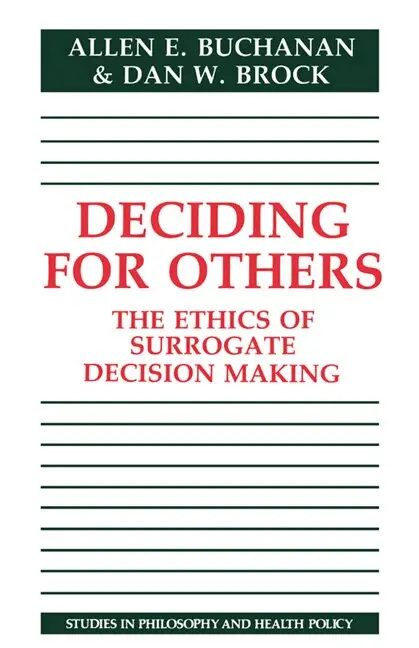
This book is the most comprehensive treatment available of one of the most urgent - and yet in some respects most neglected - problems in bioethics: decision-making for incompetents. Part I develops a general theory for making treatment and care decisions for patients who are not competent to decide for themselves. It provides an in-depth analysis of competence, articulates and defends a coherent set of principles to specify suitable surrogate decisionmakers and to guide their choices, examines the value of advance directives, and investigates the role that considerations of cost ought to play in decisions concerning incompetents. Part II applies this theoretical framework to the distinctive problems of three important classes of individuals, many of whom are incompetent: minors, the elderly and psychiatric patients. The authors' approach combines a probing analysis of fundamental issues in ethical theory with a sensitive awareness of the concrete realities of health care institutions and the highly personal and individual character of difficult practical problems. Its broad scope will appeal to health professionals, moral philosophers and lawyers alike.