
SUNY series in Health Care Politics and Policy – serie
Visar alla böcker i serien SUNY series in Health Care Politics and Policy. Handla med fri frakt och snabb leverans.
2 produkter
2 produkter
527 kr
Tillfälligt slut
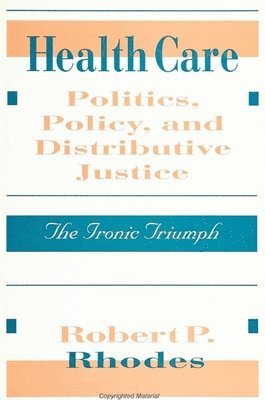
This book describes and evaluates power and influence in the creation, administration, and distribution of health care in the United States. His work is uniquely concerned with distributive justice as well as power. Who ought to receive more (or less) health care? How should we decide these distributions? Such questions are addressed in works of philosophy with little attention to political, legal, and economic analysis of budget dilemmas, professional and industrial politics, and technology. This volume takes the issue a step further by placing health policy issues in the broader context of American politics, illuminating the conflict between health resources and other needs, and evaluating the trade offs.
374 kr
Tillfälligt slut
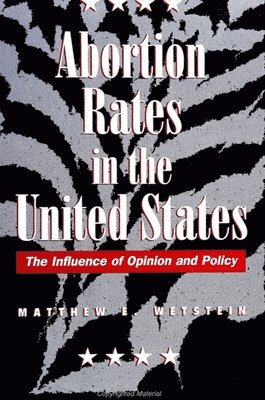
Demonstrates that individual state policies on abortion closely reflect public opinion in that state and affect abortion rates, whereas national policy and policy changes have no real effect on abortion rates.Few studies make a direct connection between public opinion, public policies, and the behavior of the mass public. This book demonstrates for the first time that such a connection can be found when examining abortion politics in the United States. Using public opinion data for all fifty states, the author demonstrates that state policies to restrict abortion closely match the preferences of the mass public. More important, he shows a profound link between public opinion on abortion and abortion rates in the United States. Where state publics are more permissive in their attitudes toward abortion, state policies tend to be more permissive, and rates of abortion utilization tend to be higher.The book also explores the impact of policy changes on abortion rates. Using sophisticated statistical techniques, the author examines policy changes at both the state and national level. The analysis points to an intriguing paradox: national policy changes have no real effect on abortion rates, yet state policy changes do. This finding suggests that the states are the place to look for significant changes in abortion utilization in response to policy.