SUNY series in Human Rights - Böcker
Visar alla böcker i serien SUNY series in Human Rights. Handla med fri frakt och snabb leverans.
4 produkter
4 produkter
Imperialism and Human Rights
Colonial Discourses of Rights and Liberties in African History
Inbunden, Engelska, 2006
1 499 kr
Skickas inom 3-6 vardagar
Looks at the language of rights used by diverse interest groups in British-colonized Nigeria.2007 CHOICE Outstanding Academic Title In this seminal study, Bonny Ibhawoh investigates the links between European imperialism and human rights discourses in African history. Using British-colonized Nigeria as a case study, he examines how diverse interest groups within colonial society deployed the language of rights and liberties to serve varied socioeconomic and political ends. Ibhawoh challenges the linear progressivism that dominates human rights scholarship by arguing that, in the colonial African context, rights discourses were not simple monolithic or progressive narratives. They served both to insulate and legitimize power just as much as they facilitated transformative processes. Drawing extensively on archival material, this book shows how the language of rights, like that of "civilization" and "modernity," became an important part of the discourses deployed to rationalize and legitimize empire.
Imperialism and Human Rights
Colonial Discourses of Rights and Liberties in African History
Häftad, Engelska, 2008
394 kr
Tillfälligt slut
Looks at the language of rights used by diverse interest groups in British-colonized Nigeria.2007 CHOICE Outstanding Academic Title In this seminal study, Bonny Ibhawoh investigates the links between European imperialism and human rights discourses in African history. Using British-colonized Nigeria as a case study, he examines how diverse interest groups within colonial society deployed the language of rights and liberties to serve varied socioeconomic and political ends. Ibhawoh challenges the linear progressivism that dominates human rights scholarship by arguing that, in the colonial African context, rights discourses were not simple monolithic or progressive narratives. They served both to insulate and legitimize power just as much as they facilitated transformative processes. Drawing extensively on archival material, this book shows how the language of rights, like that of "civilization" and "modernity," became an important part of the discourses deployed to rationalize and legitimize empire.
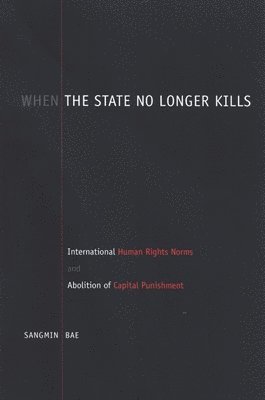
When the State No Longer Kills
International Human Rights Norms and Abolition of Capital Punishment
Inbunden, Engelska, 2007
1 057 kr
Tillfälligt slut
Why some countries comply with international norms against the death penalty while others do not.Despite public support for the death penalty, a remarkable number of countries in different parts of the world have banned capital punishment in all its forms, regardless of the nature of the crime or the criminal. Arguing that international norms are often a critical source of ideas for change in state policy, but that impact varies greatly, Sangmin Bae offers a systemic explanation of how, when, and under what conditions a country complies with international norms. She examines four countries that reached different stages of norm compliance with respect to the death penalty-Ukraine, South Africa, South Korea, and the United States. Focusing on the role of political leadership and domestic political institutions, Bae clarifies the causal mechanisms that lead to state compliance or noncompliance with the norm.
When the State No Longer Kills
International Human Rights Norms and Abolition of Capital Punishment
Häftad, Engelska, 2008
347 kr
Skickas inom 7-10 vardagar
Why some countries comply with international norms against the death penalty while others do not.Despite public support for the death penalty, a remarkable number of countries in different parts of the world have banned capital punishment in all its forms, regardless of the nature of the crime or the criminal. Arguing that international norms are often a critical source of ideas for change in state policy, but that impact varies greatly, Sangmin Bae offers a systemic explanation of how, when, and under what conditions a country complies with international norms. She examines four countries that reached different stages of norm compliance with respect to the death penalty-Ukraine, South Africa, South Korea, and the United States. Focusing on the role of political leadership and domestic political institutions, Bae clarifies the causal mechanisms that lead to state compliance or noncompliance with the norm.