• Fri frakt över 249 kr
  • •
  • Snabba leveranser
  • •
  • Billiga böcker
Kundservice

Du är på sajten för privatpersoner.

Företag, bibliotek eller offentlig verksamhet?

Du handlar på classic.bokus.com, där alla dina funktioner finns intakta.
Till classic.bokus.com
Bokus logotyp. Gå till startsidan.
  • Erbjudanden
  • Nyheter
  • Student
  • Topplistor
  • Barn & ungdom
  • Bokus Play
  • E-böcker
  • Pocketböcker
  • Spel & pussel

10% rabatt på allt med kod NYSTART10 →

Sidfot

Mina sidor

    Hjälp

    • Kundservice
    • Vanliga frågor och svar
    • Frakt och leverans
    • Retur vid ångerrätt
    • Reklamera vara
    • Betalning
    • Köpvillkor
    • Allmänna villkor
    • Information om webbplatsens tillgänglighet

    Om Bokus

    • Om oss
    • Pressrum
    • För studenter
    • För företag
    • För bibliotek och offentlig verksamhet
    • För leverantörer
    • Hållbarhet

    Populärt

    • Aktuella erbjudanden
    • Presentkort
    • Studentlitteratur
    • Nya böcker
    • Topplistor
    • Signerade böcker
    • Engelska böcker

    Inspiration

    • Boktips
    • BookTok
    • Populära bokserier
    • Barnbokskaraktärer
    • Populära författare
    Logotyp för Bokus
    Följ oss på Facebook (extern länk)Följ oss på Instagram (extern länk)Följ oss på YouTube (extern länk)Följ oss på TikTok (extern länk)
    bokus @ CookiesAnpassa cookiesIntegritetspolicyKöpvillkor
    Till Citymail hemsida (extern länk)Till Budbee hemsida (extern länk)Till Postnord hemsida (extern länk)Till Schenker hemsida (extern länk)Till Early Bird hemsida (extern länk)Till Walleys hemsida (extern länk)
    1. Samhälle och politik
    2. Politik och statsskick
    3. Politiskt förtryck

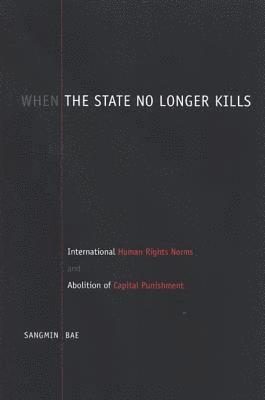
    When the State No Longer Kills

    International Human Rights Norms and Abolition of Capital Punishment

    AvSangmin Bae

    Inbunden, Engelska, 2007

    Del i serien SUNY series in Human Rights

    1 079 kr

    Tillfälligt slut

    Fler format och utgåvor

    Häftad

    353 kr

    Beskrivning

    Why some countries comply with international norms against the death penalty while others do not.Despite public support for the death penalty, a remarkable number of countries in different parts of the world have banned capital punishment in all its forms, regardless of the nature of the crime or the criminal. Arguing that international norms are often a critical source of ideas for change in state policy, but that impact varies greatly, Sangmin Bae offers a systemic explanation of how, when, and under what conditions a country complies with international norms. She examines four countries that reached different stages of norm compliance with respect to the death penalty-Ukraine, South Africa, South Korea, and the United States. Focusing on the role of political leadership and domestic political institutions, Bae clarifies the causal mechanisms that lead to state compliance or noncompliance with the norm.

    Produktinformation

    • Utgivningsdatum:2007-08-23
    • Mått:152 x 229 x 20 mm
    • Vikt:408 g
    • Format:Inbunden
    • Språk:Engelska
    • Serie:SUNY series in Human Rights
    • Antal sidor:194
    • Förlag:State University of New York Press
    • ISBN:9780791472071

    Utforska kategorier

    • Politiskt förtryck inom Samhälle och politik

    Mer om författaren

    Sangmin Bae is Assistant Professor of Political Science at Northeastern Illinois University.

    Recensioner i media

    "Overall Bae's work is highly instructive. Its comprehensive, multidimensional approach presents detailed accounts of the individual case studies, their political background, history of international norm compliance, and human rights record. The chapters are highly readable, making this book appropriate for an undergraduate audience … This volume is also highly recommended to scholars of human rights, comparative politics, and political scientists in general, given the combination of methodologies and Bae's presentation of the abolition of the death penalty as a truly multifaceted issue." — H-Net Reviews"The author has an excellent grasp of the work done on the death penalty and has applied the main arguments to regions outside Europe that deserve more attention and exploration. Her interesting conclusions provide an important basis for further research." — Agata Fijalkowski, Lancaster University Law School

    Innehållsförteckning

    • List of Figures and TablesForeword Preface1. INTRODUCTION: PROHIBITION OF THE DEATH PENALTY AS A HUMAN RIGHTS NORMInternational Standards Prohibiting Capital PunishmentInternational Norms in International Relations ResearchMethodological and Analytical Issues2. UKRAINEThe Council of Europe and the Death-Penalty-Free ZonePolitical Turbulence and Rising Crime RatesUkraine’s Resistance to the Council of EuropePublic Opinion on the Death Penalty ControversyThe Process of Enforcing the Council of Europe NormConditions for Death Penalty ReformConcluding Remarks3. SOUTH AFRICACapital Punishment under ApartheidThe Abolitionist Movement and the Role of External DonorsThe Moratorium on ExecutionsPolitical Transformation and Criminal Society: "Crime is Out of Control!"The Constitutional Court’s Ruling on the Death PenaltyPost–Death Penalty Abolition Years: The Debate ContinuesWho and What Played the Major Roles?Conclusion: The Politics of Principle4. SOUTH KOREADictatorship, Economic Miracle, and Human Security (1948–1987)Democratic Transition and the Continuing Use of the Death Penalty (1987–1997)The Emergence of the Abolitionist MovementChanging Political Conditions for Death Penalty Abolitionism (1998–Present)The Abolitionist Camp: Catholic Church, Amnesty International, and LegislatorsWhy Not Abolition Right Now?Concluding Remarks5. UNITED STATES"American Exceptionalism" and International PressureDo Crime Rates Matter?The Vigilante TraditionRacial Prejudice and InjusticeWhy More after the 1980s?: The Era of Heightened Inequality and PunitivenessAnti–Death Penalty ActivismPublic Support for the Death Penalty: A Constant VariableThe Peculiarity of the U.S. Political InstitutionsIs Political Leadership a Remaining Virtue?Concluding Remarks6. CONCLUSIONWays of Norm Compliance: Ukraine, South Africa, South Korea, and the United StatesConditions for Norm ComplianceCausal Mechanisms of Norm ComplianceConclusion: Extending the ArgumentNotesBibliographyIndex