SUNY series in Popular Culture and Political Change – serie
Visar alla böcker i serien SUNY series in Popular Culture and Political Change. Handla med fri frakt och snabb leverans.
5 produkter
5 produkter
566 kr
Skickas inom 3-6 vardagar
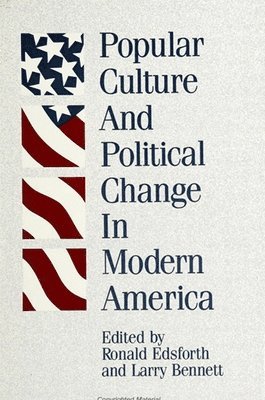
This book is a collection of essays dealing with the ways in which specific popular entertainment media, mass consumer products, and popular movements affect politics and political culture in the United States. It seeks to present a range of possibilities that reflect the dimensions of the current debate and practice in the field. Some of the contributions to this volume place popular culture media such as films, music, and books in a broad social context, and several articles deal with the historical roots of twentieth-century American popular culture. Popular culture is treated as categorically neither good nor bad, in either political or aesthetic terms. Instead, the essays reflect the editors' convictions that popular culture is simply too important to be ignored by those academics who treat politics and its history seriously. The collection also shows that studying popular or mass culture in a historical way illuminates a variety of possible relationships between popular culture and politics.
382 kr
Tillfälligt slut
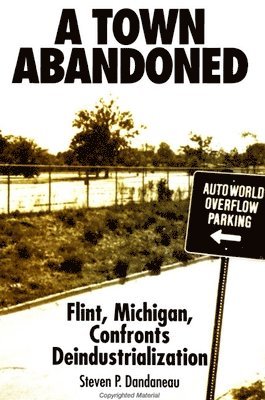
A cultural study of the Flint community's response to its own deindustrialization, within the framework of the state, national, and international forces that produced it.Hometown to both General Motors and the United Auto Workers, and the setting for the documentary film Roger and Me, Flint, Michigan, is a striking example of a declining city in America's Rust Belt. A Town Abandoned examines Flint's response to its own social and economic decline and at the same time pursues a broad analysis of class and culture in America's late capitalist society. It tells the story of how Flint's local institutions and citizens interpret and rationalize their city's massive auto-industry job loss and consequent decline, and it relates these interpretations to statewide, national, and international forces that led to the deindustrialization. Using a critical-theory approach, Dandaneau reveals the futility of Flint's efforts to confront essentially global problems and moreover depicts the disturbing conceptual and cultural distortions that result from its sustained powerlessness. Dandaneau shows that all policy solutions to Flint's problems were in essence public relations solutions, and he gives a moving portrayal of the consequences for local communities of the internationalization of American business.
1 057 kr
Tillfälligt slut
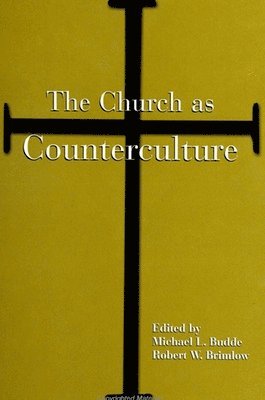
Explores a new Christian identity in which churches reclaim their roles as communities of disciples to constitute a countercultural reality and challenge to secular society and existing power relations.The question, "What does it mean to be 'the church'?" has always been among the most controversial and of vital concern to political, economic, and ecclesial leaders alike. How it is answered influences whether Christianity will be a force for legitimating or subverting existing secular relations of power, influence, and privilege. The Church as Counterculture enters the debates on Christian identity, purpose, and organization by calling for the churches to reclaim their roles as "communities of disciples"-distinct and distinctive groups formed by the priorities and practices of Jesus-to constitute a countercultural reality and challenge to secular society and existing power relations.The notion of the church as a countercultural community of disciples confounds many conventional divides within the Christian family (liberal and conservative, church and sect), while forcing redefinition of commonplace categories like religion and politics, sacred and secular. The contributors to this book-theologians, social theorists, philosophers, historians, Catholics and Protestants of various backgrounds-reflect this shifting of categories and divisions. The book provides thought-provoking Christian perspectives on war and genocide, racism and nationalism, the legitimacy of liberalism and capitalism, and more.Contributors include Michael J. Baxter, Robert W. Brimlow, Walter Brueggemann, Michael L. Budde, Curt Cadorette, Rodney Clapp, Roberto S. Goizueta, Stanley Hauerwas, Marianne Sawicki, and Michael Warren.
489 kr
Tillfälligt slut
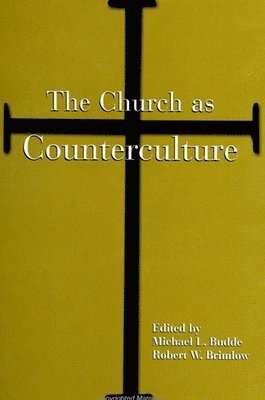
Explores a new Christian identity in which churches reclaim their roles as communities of disciples to constitute a countercultural reality and challenge to secular society and existing power relations.The question, "What does it mean to be 'the church'?" has always been among the most controversial and of vital concern to political, economic, and ecclesial leaders alike. How it is answered influences whether Christianity will be a force for legitimating or subverting existing secular relations of power, influence, and privilege. The Church as Counterculture enters the debates on Christian identity, purpose, and organization by calling for the churches to reclaim their roles as "communities of disciples"-distinct and distinctive groups formed by the priorities and practices of Jesus-to constitute a countercultural reality and challenge to secular society and existing power relations.The notion of the church as a countercultural community of disciples confounds many conventional divides within the Christian family (liberal and conservative, church and sect), while forcing redefinition of commonplace categories like religion and politics, sacred and secular. The contributors to this book-theologians, social theorists, philosophers, historians, Catholics and Protestants of various backgrounds-reflect this shifting of categories and divisions. The book provides thought-provoking Christian perspectives on war and genocide, racism and nationalism, the legitimacy of liberalism and capitalism, and more.Contributors include Michael J. Baxter, Robert W. Brimlow, Walter Brueggemann, Michael L. Budde, Curt Cadorette, Rodney Clapp, Roberto S. Goizueta, Stanley Hauerwas, Marianne Sawicki, and Michael Warren.
382 kr
Tillfälligt slut
Compares urban revitalization efforts in two cities with failing industrial bases, one in the United States and the other in Japan.This probing comparison of two struggling company towns, one in Japan and one in the United States, offers valuable urban revitalization lessons. The author compares urban revitalization efforts in Flint, Michigan, the declining automobile industry town, and Omuta, Fukuoka Prefecture, home of the largest coal mine in Japan, from the early 1970s through the early 1990s. Striking similarities emerge, both in the way redevelopment policy is made and in policy content. For example, both cities work to create new jobs, attract tourism, and diversify their economic bases. Despite these similarities, there are also differences that help the Japanese do a better job of managing socioeconomic decline. Notably, the Japanese system is better suited to effecting incremental improvements in local socioeconomic conditions, while the American system often takes the big gamble that, if successful, dramatically improves conditions. This gamble, however, can also result in a failure to reverse a city's economic decline. No Miracles Here finds that although Japanese and American cities rarely achieve truly successful revitalization, the Japanese have been more successful at avoiding the pitfalls of bad redevelopment policy.