Symbolae botanicae Upsalienses – serie
Visar alla böcker i serien Symbolae botanicae Upsalienses. Handla med fri frakt och snabb leverans.
3 produkter
3 produkter
Del 39 - Symbolae botanicae Upsalienses
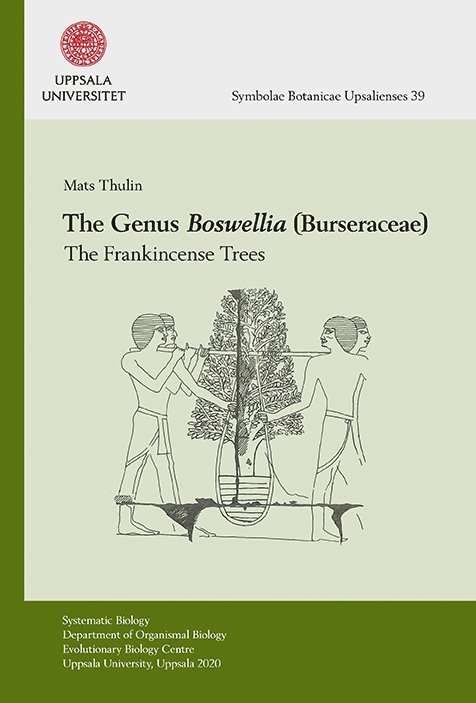
The genus Boswellia (Burseraceae) : the frankincense trees
Inbunden, Engelska, 2020
317 kr
Skickas inom 5-8 vardagar
The history of frankincense, starting in ancient Egypt, and the frankincense trees, what is now the genus Boswellia Roxb., is briefly outlined. General remarks are given on phylogeny and dating of the genus, previous taxonomic treatments, authorship and etymology, chromosome number, cotyledons and hypocotyl, cliff-dwelling versus ground-dwelling species, bark, stipules, breeding system and pollination, fruits and dispersal, hybrids, chemistry and uses, conservation, and harvesting and processing of frankincense. According to previously published phylogenies, Boswellia is sister to the Asian genus Garuga Roxb., and the crown group dates back to the mid Miocene. Twenty-four species are recognized in Boswellia, distributed from Mali and Burkina Faso in the west to India in the east, and from Oman and north-central India in the north to northeastern Tanzania in the south. Most species are found in the Horn of Africa region, with the highest concentration (11 species) in the Socotra archipelago (Yemen). A key to the species of Boswellia is provided, as well as distribution maps, illustrations, descriptions, notes on etymology, distribution and habitat, vernacular names and uses, IUCN Red List assessments, taxonomic remarks, and lists of collections, for all species. Boswellia aspleniifolia (Balf.f.) Thulin, comb. nov., based on Odina aspleniifolia Balf.f., B. samhaensis Thulin & Scholte, sp. nov., and B. scopulorum Thulin, sp. nov., are published, all from the Socotra archipelago. The name Boswellia “hesperia” is provisionally proposed for an apparently new species from Socotra, of which only photographs have been available. Fifteen names are lectotypified, and a neotype is designated for B. papyrifera (Delile) Hochst.
Del 40 - Symbolae Botanicae Upsalienses
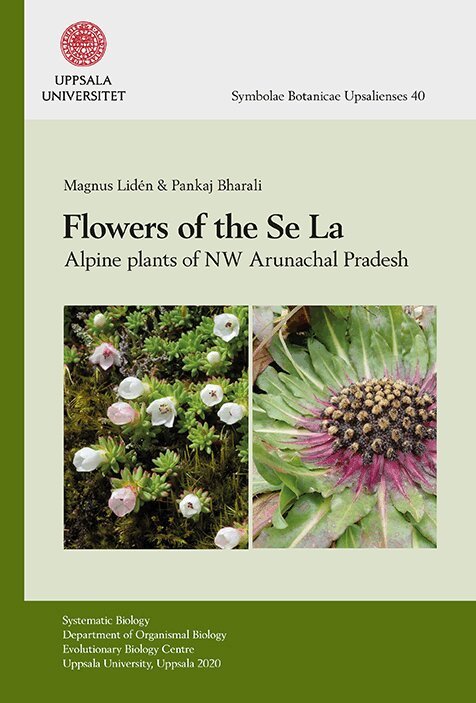
Flowers of the Se La : alpine plants of NW Arunachal Pradesh
Inbunden, Engelska, 2020
317 kr
Skickas inom 5-8 vardagar
Arunachal Pradesh in NE India, the land of the rising sun, is a Paradise for botanists, still largely unexplored. In the west part of the state, the Se La straddles the Himalayan range at 4200 metres above sea level. Being the only alpine area in Arunachal accessible by road, it is far better known than the high elevations of the central and east parts of the state. Despite this, numerous novelties have been discovered in the past decade: species new to Arunachal Pradesh, to India or to science (one of them described herein). Certainly additional novelties will turn up with more research. This book aims to satisfy the need for a quick reference guide to the flora of the Se La, that will benefit students, researchers, tourists and budding botanists of the region. It depicts in colour 280 species in 128 genera of vascular plants, with emphasis on summer- and autumn-flowering herbs. Woody plants
Del 41 - Symbolae botanicae Upsalienses
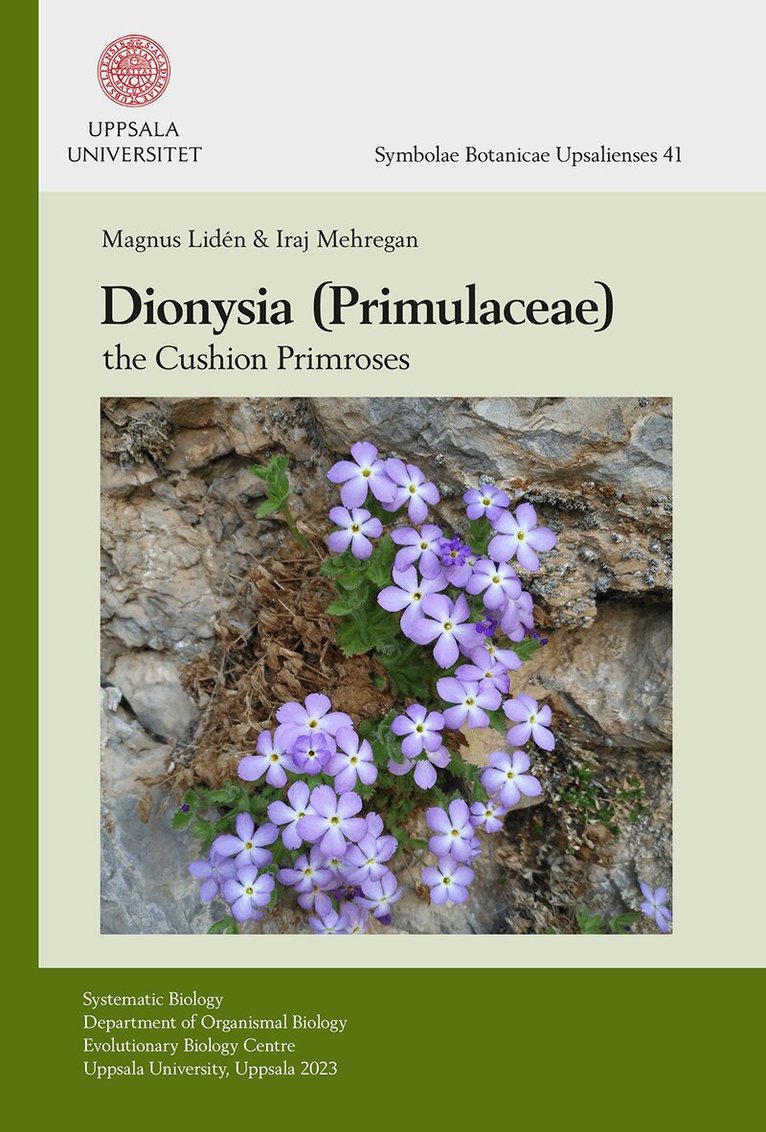
Dionysia (Primulaceae): the Cushion Primroses
Inbunden, Engelska, 2023
317 kr
Skickas inom 5-8 vardagar
Dionysia comprises 64 species of aromatic dwarf shrubs growing in crevices of steep or often overhanging rocks in semi-arid areas. Most species form cushions, and are covered in violet or yellow flowers in spring. They are restricted to the South-central part of the Irano-Turanian floristic region, ± corresponding to the Flora Iranica area. Several species have been used since antiquity for medicine and incense. Until the late 19th century, the drug Hamámá (Dionysia diapensiifolia) was marketed in India as an ingredient in various panaceas. It most likely corresponds to the most precious of the three kinds of ἄμωμον (latin Amomum) recorded by Dioscorides in the first century. Dionysia is a natural taxon, its monophyly well supported by DNA evidence. It is distinguished from related taxa by the apomorphies: shrubby habit with elongated woody branches, very dense amorphous burgundy or dark amber “bark”, woolly farina and ovules embedded in a fleshy placenta. The ancestral Dionysia was rock-growing with fairly large dentate leaves with revolute leaf vernation, stalked inflorescences with tiers of verticillate flowers subtended by foliaceous bracts, long-tubed yellow corollas, and many-seeded capsules (save for revolute leaf vernation, these characters are shared with the sister taxon Evotrochis). Changes to tighter cushions, small leaves, small bracts, sessile flowers, few-seeded capsules and large seeds occurred in parallel in several lineages. Like most species in the Primula group, all Dionysia species are heterostylous and obligately out-crossing, except for D. involucrata (homostylous) and D. teucrioides (mixed). Large phenotypic variation within populations, as well as in cultivated plants from single-mother seed batches, has been documented in many cases. The bulk of this book is a taxonomic treatment of Dionysia, with nomenclature, descriptions, distribution maps, photos and line drawings. The subgeneric classification is based on clearly recognizable natural entities. The enigmatic section Tapetodes is shown to be of hybridogeneous origin, based on DNA and morphology. Twelve new taxa (1 section, 9 species, 2 subspecies) are described: Dionysia sect. Primulopsis, D. tjeerdsmae, D. juniperina, D. mariae, D. moazzenii, D. revoluta ssp. ericoides, D. brinkii, D. gaubae ssp. nodosa, D. mallos, D. bokharii, D. crassifolia, D. alipourii. Four stat. and/or comb. nov. are made (D. sect. Tapetodes, D. involucrata ssp. gandzhinae, D. cespitosa ssp. isophylla and D. odora ssp. zeynepiae). Dionysia wendelboi and D. odora ssp. straussii are rehabilitated. The older name D. drabifolia replaces D. termeana, and D. bachtiarica is shown to be the correct name for “D. sawyeri” sensu Wendelbo, non Primula sawyeri G.Watt, nom. rej. prop., q.e. D. archibaldii. There are also overviews on morphology, phylogeny, biogeography, chemistry and scientific history, and finally advice on how to grow and propagate Dionysia, the latter largely informed by Marika Irvine from Göteborgs botaniska trädgård.