Symploke Studies in Contemporary Theory - Böcker
Visar alla böcker i serien Symploke Studies in Contemporary Theory. Handla med fri frakt och snabb leverans.
3 produkter
3 produkter
543 kr
Skickas inom 10-15 vardagar
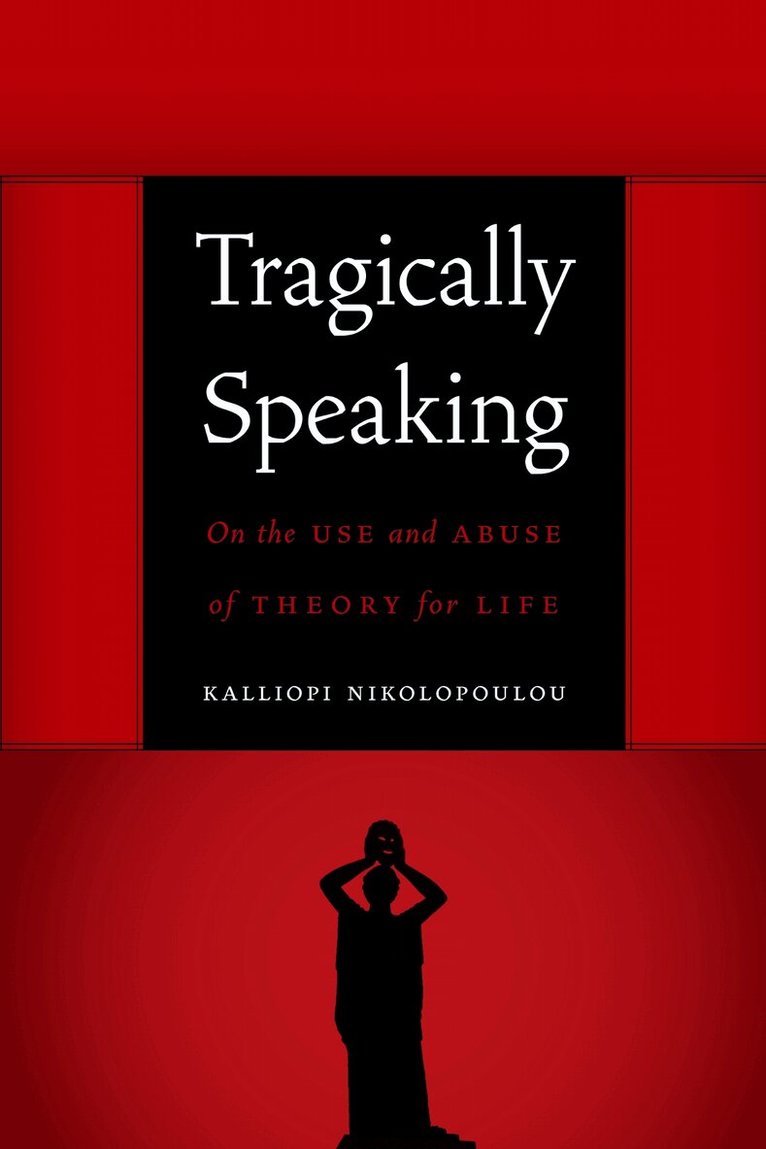
From German idealism onward, Western thinkers have sought to revalue tragedy, invariably converging at one cardinal point: tragic art risks aestheticizing real violence. Tragically Speaking critically examines this revaluation, offering a new understanding of the changing meaning of tragedy in literary and moral discourse. It questions common assumptions about the Greeks' philosophical relation to the tragic tradition and about the ethical and political ramifications of contemporary theories of tragedy.Starting with the poet Friedrich Hölderlin and continuing to the present, Kalliopi Nikolopoulou traces how tragedy was translated into an idea ("the tragic") that was then revised further into the "beyond the tragic" of postmetaphysical contemporary thought. While recognizing some of the merits of this revaluation, Tragically Speaking concentrates on the losses implicit in such a turn. It argues that by translating tragedy into an idea, these rereadings effected a problematic subordination of politics to ethics: the drama of human conflict gave way to philosophical reflection, bracketing the world in favor of the idea of the world. Where contemporary thought valorizes absence, passivity, the Other, rhetoric, writing, and textuality, the author argues that their "deconstructed opposites" (presence, will, the self, truth, speech, and action, all of which are central to tragedy) are equally necessary for any meaningful discussion of ethics and politics.
435 kr
Skickas
Although there have been many attempts to apply the ideas of psychoanalysis to political thought, this book is the first to identify the political project inherent in the fundamental tenets of psychoanalysis. And this political project, Todd McGowan contends, provides an avenue for emancipatory politics after the failure of Marxism in the twentieth century. Where others seeking the political import of psychoanalysis have looked to Freud’s early work on sexuality, McGowan focuses on Freud’s discovery of the death drive and Jacques Lacan’s elaboration of this concept. He argues that the self-destruction occurring as a result of the death drive is the foundational act of emancipation around which we should construct our political philosophy. Psychoanalysis offers the possibility for thinking about emancipation not as an act of overcoming loss but as the embrace of loss. It is only through the embrace of loss, McGowan suggests, that we find the path to enjoyment, and enjoyment is the determinative factor in all political struggles-and only in a political project that embraces the centrality of loss will we find a viable alternative to global capitalism.
420 kr
Skickas inom 10-15 vardagar
Drawing on literary theory and canonical French literature, Reading Unruly examines unruliness as both an aesthetic category and a mode of reading conceived as ethical response. Zahi Zalloua argues that when faced with an unruly work of art, readers confront an ethical double bind, hesitating then between the two conflicting injunctions of either thematizing (making sense) of the literary work, or attending to its aesthetic alterity or unreadability. Creatively hesitating between incommensurable demands (to interpret but not to translate back into familiar terms), ethical readers are invited to cultivate an appreciation for the unruly, to curb the desire for hermeneutic mastery without simultaneously renouncing meaning or the interpretive endeavor as such. Examining French texts from Montaigne's sixteenth-century Essays to Diderot's fictional dialogue Rameau's Nephew and Baudelaire's prose poems The Spleen of Paris, to the more recent works of Jean-Paul Sartre's Nausea, Alain Robbe-Grillet's Jealousy, and Marguerite Duras's The Ravishing of Lol Stein, Reading Unruly demonstrates that in such an approach to literature and theory, reading itself becomes a desire for more, an ethical and aesthetic desire to prolong rather than to arrest the act of interpretation.