Technologies of the Imagination: New Media in Everyday Life – serie
Visar alla böcker i serien Technologies of the Imagination: New Media in Everyday Life. Handla med fri frakt och snabb leverans.
4 produkter
4 produkter
347 kr
Skickas inom 7-10 vardagar
"Intellectually deft and lively to read, Skate Life is an important addition to the literature on youth cultures, contemporary masculinity, and the role of media in identity formation."---Janice A. Radway, Northwestern University, author of Reading the Romance: Women, Patriarchy, and Popular Literature"With her elegant research design and sophisticated array of anthropological and media studies approaches, Emily Chivers Yochim has produced one of the best books about race, gender, and class that I have read in the last ten years. In a moment where celebratory studies of youth, youth subcultures, and their relationship to media abound, this book stands as a brilliantly argued analysis of the limitations of youth subcultures and their ambiguous relationship to mainstream commercial culture."---Ellen Seiter, University of Southern California"Yochim has made a valuable contribution to media and cultural studies as well as youth and American studies by conducting this research and by coining the phrase 'corresponding cultures,' which conceptualizes the complex and dynamic processes skateboarders employ to negotiate their identities as part of both mainstream and counter-cultures."---JoEllen Fisherkeller, New York UniversitySkate Life examines how young male skateboarders use skate culture media in the production of their identities. Emily Chivers Yochim offers a comprehensive ethnographic analysis of an Ann Arbor, Michigan, skateboarding community, situating it within a larger historical examination of skateboarding's portrayal in mainstream media and a critique of mainstream, niche, and locally produced media texts (such as, for example, Jackass, Viva La Bam, and Dogtown and Z-Boys). The book uses these elements to argue that adolescent boys can both critique dominant norms of masculinity and maintain the power that white heterosexual masculinity offers. Additionally, Yochim uses these analyses to introduce the notion of "corresponding cultures," conceptualizing the ways in which media audiences both argue with and incorporate mediated images into their own ideas about identity. In a strong combination of anthropological and media studies approaches, Skate Life asks important questions of the literature on youth and provides new ways of assessing how young people create their identities.Emily Chivers Yochim is Assistant Professor in the Department of Communication Arts, Allegheny College.Cover design by Brian V. Smith
361 kr
Skickas inom 7-10 vardagar
"Ever since the creators of the animated television show South Park turned their lovingly sardonic gaze on the massively multiplayer online game World of Warcraft for an entire episode, WoW's status as an icon of digital culture has been secure. My Life as a Night Elf Priest digs deep beneath the surface of that icon to explore the rich particulars of the World of Warcraft player's experience."—Julian Dibbell, Wired"World of Warcraft is the best representative of a significant new technology, art form, and sector of society: the theme-oriented virtual world. Bonnie Nardi's pioneering transnational ethnography explores this game both sensitively and systematically using the methods of cultural anthropology and aesthetics with intensive personal experience as a guild member, media teacher, and magical quest Elf."—William Sims Bainbridge, author of The Warcraft Civilization and editor of Online Worlds “Nardi skillfully covers all of the hot button issues that come to mind when people think of video games like World of Warcraft such as game addiction, sexism, and violence. What gives this book its value are its unexpected gems of rare and beautifully detailed research on less sensationalized topics of interest such as the World of Warcraft player community in China, game modding, the increasingly blurred line between play and work, and the rich and fascinating lives of players and player cultures. Nardi brings World of Warcraft down to earth for non-players and ties it to social and cultural theory for scholars. . . . the best ethnography of a single virtual world produced so far.”—Lisa Nakamura, University of IllinoisWorld of Warcraft rapidly became one of the most popular online world games on the planet, amassing 11.5 million subscribers—officially making it an online community of gamers that had more inhabitants than the state of Ohio and was almost twice as populous as Scotland. It's a massively multiplayer online game, or MMO in gamer jargon, where each person controls a single character inside a virtual world, interacting with other people's characters and computer-controlled monsters, quest-givers, and merchants. In My Life as a Night Elf Priest, Bonnie Nardi, a well-known ethnographer who has published extensively on how theories of what we do intersect with how we adopt and use technology, compiles more than three years of participatory research in Warcraft play and culture in the United States and China into this field study of player behavior and activity. She introduces us to her research strategy and the history, structure, and culture of Warcraft; argues for applying activity theory and theories of aesthetic experience to the study of gaming and play; and educates us on issues of gender, culture, and addiction as part of the play experience. Nardi paints a compelling portrait of what drives online gamers both in this country and in China, where she spent a month studying players in Internet cafes. Bonnie Nardi has given us a fresh look not only at World of Warcraft but at the field of game studies as a whole. One of the first in-depth studies of a game that has become an icon of digital culture, My Life as a Night Elf Priest will capture the interest of both the gamer and the ethnographer.Bonnie A. Nardi is an anthropologist by training and a professor in the Department of Informatics in the Donald Bren School of Information and Computer Sciences at the University of California, Irvine. Her research focus is the social implications of digital technologies. She is the author of A Small Matter of Programming: Perspectives on End User Computing and the coauthor of Information Ecologies: Using Technology with Heart and Acting with Technology: Activity Theory and Interaction Design.Cover art by Jessica Damsky
432 kr
Skickas inom 7-10 vardagar
Over the past decade, the video camera has become a commonplace household technology. With falling prices on compact and easy-to-use cameras, as well as mobile phones and digital still cameras with video recording capabilities, access to moving image production technology is becoming virtually universal. Home Truths? represents one of the few academic research studies exploring this everyday, popular use of video production technology, looking particularly at how families use and engage with the technology and how it fits into the routines of everyday life.The authors draw on interviews, observations, and the participants' videos themselves, seeking to paint a comprehensive picture of the role of video making in their everyday lives. While readers gain a sense of the individual characters involved in the project and the complexities and diversities of their lives, the analysis also raises a range of broader issues about the nature of learning and creativity, subjectivity and representation, and the "domestication" of technology---issues that are of interest to many in the fields of sociology and media/cultural studies.David Buckingham is Professor of Education at the Institute of Education, University of London, and Director of the Institute's Centre for the Study of Children, Youth and Media.Rebekah Willett is Lecturer at the Institute of Education, University of London, where she teaches in Media, Culture and Communication.Maria Pini previously worked as Lecturer in Media and Communications at Goldsmiths College, London University, and is now a researcher on the Camcorder Cultures project at the Institute of Education.Cover art: Young videomaker ©iStockphoto.com/ kaisersosa67Technologies of the Imagination: New Media in Everyday Lifedigitalculturebooks is an imprint of the University of Michigan Press and the Scholarly Publishing Office of the University of Michigan Library dedicated to publishing innovative and accessible work exploring new media and their impact on society, culture, and scholarly communication. Visit the website at www.digitalculture.org.
351 kr
Skickas inom 7-10 vardagar
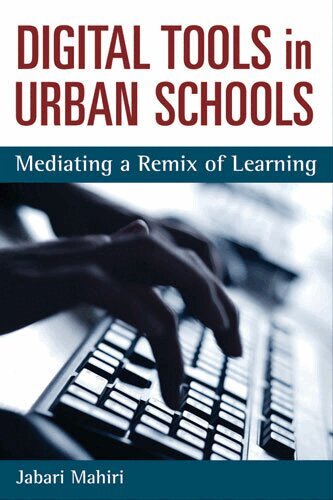
"Today there is massive interest in how digital tools and popular culture are transforming learning out of school and lots of dismay at how digitally lost our schools are. Jabari Mahiri works his usual magic and here shows us how to cross this divide in a solidly grounded and beautifully written book."---James Paul Gee, Fulton Presidential Professor of Literacy Studies, Arizona State University"Digital Tools in Urban Schools is a profoundly sobering yet inspiring depiction of the potential for committed educators to change the lives of urban youth, with the assistance of a new set of technical capabilities."---Mimi Ito, Professor in Residence and MacArthur Foundation Chair in Digital Media and Learning, Departments of Informatics and Anthropology, University of California, Irvine"An uplifting book that addresses a critical gap in existing literature by providing rich and important insights into ways teachers, administrators, and members of the wider community can work together with students previously alienated---even excluded---from formal education to enhance classroom learning with appropriate digital tools and achieve inspiring results under challenging circumstances." ---Colin Lankshear, James Cook University, and Michele Knobel, Montclair State UniversityDigital Tools in Urban Schools demonstrates significant ways in which high school teachers in the complex educational setting of an urban public high school in northern California extended their own professional learning to revitalize learning in their classrooms. Through a novel research collaboration between a university and this public school, these teachers were supported and guided in developing the skills necessary to take greater advantage of new media and new information sources to increase student learning while making connections to their relevant experiences and interests. Jabari Mahiri draws on extensive qualitative data---including blogs, podcasts, and other digital media---to document, describe, and analyze how the learning of both students and teachers was dramatically transformed as they utilized digital media in their classrooms. Digital Tools in Urban Schools will interest instructional leaders and participants in teacher preparation and professional development programs, education and social science researchers and scholars, graduate and undergraduate programs and classes emphasizing literacy and learning, and those focused on urban education issues and conditions.