Textbooks in Mathematical Sciences - Böcker
Visar alla böcker i serien Textbooks in Mathematical Sciences. Handla med fri frakt och snabb leverans.
8 produkter
8 produkter
712 kr
Skickas inom 5-8 vardagar
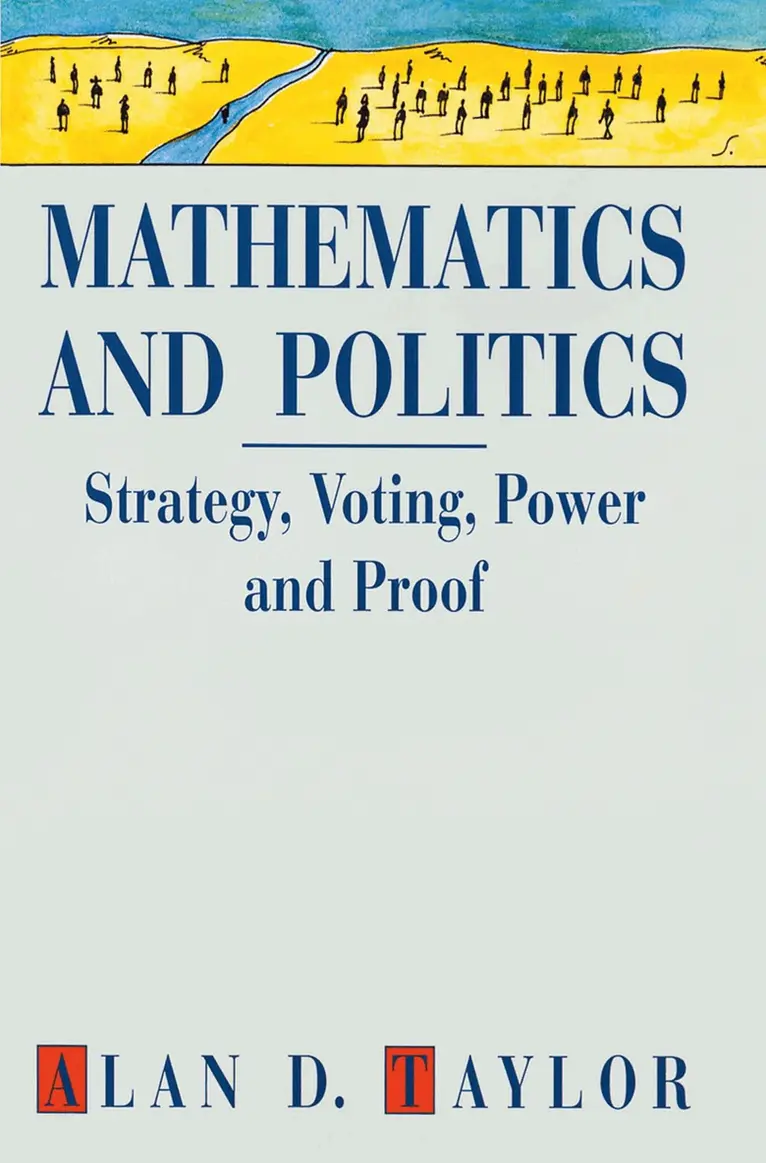
interest in a particular application, however, often depends on his or hergeneralinterestintheareainwhichtheapplicationistakingplace. My experience at Union College has been that there is a real advan tage in having students enter the course knowing thatvirtually all the applications will focus on a single discipline-in this case, political science. The level ofpresentation assumes no college-level mathematicalor social science prerequisites. The philosophy underlying the approach we have taken in this book is based on the sense that we (mathemati cians)havetendedtomaketwoerrorsinteachingnonsciencestudents: wehaveoverestimatedtheircomfortwithcomputationalmaterial,and we have underestimated their ability to handle conceptual material. Thus, while there is very little algebra (and certainly no calculus) in our presentation, we have included numerous logical arguments that students in the humanitiesand the socialscienceswill find accessible, but not trivial. The book contains five main topics: a m.odel of escalation, game theoretic models of international conflict, yes-no voting systems, political power, and social choice. The first partofthe text is made up of a single chapter devoted to each topic. The second part of the text revisits each topic, again with a single chapter devoted to each. The organizationofthe bookisbasedonpedagogicalconsiderations, with the material becoming somewhat more sophisticated as one moves through the ten chapters. On the other hand, within any given chap terthere is little reliance on material from earlierchapters, except for those devoted to the same topic.
535 kr
Skickas inom 10-15 vardagar
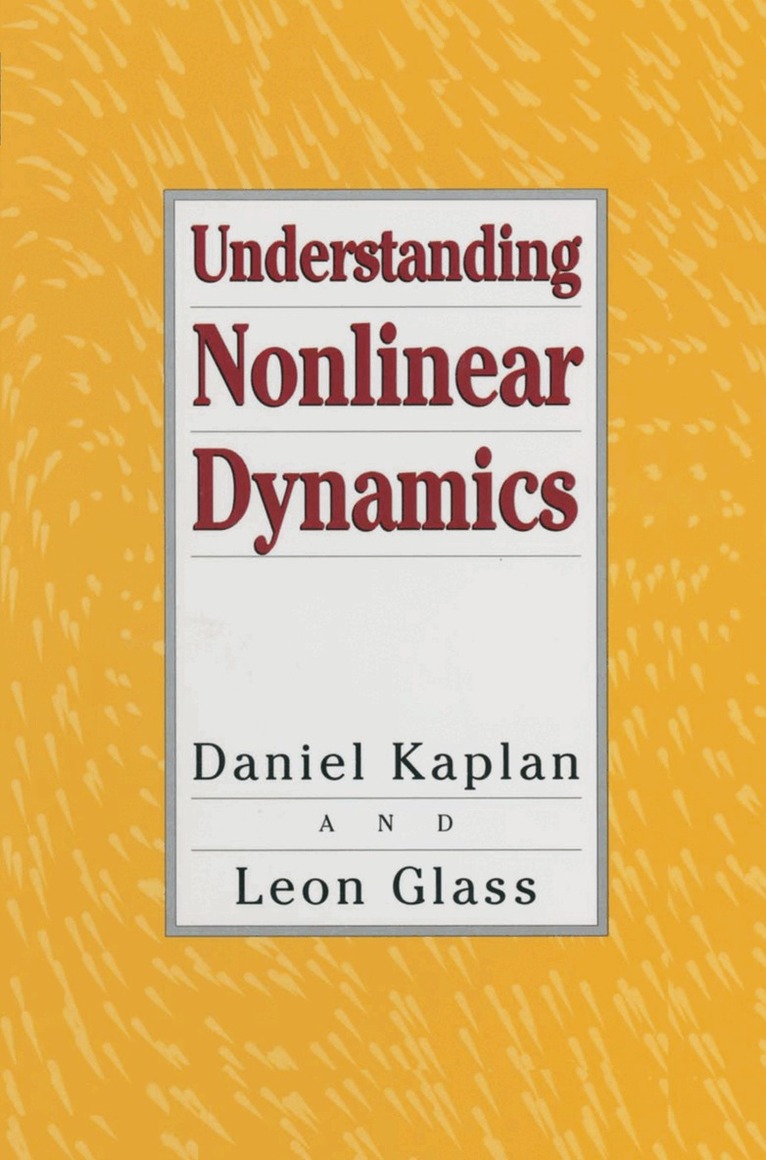
Mathematics is playing an ever more important role in the physical and biological sciences, provoking a blurring of boundaries between scientific disciplines and a resurgence of interest in the modern as well as the classical techniques of applied mathematics. This renewal of interest, both in research and teaching, has led to the establishment of the series: Texts in Applied Mathematics ( TAM). The development of new courses is a natural consequence of a high level of excitement on the research frontier as newer techniques, such as numerical and symbolic computer systems, dynamical systems, and chaos, mix with and reinforce the traditional methods of applied mathematics. Thus, the purpose of this textbook series is to meet the current and future needs of these advances and encourage the teaching of new courses. TAM will publish textbooks suitable for use in advanced undergraduate and beginning graduate courses, and will complement the Applied Mathematical Sciences (AMS) series, which will focus on advanced textbooks and research level monographs. About the Authors Daniel Kaplan specializes in the analysis of data using techniques motivated by nonlinear dynamics. His primary interest is in the interpretation of irregular physiological rhythms, but the methods he has developed have been used in geo physics, economics, marine ecology, and other fields. He joined McGill in 1991, after receiving his Ph.D from Harvard University and working at MIT. His un dergraduate studies were completed at Swarthmore College. He has worked with several instrumentation companies to develop novel types of medical monitors.
535 kr
Skickas inom 10-15 vardagar
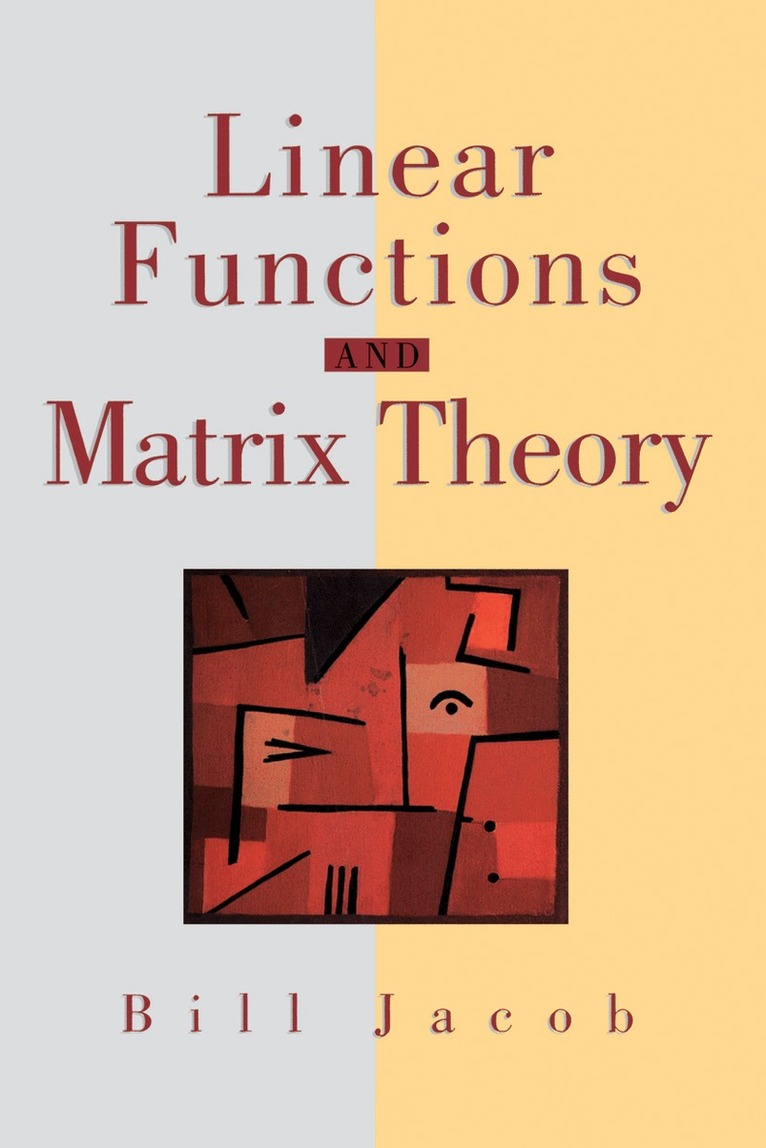
Courses that study vectors and elementary matrix theory and introduce linear transformations have proliferated greatly in recent years. Most of these courses are taught at the undergraduate level as part of, or adjacent to, the second-year calculus sequence. Although many students will ultimately find the material in these courses more valuable than calculus, they often experience a class that consists mostly of learning to implement a series of computational algorithms. The objective of this text is to bring a different vision to this course, including many of the key elements called for in current mathematics-teaching reform efforts. Three of the main components of this current effort are the following: 1. Mathematical ideas should be introduced in meaningful contexts, with after a clear understanding formal definitions and procedures developed of practical situations has been achieved. 2. Every topic should be treated from different perspectives, including the numerical, geometric, and symbolic viewpoints. 3. The important ideas need to be visited repeatedly throughout the term, with students' understan9ing deepening each time. This text was written with these three objectives in mind. The first two chapters deal with situations requiring linear functions (at times, locally linear functions) or linear ideas in geometry for their understanding. These situations provide the context in which the formal mathematics is developed, and they are returned to with increasing sophistication throughout the text.
535 kr
Skickas inom 10-15 vardagar
Preface Objectives of This Book • To teach calculus as a laboratory science, with the computer and software as the lab, and to use this lab as an essential tool in learning and using calculus. • To present calculus and elementary differential equations with a minimum of fuss-through practice, not theory. • To stress ideas of calculus, applications, and problem solving, rather than definitions, theorems, and proofs. • Toemphasize numerical aspects: approximations, order of magnitude, concrete answers to problems. • To organize the topics consistent with the needs of students in their concurrent science and engineering courses. The subject matter of calculus courses has developed over many years, much by negotiation with the disciplines calculus serves, particularly engineering. This text covers the standard topics in their conventional order. Mostly because of commercial pressures, calculus texts have grown larger and larger, trying to include everything that anyone conceivably would cover. Calculus texts have also added more and more expensive pizzazz, up to four colors now. This text is lean; it eliminates most of the "fat" of recent calculus texts; it has a simple physical black/white format; it ignores much of current calculus "culture". The computer has forced basic changes in emphasis and how to teach calculus.
694 kr
Skickas inom 10-15 vardagar
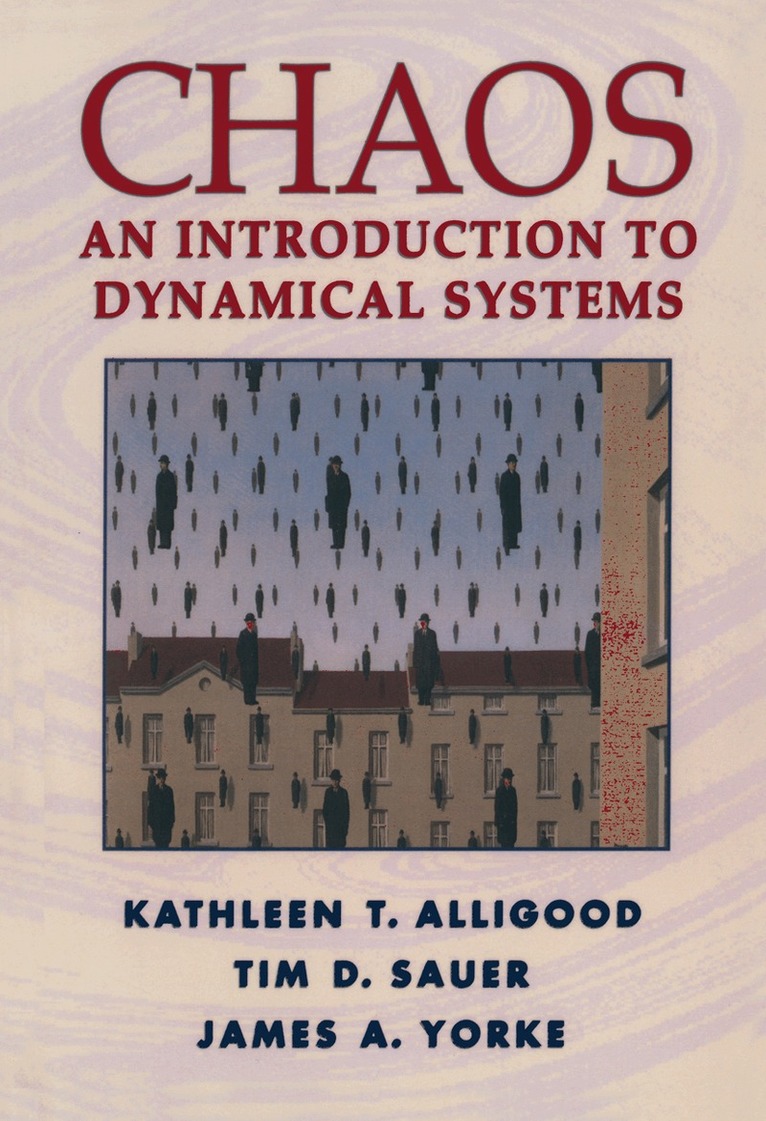
Chaos: An Introduction to Dynamical Systems, was developed and class-tested by a distinguished team of authors at two universities through their teaching of courses based on the material. Intended for courses in nonlinear dynamics offered either in Mathematics or Physics, the text requires only calculus, differential equations, and linear algebra as prerequisites. Along with discussions of the major topics, including discrete dynamical systems, chaos, fractals, nonlinear differential equations and bifurcations, the text also includes Lab Visits, short reports that illustrate relevant concepts from the physical, chemical and biological sciences. There are Computer Experiments throughout the text that present opportunities to explore dynamics through computer simulations, designed to be used with any software package. And each chapter ends with a Challenge, which provides students a tour through an advanced topic in the form of an extended exercise.
430 kr
Skickas inom 10-15 vardagar
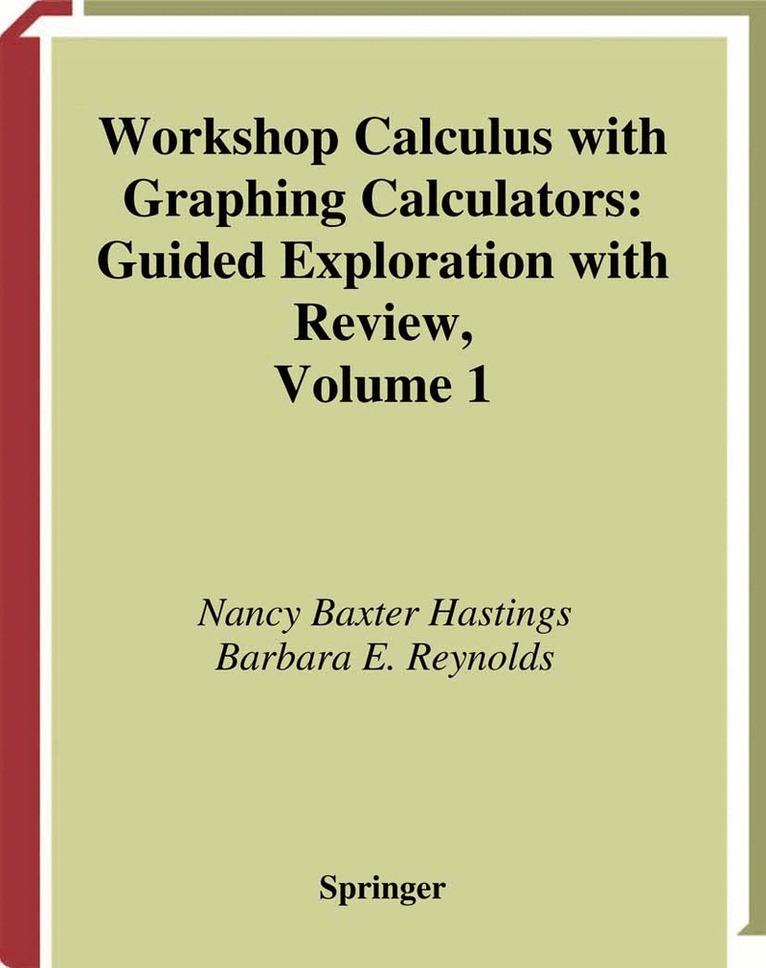
This project is based on the use of graphing calculators by students enrolled in calculus. There is enough material in the book to cover precalculus review, as well as first year single variable calculus topics. Intended for use in workshop-centered calculus courses. Developed as part of the well-known NSF-sponsored project, Workshop Mathematics, the text is intended for use with students in a math laboratory, instead of a traditional lecture course. There are student-oriented activities, experiments and graphing calculator exercises found throughout the text. The authors are well-known teachers and innovative thinkers about ways to improve undergraduate mathematics teaching.
482 kr
Skickas inom 10-15 vardagar
This project is based on the use of graphing calculators by students enrolled in calculus. There is enough material in the book to cover precalculus review, as well as first year single variable calculus topics. Intended for use in workshop-centered calculus courses. Developed as part of the well-known NSF-sponsored project, Workshop Mathematics, the text is intended for use with students in a math laboratory, instead of a traditional lecture course. There are student-oriented activities, experiments and graphing calculator exercises found throughout the text. The authors are well-known teachers and innovative thinkers about ways to improve undergraduate mathematics teaching.
528 kr
Skickas inom 10-15 vardagar
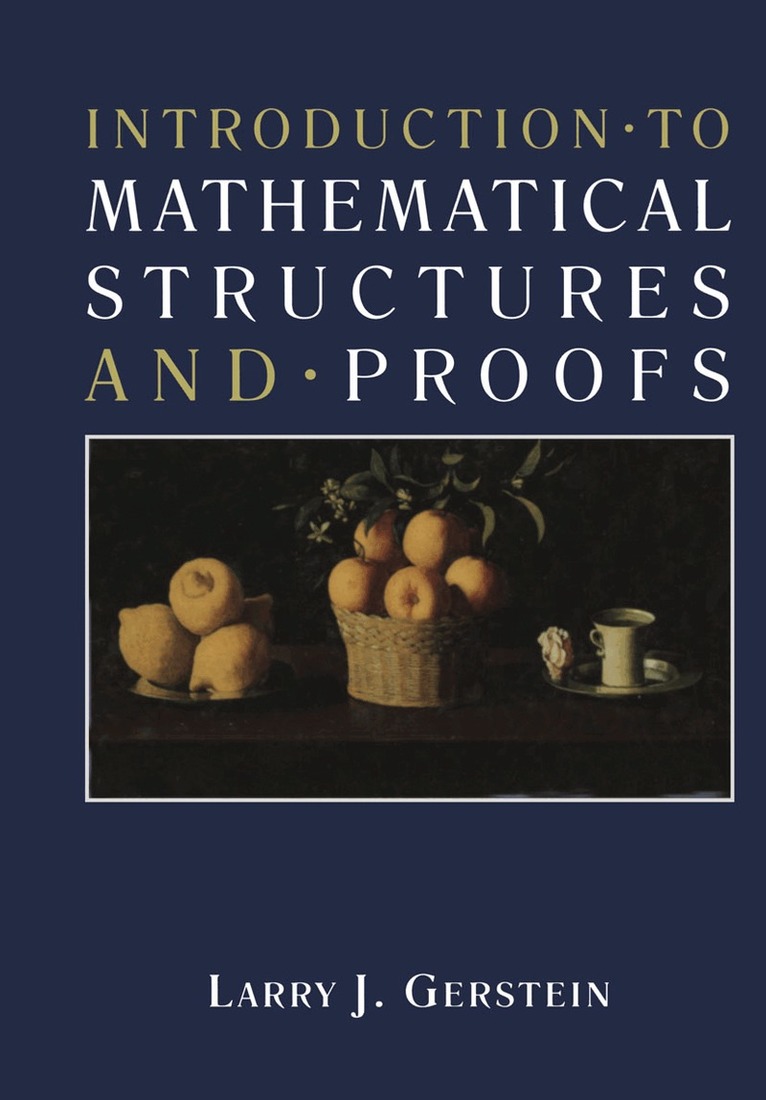
This is a textbook for a one-term course whose goal is to ease the transition from lower-division calculus courses to upper-division courses in linear and abstract algebra, real and complex analysis, number theory, topology, combinatorics, and so on. Without such a "bridge" course, most upper division instructors feel the need to start their courses with the rudiments of logic, set theory, equivalence relations, and other basic mathematical raw materials before getting on with the subject at hand. Students who are new to higher mathematics are often startled to discover that mathematics is a subject of ideas, and not just formulaic rituals, and that they are now expected to understand and create mathematical proofs. Mastery of an assortment of technical tricks may have carried the students through calculus, but it is no longer a guarantee of academic success. Students need experience in working with abstract ideas at a nontrivial level if they are to achieve the sophisticated blend of knowledge, disci pline, and creativity that we call "mathematical maturity. " I don't believe that "theorem-proving" can be taught any more than "question-answering" can be taught. Nevertheless, I have found that it is possible to guide stu dents gently into the process of mathematical proof in such a way that they become comfortable with the experience and begin asking them selves questions that will lead them in the right direction.