• Fri frakt över 249 kr
  • •
  • Snabba leveranser
  • •
  • Billiga böcker
Kundservice

Du är på sajten för privatpersoner.

Företag, bibliotek eller offentlig verksamhet?

Du handlar på classic.bokus.com, där alla dina funktioner finns intakta.
Till classic.bokus.com
Bokus logotyp. Gå till startsidan.
  • Erbjudanden
  • Nyheter
  • Student
  • Topplistor
  • Barn & ungdom
  • Bokus Play
  • E-böcker
  • Pocketböcker
  • Spel & pussel

10% rabatt på allt med kod NYSTART10 →

Sidfot

Mina sidor

    Hjälp

    • Kundservice
    • Vanliga frågor och svar
    • Frakt och leverans
    • Retur vid ångerrätt
    • Reklamera vara
    • Betalning
    • Köpvillkor
    • Allmänna villkor
    • Information om webbplatsens tillgänglighet

    Om Bokus

    • Om oss
    • Pressrum
    • För studenter
    • För företag
    • För bibliotek och offentlig verksamhet
    • För leverantörer
    • Hållbarhet

    Populärt

    • Aktuella erbjudanden
    • Presentkort
    • Studentlitteratur
    • Nya böcker
    • Topplistor
    • Signerade böcker
    • Engelska böcker

    Inspiration

    • Boktips
    • BookTok
    • Populära bokserier
    • Barnbokskaraktärer
    • Populära författare
    Logotyp för Bokus
    Följ oss på Facebook (extern länk)Följ oss på Instagram (extern länk)Följ oss på YouTube (extern länk)Följ oss på TikTok (extern länk)
    bokus @ CookiesAnpassa cookiesIntegritetspolicyKöpvillkor
    Till Citymail hemsida (extern länk)Till Budbee hemsida (extern länk)Till Postnord hemsida (extern länk)Till Schenker hemsida (extern länk)Till Early Bird hemsida (extern länk)Till Walleys hemsida (extern länk)
    1. Naturvetenskap och teknik
    2. Matematik och naturvetenskap
    3. Matematik
    4. Tillämpad matematik

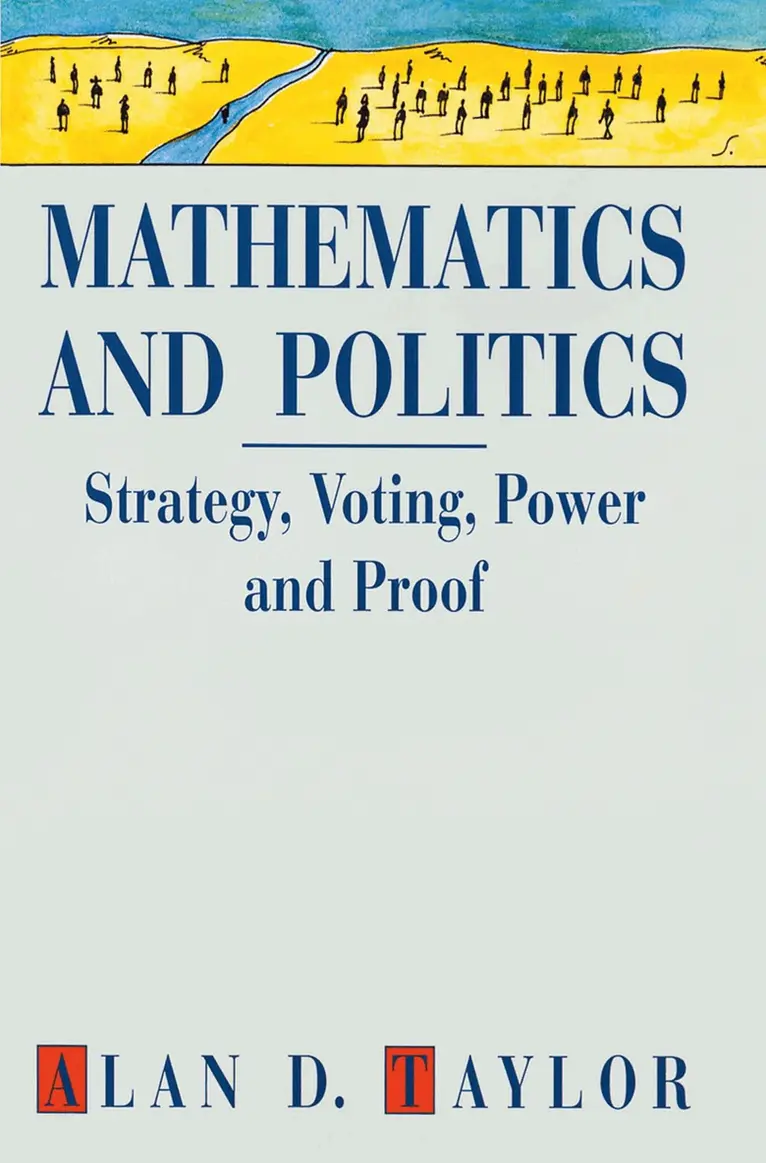
    Mathematics and Politics

    Strategy, Voting, Power and Proof

    AvAlan D. Taylor

    Häftad, Engelska, 1996

    Del i serien Textbooks in Mathematical Sciences

    725 kr

    Beställningsvara. Skickas inom 5-8 vardagar. Fri frakt över 249 kr.

    Fler format och utgåvor

    Inbunden

    924 kr

    Häftad

    654 kr

    E-bok

    710 kr

    Beskrivning

    interest in a particular application, however, often depends on his or hergeneralinterestintheareainwhichtheapplicationistakingplace. My experience at Union College has been that there is a real advan­ tage in having students enter the course knowing thatvirtually all the applications will focus on a single discipline-in this case, political science. The level ofpresentation assumes no college-level mathematicalor social science prerequisites. The philosophy underlying the approach we have taken in this book is based on the sense that we (mathemati­ cians)havetendedtomaketwoerrorsinteachingnonsciencestudents: wehaveoverestimatedtheircomfortwithcomputationalmaterial,and we have underestimated their ability to handle conceptual material. Thus, while there is very little algebra (and certainly no calculus) in our presentation, we have included numerous logical arguments that students in the humanitiesand the socialscienceswill find accessible, but not trivial. The book contains five main topics: a m.odel of escalation, game­ theoretic models of international conflict, yes-no voting systems, political power, and social choice. The first partofthe text is made up of a single chapter devoted to each topic. The second part of the text revisits each topic, again with a single chapter devoted to each. The organizationofthe bookisbasedonpedagogicalconsiderations, with the material becoming somewhat more sophisticated as one moves through the ten chapters. On the other hand, within any given chap­ terthere is little reliance on material from earlierchapters, except for those devoted to the same topic.

    Produktinformation

    • Utgivningsdatum:1996-01-26
    • Mått:155 x 235 x 16 mm
    • Vikt:434 g
    • Format:Häftad
    • Språk:Engelska
    • Serie:Textbooks in Mathematical Sciences
    • Antal sidor:284
    • Förlag:Springer-Verlag New York Inc.
    • ISBN:9780387943916

    Utforska kategorier

    • Tillämpad matematik inom Naturvetenskap och teknik
    • Statsvetenskap och politisk teori inom Samhälle och politik

    Innehållsförteckning

    • 1 Escalation.- 1.1. Introduction.- 1.2. Game-Tree Analyses.- 1.3. Limitations and Back-of-the-Envelope Calculations.- 1.4. Statement of O’Neill’s Theorem.- 1.5. Conclusions.- Exercises.- 2 Conflict.- 2.1. Introduction.- 2.2. Dominant Strategies and Nash Equilibria.- 2.3. Prisoner’s Dilemma.- 2.4. A Game-Theoretic Model of the Arms Race.- 2.5. Chicken.- 2.6. Game-Theoretic Models of the Cuban Missile Crisis.- 2.7. Conclusions.- Exercises.- 3 Yes-No Voting.- 3.1. Introduction.- 3.2. Swap Robustness and the Nonweightedness of the Federal System.- 3.3. Trade Robustness and the Nonweightedness of the Procedure to Amend the Canadian Constitution.- 3.4. Statement of the Characterization Theorem.- 3.5. Conclusions.- Exercises.- 4 Political Power.- 4.1. Introduction.- 4.2. The Shapley-Shubik Index of Power.- 4.3. Calculations for the European Economic Community.- 4.4. A Theorem on Voting Blocs.- 4.5. The Banzhaf Index of Power.- 4.6. Two Methods of Computing Banzhaf Power.- 4.7. Ordinal Power: Incomparability.- 4.8. Conclusions.- Exercises.- 5 Social Choice.- 5.1. Introduction.- 5.2. Five Examples of Social Choice Procedures.- 5.3. Four Desirable Properties of Social Choice Procedures.- 5.4. Positive Results—Proofs.- 5.5. Negative Results—Proofs.- 5.6. The Condorcet Voting Paradox.- 5.7. A Glimpse of Impossibility.- 5.8. Conclusions.- Exercises.- 6 More Escalation.- 6.1. Introduction.- 6.2. Statement of the Strong Version of O’Neill’s Theorem.- 6.3. Proof (by Mathematical Induction) of the Strong Version of O’Neill’s Theorem.- 6.4. Vickrey Auctions.- 6.5. Vickrey Auctions as a Generalized Prisoner’s Dilemma.- 6.6. Conclusions.- Exercises.- 7 More Conflict.- 7.1. Introduction.- 7.2. The Yom Kippur War.- 7.3. The Theory of Moves.- 7.4. Models of Deterrence.-7.5. A Probabilistic Model of Deterrence.- 7.6. Two-Person Zero-Sum Games.- 7.7. Conclusions.- Exercises.- 8 More Yes-No Voting.- 8.1. Introduction.- 8.2. A Magic Square Voting System.- 8.3. Dimension Theory and the U.S. Federal System.- 8.4. Vector-Weighted Voting Systems.- 8.5. Conclusions.- Exercises.- 9 More Political Power.- 9.1. Introduction.- 9.2. The Johnston Index of Power.- 9.3. The Deegan-Packel Index of Power.- 9.4. The Power of the President.- 9.5. Ordinal Power: Comparability.- 9.6. The Chair’s Paradox.- 9.7. Conclusions.- Exercises.- 10 More Social Choice.- 10.1. Introduction.- 10.2. Social Welfare Functions.- 10.3. May’s Theorem for Two Alternatives.- 10.4. Arrow’s Impossibility Theorem.- 10.5. Single Peakedness—Theorems of Black and Sen.- 10.6. Conclusions.- Exercises.- Attributions.- References.