The Evolution of Modern Philosophy - Böcker
Visar alla böcker i serien The Evolution of Modern Philosophy. Handla med fri frakt och snabb leverans.
12 produkter
12 produkter
1 311 kr
Skickas inom 7-10 vardagar
A magisterial study of the philosophy of physics that both introduces the subject to the non-specialist and contains many original and important contributions for professionals in the area. Modern physics was born as a part of philosophy and has retained to this day a properly philosophical concern for the clarity and coherence of ideas. Any introduction to the philosophy of physics must therefore focus on the conceptual development of physics itself. This book pursues that development from Galileo and Newton through Maxwell and Boltzmann to Einstein and the founders of quantum mechanics. There is also discussion of important philosophers of physics in the eighteenth and nineteenth centuries and of twentieth-century debates. In the interest of appealing to the broadest possible readership the author avoids technicalities and explains both the physics and philosophical terms.
460 kr
Skickas inom 7-10 vardagar
A magisterial study of the philosophy of physics that both introduces the subject to the non-specialist and contains many original and important contributions for professionals in the area. Modern physics was born as a part of philosophy and has retained to this day a properly philosophical concern for the clarity and coherence of ideas. Any introduction to the philosophy of physics must therefore focus on the conceptual development of physics itself. This book pursues that development from Galileo and Newton through Maxwell and Boltzmann to Einstein and the founders of quantum mechanics. There is also discussion of important philosophers of physics in the eighteenth and nineteenth centuries and of twentieth-century debates. In the interest of appealing to the broadest possible readership the author avoids technicalities and explains both the physics and philosophical terms.
511 kr
Skickas inom 7-10 vardagar
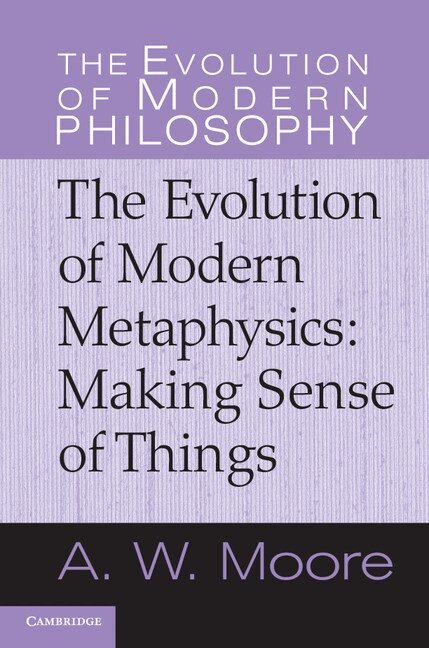
This book is concerned with the history of metaphysics since Descartes. Taking as its definition of metaphysics 'the most general attempt to make sense of things', it charts the evolution of this enterprise through various competing conceptions of its possibility, scope, and limits. The book is divided into three parts, dealing respectively with the early modern period, the late modern period in the analytic tradition, and the late modern period in non-analytic traditions. In its unusually wide range, A. W. Moore's study refutes the tired old cliché that there is some unbridgeable gulf between analytic philosophy and philosophy of other kinds. It also advances its own distinctive and compelling conception of what metaphysics is and why it matters. Moore explores how metaphysics can help us to cope with continually changing demands on our humanity by making sense of things in ways that are radically new.
1 166 kr
Skickas inom 7-10 vardagar
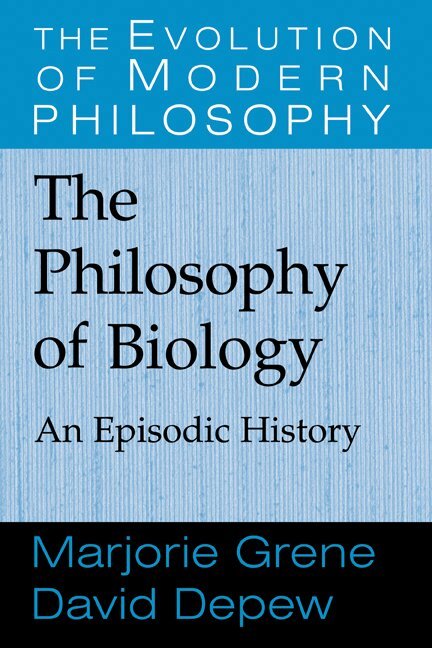
Is life different from the non-living? If so, how? And how, in that case, does biology as the study of living things differ from other sciences? These questions are traced through an exploration of episodes in the history of biology and philosophy. The book begins with Aristotle, then moves on to Descartes, comparing his position with that of Harvey. In the eighteenth century the authors consider Buffon and Kant. In the nineteenth century the authors examine the Cuvier-Geoffroy debate, pre-Darwinian geology and natural theology, Darwin and the transition from Darwin to the revival of Mendelism. Two chapters deal with the evolutionary synthesis and such questions as the species problem, the reducibility or otherwise of biology to physics and chemistry, and the problem of biological explanation in terms of function and teleology. The final chapters reflect on the implications of the philosophy of biology for philosophy of science in general.
511 kr
Skickas inom 7-10 vardagar
Is life different from the non-living? If so, how? And how, in that case, does biology as the study of living things differ from other sciences? These questions are traced through an exploration of episodes in the history of biology and philosophy. The book begins with Aristotle, then moves on to Descartes, comparing his position with that of Harvey. In the eighteenth century the authors consider Buffon and Kant. In the nineteenth century the authors examine the Cuvier-Geoffroy debate, pre-Darwinian geology and natural theology, Darwin and the transition from Darwin to the revival of Mendelism. Two chapters deal with the evolutionary synthesis and such questions as the species problem, the reducibility or otherwise of biology to physics and chemistry, and the problem of biological explanation in terms of function and teleology. The final chapters reflect on the implications of the philosophy of biology for philosophy of science in general.
1 065 kr
Skickas inom 7-10 vardagar
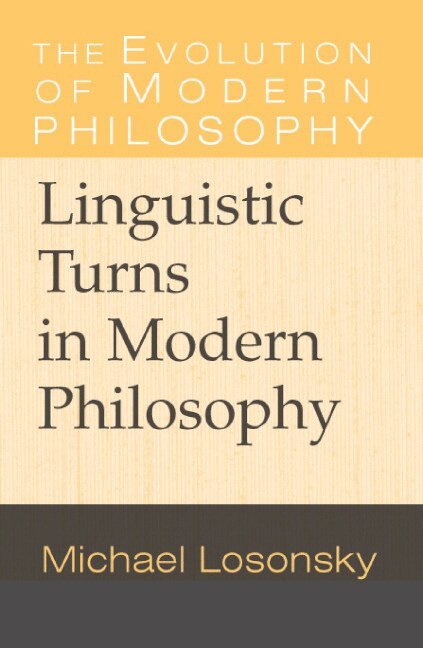
This book traces the linguistic turns in the history of modern philosophy and the development of the philosophy of language from Locke to Wittgenstein. It examines the contributions of canonical figures such as Leibniz, Mill, Frege, Russell, Wittgenstein, Austin, Quine, and Davidson, as well as those of Condillac, Humboldt, Chomsky, and Derrida. Michael Losonsky argues that the philosophy of language begins with Locke's Essay Concerning Human Understanding. He shows how the history of the philosophy of language in the modern period is marked by a dichotomy between formal and pragmatic perspectives on language and that modern philosophy has not been able to integrate these two aspects of human language. Language as a human activity and language as a syntactic and semantic system remain distinct and competing focal points, although the interplay between these points of view has driven the development of the philosophy of language.
370 kr
Skickas inom 7-10 vardagar
This book traces the linguistic turns in the history of modern philosophy and the development of the philosophy of language from Locke to Wittgenstein. It examines the contributions of canonical figures such as Leibniz, Mill, Frege, Russell, Wittgenstein, Austin, Quine, and Davidson, as well as those of Condillac, Humboldt, Chomsky, and Derrida. Michael Losonsky argues that the philosophy of language begins with Locke's Essay Concerning Human Understanding. He shows how the history of the philosophy of language in the modern period is marked by a dichotomy between formal and pragmatic perspectives on language and that modern philosophy has not been able to integrate these two aspects of human language. Language as a human activity and language as a syntactic and semantic system remain distinct and competing focal points, although the interplay between these points of view has driven the development of the philosophy of language.
360 kr
Skickas inom 7-10 vardagar
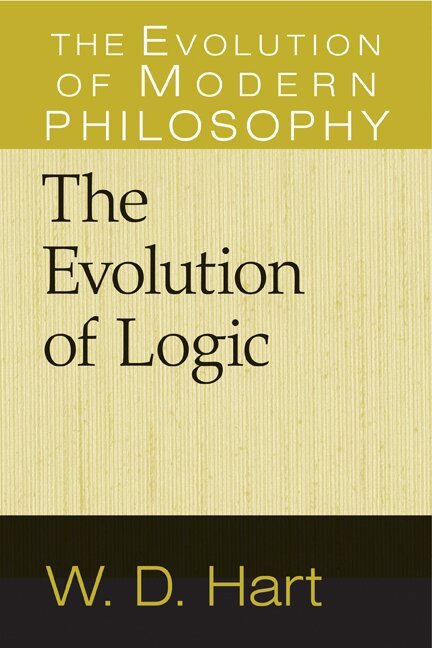
Examines the relations between logic and philosophy over the last 150 years. Logic underwent a major renaissance beginning in the nineteenth century. Cantor almost tamed the infinite, and Frege aimed to undercut Kant by reducing mathematics to logic. These achievements were threatened by the paradoxes, like Russell's. This ferment generated excellent philosophy (and mathematics) by excellent philosophers (and mathematicians) up to World War II. This book provides a selective, critical history of the collaboration between logic and philosophy during this period. After World War II, mathematical logic became a recognized subdiscipline in mathematics departments, and consequently but unfortunately philosophers have lost touch with its monuments. This book aims to make four of them (consistency and independence of the continuum hypothesis, Post's problem, and Morley's theorem) more accessible to philosophers, making available the tools necessary for modern scholars of philosophy to renew a productive dialogue between logic and philosophy.
1 113 kr
Skickas inom 7-10 vardagar
Examines the relations between logic and philosophy over the last 150 years. Logic underwent a major renaissance beginning in the nineteenth century. Cantor almost tamed the infinite, and Frege aimed to undercut Kant by reducing mathematics to logic. These achievements were threatened by the paradoxes, like Russell's. This ferment generated excellent philosophy (and mathematics) by excellent philosophers (and mathematicians) up to World War II. This book provides a selective, critical history of the collaboration between logic and philosophy during this period. After World War II, mathematical logic became a recognized subdiscipline in mathematics departments, and consequently but unfortunately philosophers have lost touch with its monuments. This book aims to make four of them (consistency and independence of the continuum hypothesis, Post's problem, and Morley's theorem) more accessible to philosophers, making available the tools necessary for modern scholars of philosophy to renew a productive dialogue between logic and philosophy.
1 311 kr
Skickas inom 7-10 vardagar
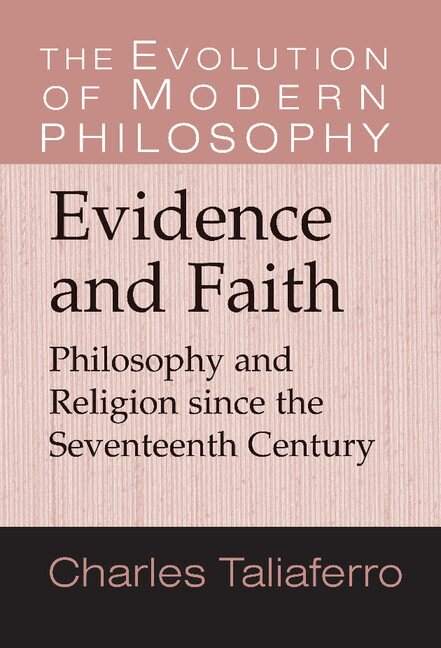
Charles Taliaferro has written a dynamic narrative history of philosophical reflection on religion from the seventeenth century to the present, with an emphasis on shifting views of faith and the nature of evidence. The book begins with the movement called Cambridge Platonism, which formed a bridge between the ancient and medieval worlds and early modern philosophy. While the book provides a general overview of different movements in philosophy, it also offers a detailed exposition and reflection on key arguments. The scope is broad, from Descartes to contemporary feminist philosophy of religion. Written with clarity and verve, this is a book that will appeal to professionals and students in the philosophy of religion, religious studies, and the history of ideas, as well as informed lay readers.
485 kr
Skickas inom 7-10 vardagar
Charles Taliaferro has written a dynamic narrative history of philosophical reflection on religion from the seventeenth century to the present, with an emphasis on shifting views of faith and the nature of evidence. The book begins with the movement called Cambridge Platonism, which formed a bridge between the ancient and medieval worlds and early modern philosophy. While the book provides a general overview of different movements in philosophy, it also offers a detailed exposition and reflection on key arguments. The scope is broad, from Descartes to contemporary feminist philosophy of religion. Written with clarity and verve, this is a book that will appeal to professionals and students in the philosophy of religion, religious studies, and the history of ideas, as well as informed lay readers.
1 060 kr
Skickas inom 7-10 vardagar
This book is concerned with the history of metaphysics since Descartes. Taking as its definition of metaphysics 'the most general attempt to make sense of things', it charts the evolution of this enterprise through various competing conceptions of its possibility, scope, and limits. The book is divided into three parts, dealing respectively with the early modern period, the late modern period in the analytic tradition, and the late modern period in non-analytic traditions. In its unusually wide range, A. W. Moore's study refutes the tired old cliché that there is some unbridgeable gulf between analytic philosophy and philosophy of other kinds. It also advances its own distinctive and compelling conception of what metaphysics is and why it matters. Moore explores how metaphysics can help us to cope with continually changing demands on our humanity by making sense of things in ways that are radically new.