The Johns Hopkins Studies in Development - Böcker
Visar alla böcker i serien The Johns Hopkins Studies in Development. Handla med fri frakt och snabb leverans.
8 produkter
8 produkter
352 kr
Skickas inom 7-10 vardagar
The Agrarian Question and Reformism in Latin America epitomizes the emerging tradition of conflict-oriented approaches to problems of economic, agricultural, and rurual development in Third World nations. Drawing on firsthand observations of the agrarian crises in Argentina, Chile, Colombia, Peru, and ten other Latin-American nations, Alain de Janvry effectively blends Marxist theories of world-wide economic development with empirical analysis and policy recommendations.De Janvry offers both a careful examination of the conditions of underdevelopment in Latin America and detailed discussions of the achievements and limits of technological change, land reform, integrated rural development, and basic-needs program. The Agrarian Question and Reformism in Latin America is written for both practitioners and academicians. Students of economic development will benefit especially from its intelligent explication of conflict-oriented theory and technique.
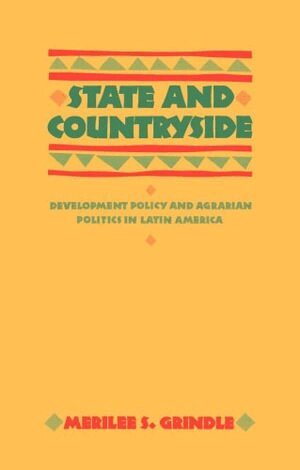
State and Countryside
Development Policy and Agrarian Politics in Latin America
Häftad, Engelska, 1986
410 kr
Skickas inom 5-8 vardagar
What is responsible for the persistance of underdevelopment in rural Latin America? Merilee S. Grindle analyzes the role of public policies in stimulating agrarian change in Latin America from 1940 to 1980. Assessing the cases of Mexico, Colombia, and Brazil, she concludes that state policies aimed at promoting development or reform have played critical and multifaceted roles in shaping current conditions.In focusing specifically on the motivations and actions of state planners and policy makes, Grindle provides an alternative to traditional class analysis. Since 1940, Latin American countries have inervened extensively in rural areas to encourage agricultural modernization and rural development. Attempts to "stimulate economic growth, engender social peace, and expand the influence of the state apparatus," Grindle writes, "are closely linked to efforts by state elites to enhance the sustainability of the regime in power." The state does not automatically reflect and reinforce class relationships, but have "a variable capacity for autonomous decision making and have specific interests to achieve that may bring it into conflict or bargaining relationships with dominant class interests in society."State prescriptions for agricultural modernization have been more concerned with productivity than with equity. Moreover, the task of shaping policy is complicated by the fact that previous development policies supported the emergence of a small class of agrarian entrepreneurs who acquired the economic and political power to demand continued favorable treatment from the state. When policies such as agrarian reform and rural development are promoted, Grindle indicates, they are utilized primarily to increase social control and manage political protest rather than to redistribute land or improve living standards among the rural poor.
385 kr
Tillfälligt slut
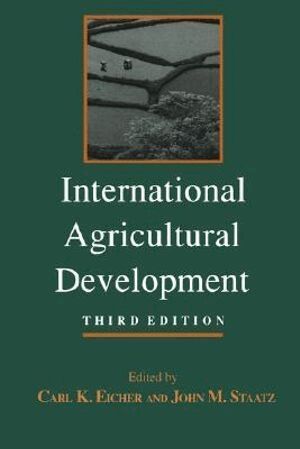
What are the food and agricultural development problems facing Third World nations? Does current economic theory help accelerate growth? Does it foster useful development policies? This book addresses these and other questions to provide a wide-ranging and thorough introduction to the theories, policies, and practices aimed at increasing food production and agricultural development.Individual sections examine recent agricultual prograss in developing nations, including increased production and growing demand; the economic and social theory of agricultural development; and sources of accelerated growth through biochemical and mechanical technologies and improved argicultural institutions. Rural financial markets, cooperatives, and land reform are also examined. Later chapters focus on agricultural research and extention, agricultural marketing, trade, price policies, and planning. A concluding chapter looks at new strategies for accelerating agricultural development.Past decades have seen an explosion of empirical research on Third Wolrd agriculture. This up-to-date, comprehensive overview will interest not only students of agricultural development in the Third World but also professional in government and international organizations.
Order of Economic Liberalization
Financial Control in the Transition to a Market Economy
Häftad, Engelska, 1993
342 kr
Skickas
Can knowledge of financial policies in developing countries over four decades help the socialist economies of Asia and Eastern Europe become open market economies in the 1990s? In all these countries the loss of fiscal and monetary control has often resulted in high inflation that undermines the liberalization process itself. In the second edition of The Order of Economic Liberalization, Ronald McKinnon builds on his influential work on the liberalization of financial markets in less developed countries and outlines the progression necessary to move from a "repressed" to an open economy. New to this edition are chapters that contrast the gradual Chinese approach to liberalizing domestic and foreign trade with the "big bang" approach followed by some Eastern European countries and republics of the former Soviet Union. Financial control and macroeconomic stability, McKinnon argues, are more critical to a successful transition than is any crash program to privatize state-owned industrial assets and the banking system.
427 kr
Skickas inom 7-10 vardagar
Combining theory, empirical evidence, institutional analysis, and policy evaluation, the second edition of Money, Interest, and Banking in Economic Development provides a comprehensive overview of the role of monetary and financial economics in developing countries. Maxwell Fry includes new chapters on finance in endogenous growth models, foreign direct investment and the accumulation of foreign debt, and fiscal activities of central banks in developing countries.
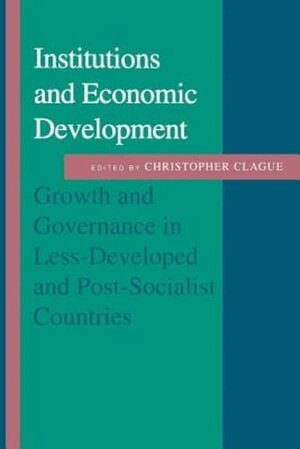
Institutions and Economic Development
Growth and Governance in Less-Developed and Post-Socialist Countries
Häftad, Engelska, 1997
384 kr
Skickas inom 7-10 vardagar
The puzzles of economic development and post-communist transitions, according to Christopher Clague and his colleagues, can be illuminated by a serious economic analysis of institutions. Economic performance is strongly dependent on the economic policies selected and on the manner in which these policies are implemented by government agencies. Performance is also affected by property rights and contract enforcement mechanisms in the business community and by patterns of participation in community organizations. These and other institutional arrangements are analyzed in this book under the rubric of the New Institutional Economics. Christopher Clague brings together a distinguished group of economists and political scientists to address the determinants and consequences of international differences in economic and political institutions. After reviewing the intellectual landscape of the New Institutional Economics and other contributions, the authors present new evidence that international differences in property rights and contract enforcement help to explain differences in income, investment, and growth.Additional topics include the effects of democratic political institutions on economic performance, the determinants of success or failure in community organization, the institutional challenges facing formerly communist societies, and the use of the economics of information to improve government administrative performance. The book will be of interest to both scholars and development practitioners. Contributors include economists Christopher Clague, Robert Klitgaard, Peter Murrell, Mancur Olson, Vernon Ruttan, and Vito Tanzi, and political scientists Stephan Haggard, Margaret Levi, and Elinor Ostrom.
449 kr
Skickas inom 7-10 vardagar
Extensively revised to reflect the new directions in development thought and policy, this new edition of a classic text examines what has been learned theoretically and empirically about agricultural and rural economic development since the 1950s. With 24 of the 35 chapters completely new, the book takes into account recent developments in international agricultural development, especially as these affected the role of the state, markets, and other institutions in development. The authors address three basic questions about agricultural development in low- and middle-income countries: What are the strategic roles of agriculture in national development strategies? How can the agrarian transformation be accelerated? How can rural economic development be promoted to generate jobs and reduce poverty in rural areas? In addressing these questions, the authors deal with topics such as market failures, food insecurity, rural poverty, environmental degradation, income and asset inequality, fiscally sustainable organizations, the changing roles of the public and private sector in research, and input and output marketing systems.Four case studies (China, Indonesia, Colombia, and Sub-Saharan Africa) examine how different countries struggle with these issues as they restructure their basic economic institutions.
441 kr
Skickas inom 5-8 vardagar
In Good Government in the Tropics, Judith Tendler questions widely prevailing views about why governments so often perform poorly and about what causes them to improve. Drawing on a set of four cases involving public bureaucracies at work under the direction of an innovative state government in Brazil, the book offers findings of significance to the current debates about organization of the public-sector workplace, public service delivery, decentralization, and the interaction between government and civil society. The case chapters represent four different sectors, each traditionally spoken for by its distinct experts, literatures, and public agnecies-rural preventive health, small enterprise development, agricultural extension for small farmers, and employment-creating public works construction and drought relief. With findings that cut across these sectoral boundaries, the book raises questions about the policy advice proferred by the international donor community.It shifts the terms of the prevailing debate away from mistrust of government toward an understanding of the circumstances under which public servants become truly committed to their work and public service improves dramatically.