The Johns Hopkins University series on Entrepreneurship – serie
Visar alla böcker i serien The Johns Hopkins University series on Entrepreneurship. Handla med fri frakt och snabb leverans.
5 produkter
5 produkter
2 002 kr
Skickas inom 7-10 vardagar
Scholars and policy makers have long recognized entrepreneurship as a powerful engine of economic growth. There is clear evidence, however, that when it comes to social entrepreneurship, policy attention has not been matched by growth in scholarly research. This volume illustrates the type of empirical effort that must take place for the field to advance.The authors review the latest research in the field and then address the many challenges - heterogeneous institutions, geographies and cultures, fast evolving practices, the lack of reliable large datasets, and fragmented theory building that have hampered the development of this research. In many ways, the fundamental questions relating to the rationale and definitions of social entrepreneurship are still very much a work in progress. The main characteristics emerging from the theoretical and empirical discussions in this volume exemplify such complexity. This volume will inspire future researchers to pursue cross-disciplinary theory building, with the aim of building on what we already know and resolving what remains controversial. It will also help researchers think creatively about how their work can inform practice and policy making through the initial design of the research model.This book offers an empirical approach to social entrepreneurship, that researchers, students and policy makers will find invaluable.Contributors: A.-K. Achleitner, N. Auch, H. Aygören, S. Bacq, A.V. Bruno, J.F.G. Bunders, E.D. Carlson, J.E. Clarkin, P. Heister, J.R. Kickul, A. Kroeger, K. Lambrich, S.H. Lee, J. Maas, M. Meyskens, M. Nordqvist, P.H. Phan, A.A. Seferiadis, W. Spiess-Knafl, C. Weber, J.L. Woolley, M.B.M. Zweekhorst
1 836 kr
Skickas inom 7-10 vardagar
Academic entrepreneurship is a multifactorial and multidimensional phenomenon. This book presents research featuring aspects of academic entrepreneurship at the regional, institutional, and organizational levels of analysis. Phillip H. Phan and the authors illustrate that the more interesting aspects of this subject are in the 'tails of the distribution,' where counter-intuitive findings from the data call simple theories into question and inspire a vigorous discussion of alternatives.This edited collection covers a variety of topics including, but not limited to:corporate governance of innovationtechnology commercialization in pharmaceuticals and life sciencesinstitutional impediments to technology development and economic growtheconomic impact of universitiesacademic labor markets and technology commercialization<.li>translational research and developmenttechnology commercialization in regenerative medicine.The contributors also consider the relative value of general versus specific human capital development and the implications for entrepreneurship and wealth creation.The audience for this book comprises PhD students, new scholars in technology commercialization research, university technology transfer office personnel, economic development specialists and policymakers, and students studying the management of technology.Contributors: D. Balkin, S. Berry, A.J. Bock, B. Bradley, R. Cawley, B. Chatot, J.A. Cunningham, S. Deely, J. DeFelice, I. Dibua, D. Ding, G.R. Djavanshir, A. Dobos, M. Duffy, H. Ener, M. Guerrero, K. Hazelbach, W. Hefley, H. Hoang, H. Hu, D. Johnson, M. Kearns, M. Kiniry, B.K. Lee, K.T. Lim, R. Magath, G. Markman, M. Meoli, M. Michaels, S. Paruchuri, P.H. Phan, A. Rosenbaum, C. Rosenfeld, S.Y.Sohn, J. Somma, R. Strouse, D. Urbano, Z. Venema, S. Vismara, C. Weber, J. Yang
1 954 kr
Skickas inom 7-10 vardagar
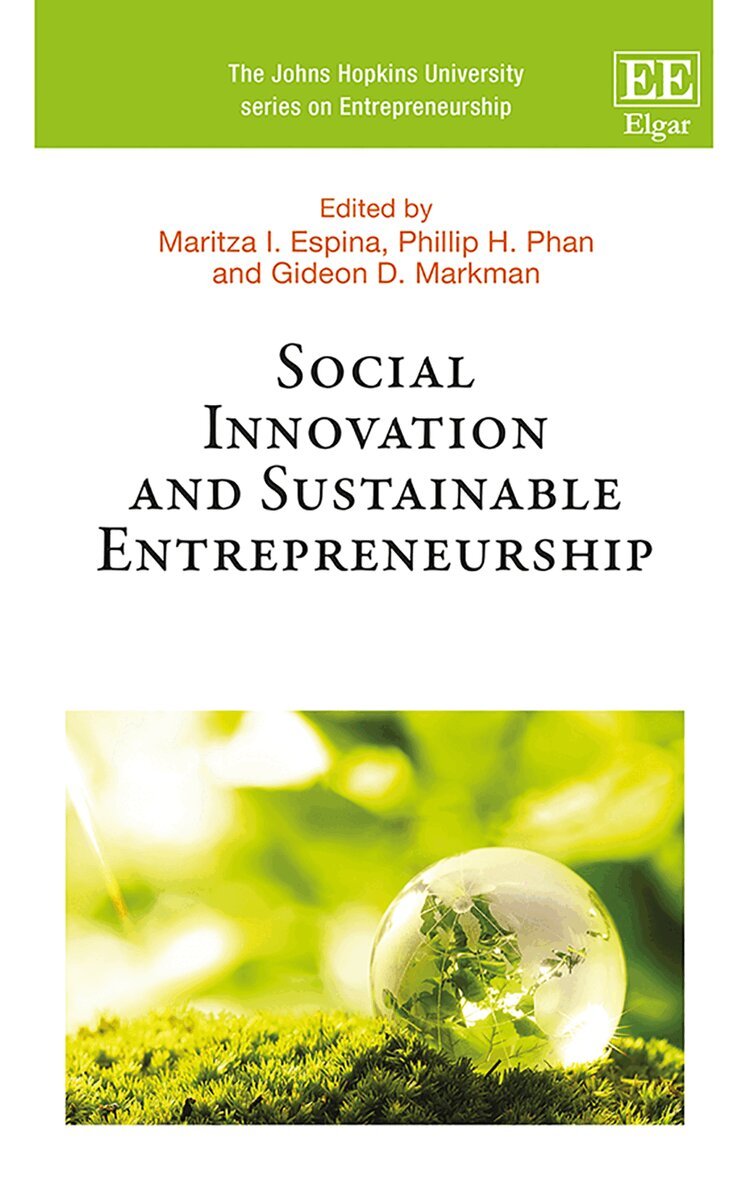
The rapid and formative rise in research on social innovation and entrepreneurship means that theoretical frameworks are still being created, while traditional notions of economic efficiency and social welfare are tested. The field is progressing fastest in the measurement and measuring of social entrepreneurial effectiveness. Social innovators, who draw from philanthropy, as well as capital markets, for financial resources, have adopted the lean start up as a paradigm for their organization logics. This collection showcases the myriad emerging philosophical, methodological, and theoretical approaches, many of which are led by practitioners. It is organized into five sections. The first section reports on theoretical approaches to researching sustainable entrepreneurship that are less familiar. The second section reports on research focusing on the entrepreneurial responses to problems of climate change. The third and fourth sections report on research investigating social entrepreneurial processes, and how opportunities are formed and exploited. The fifth section reports on the ethical dimensions of social innovation.Researchers, scholars, educators and policymakers will find this book a useful reference, with novel ideas for future research and discourse.Contributors include: S.G.S. Abdelgawad, P. Bruner, R. Cortina-Cruz, M. Cortina-Mercado, R. Defiebre-Muller, P.F. Diochon, A.G. Earle, H.D. Fountaine, R. Harrison, R.T. Herko, K. Joensuu, K. Kaesehage, L. Katz, M. Leyshon, S. Lopez-Palau, M. Mäkelä, S.D. Ocampo, T. Onkila, M. Pasquini, B. Rivera-Cruz, M.A. Tietz, Y.W. Turell, D. van der Horst, F.I. Viola, D. Windsor, M. Zhang
1 778 kr
Skickas inom 7-10 vardagar
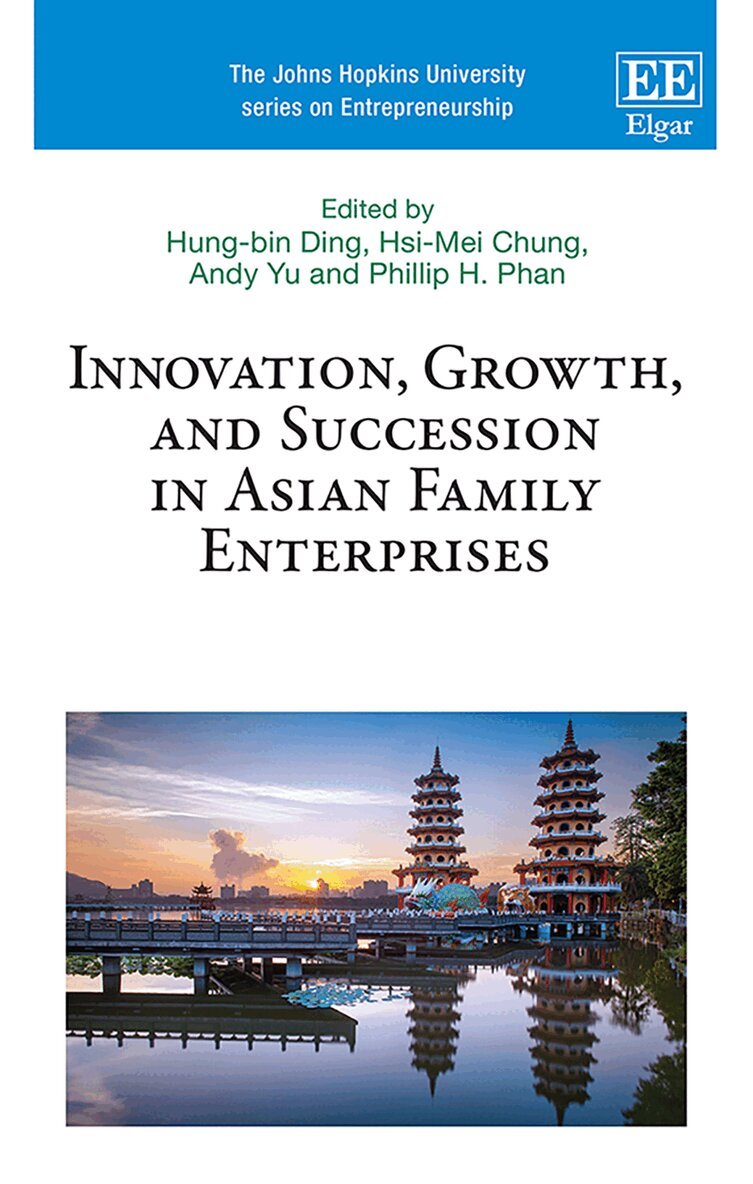
The scope and depth of family business research have been quickly expanding in the last two decades. The editors and contributors to this book present eight recent studies examining the impact of external or internal family conditions on the innovation, growth, and succession of family firms in Asia.By examining the influence of families on firm behaviors and decisions, researchers have been pushing the boundaries of this field. As researchers develop a better understanding of how families influence their businesses, the family conditions, including the properties and dynamics of families, have been found to play significant roles in the business decisions. In addition, globalization as a pressing issue has brought new opportunities and challenges to families and their businesses. This volume comprises diverse topics, including less commonly examined issues such as kinship, immigrant family enterprises, and family asset management. This book is a rich resource for researchers, students, and family business consultants.
2 948 kr
Skickas inom 7-10 vardagar
Research on general market entry usually focuses on large enterprises. Often, however, small entrants can alter the competitive dynamics of an industry. This volume brings together the most prominent thought leaders and the best research on the asymmetric entrant-incumbent dynamics. The ideas presented offer a more nuanced perspective on how, when, where and with what consequences small, single-product firms enter markets that are dominated by large, multiproduct and multimarket incumbents. Large enterprises often enjoy a number of advantages that young, small ventures (as well as matured, but still small firms) lack. These differences manifest not only in how large and small firms operate and in their resource-capability mix, but also in how they compete and interact with each other. Research on general market entry and competitive dynamics is extensive yet it focuses on entrants and incumbents that are of similar profile - similar size, comparable asset mixes, related product strategies, and equivalent organizational capabilities. The unique contribution of this volume is its concentration on asymmetric entrant-incumbent dynamics. Scholars and students in entrepreneurship, strategy, international business and related fields will find this excellent collection of key published and original material illuminating.