Understanding Statistics - Böcker
Visar alla böcker i serien Understanding Statistics. Handla med fri frakt och snabb leverans.
5 produkter
5 produkter
596 kr
Skickas inom 5-8 vardagar
The Philosophy of Quantitative Methods focuses on the conceptual foundations of research methods within the behavioral sciences. In particular, it undertakes a close philosophical examination of a variety of quantitative research methods that are prominent in (or relevant for) the conduct of research in these fields. By doing so, the deep structure of these methods is examined in order to overcome the non-critical approaches typically found in the existing literature today.In this book, Brian D. Haig focuses on the more well-known research methods such as exploratory data analysis, statistical significant testing, Bayesian confirmation theory and statistics, meta-analysis, and exploratory factor analysis. These methods are then examined with a philosophy consistent of scientific realism. In addition, each chapter provides a helpful Further Reading section in order to better assist the reader in extending their own thinking and research methods specific to their needs.
438 kr
Skickas inom 5-8 vardagar
This is a title in our Understanding Statistics series, which is designed to provide researchers with authoritative guides to understanding, presenting and critiquing analyses and associated inferences. Each volume in the series demonstrates how the relevant topic should be reported -- including detail surrounding what can be said, and how it should be said, as well as drawing boundaries around what cannot appropriately be claimed or inferred. This volume addresses an important issue for the design of survey instruments, which is rarely taught in graduate programs beyond those specifically for statisticians. Item Response Theory is used to describe the application of mathematical models to data from questionnaires and tests as a basis for measuring abilities, attitudes, or other variables. It is used for statistical analysis and development of assessments, often for high stakes tests such as the Graduate Record Examination. The author is known for her clear, accessible writing; like all books in this series, this volume includes examples of both good and bad write-ups for methods sections of journal articles.
486 kr
Skickas inom 5-8 vardagar
This is a title in our Understanding Statistics series, which is designed to provide researchers with authoritative guides to understanding, presenting and critiquing analyses and associated inferences. Each volume in the series demonstrates how the relevant topic should be reported -- including detail surrounding what can be said, and how it should be said, as well as drawing boundaries around what cannot appropriately be claimed or inferred. This volume addresses reliability, which is a fundamental aspect of any social science study that involves educational or psychological measurement. It not only has implications for the quality of test scores themselves,but also any statistical analysis conducted using those scores. Topics addressed in this book include cover three different types of reliability methods and appropriate standard errors of measurement: classical test theory methods, decision consistency indices, and generalizability theory coeffcients. After a brief introduction to the topic, the author outlines how to report reliability in professional journal articles. Meyer is known for his clear, accessible writing; like all books in this series, this volume includes examples of both good and bad write-ups for methods sections of journal articles.
454 kr
Skickas inom 5-8 vardagar
Exploratory Factor Analysis (EFA) has played a major role in research conducted in the social sciences for more than 100 years, dating back to the pioneering work of Spearman on mental abilities. Since that time, EFA has become one of the most commonly used quantitative methods in many of the social sciences, including psychology, business, sociology, education, political science, and communications. To a lesser extent, it has also been utilized within the physical and biological sciences. Despite its long and widespread usage in many domains, numerous aspects of the underlying theory and application of EFA are poorly understood by researchers. Indeed, perhaps no widely used quantitative method requires more decisions on the part of a researcher and offers as wide an array of procedural options as EFA does. This book provides a non-mathematical introduction to the underlying theory of EFA and reviews the key decisions that must be made in its implementation. Among the issues discussed are the use of confirmatory versus exploratory factor analysis, the use of principal components analysis versus common factor analysis, procedures for determining the appropriate number of factors, and methods for rotating factor solutions. Explanations and illustrations of the application of different factor analytic procedures are provided for analyses using common statistical packages (SPSS and SAS), as well as a free package available on the web (Comprehensive Exploratory Factor Analysis). In addition, practical instructions are provided for conducting a number of useful factor analytic procedures not included in the statistical packages.
436 kr
Skickas inom 5-8 vardagar
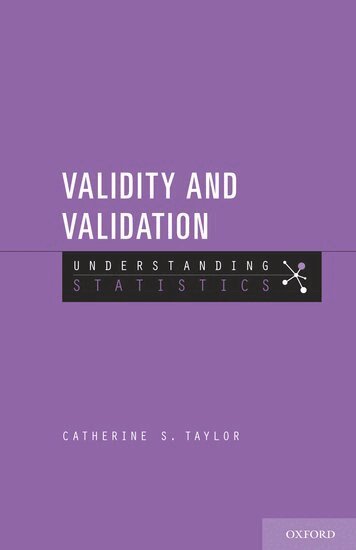
The Understanding Research series focuses on the process of writing up social research. The series is broken down into three categories: Understanding Statistics, Understanding Measurement, and Understanding Qualitative Research. The books provide researchers with guides to understanding, writing, and evaluating social research. Each volume demonstrates how research should be represented, including how to write up the methodology as well as the research findings. Each volume also reviews how to appropriately evaluate published research. Validity and Validation is an introduction to validity theory and to the methods used to obtain evidence for the validity of research and assessment results. The book pulls together the best thinking from educational and psychological research and assessment over the past 50 years. It briefly describes validity theory's roots in the philosophy of science. It highlights the ways these philosophical perspectives influence concepts of internal and external validity in research methodology, as well as concepts of validity and reliability in educational and psychological tests and measurements. Each chapter provides multiple examples (e.g., research designs and examples of output) to help the readers see how validation work is done in practice, from the ways we design research studies to the ways we interpret research results. Of particular importance is the practical focus on validation of scores from tests and other measures. The book also addresses strategies for investigating the validity of inferences we make about examinees using scores from assessments, as well as how to investigate score uses, the value implications of score interpretations, and the social consequences of score use. With this foundation, the book presents strategies for minimizing threats for validity as well as quantitative and qualitative methods for gathering evidence for the validity of scores.