• Fri frakt över 249 kr
  • •
  • Snabba leveranser
  • •
  • Billiga böcker
Kundservice

Du är på sajten för privatpersoner.

Företag, bibliotek eller offentlig verksamhet?

Du handlar på classic.bokus.com, där alla dina funktioner finns intakta.
Till classic.bokus.com
Bokus logotyp. Gå till startsidan.
  • Erbjudanden
  • Nyheter
  • Student
  • Topplistor
  • Barn & ungdom
  • Bokus Play
  • E-böcker
  • Pocketböcker
  • Spel & pussel

10% rabatt på allt med kod: NYSTART10 →

Sidfot

Mina sidor

    Hjälp

    • Kundservice
    • Vanliga frågor och svar
    • Frakt och leverans
    • Retur vid ångerrätt
    • Reklamera vara
    • Betalning
    • Köpvillkor
    • Allmänna villkor
    • Information om webbplatsens tillgänglighet

    Om Bokus

    • Om oss
    • Pressrum
    • För studenter
    • För företag
    • För bibliotek och offentlig verksamhet
    • För leverantörer
    • Hållbarhet

    Populärt

    • Aktuella erbjudanden
    • Presentkort
    • Studentlitteratur
    • Nya böcker
    • Topplistor
    • Signerade böcker
    • Engelska böcker

    Inspiration

    • Boktips
    • BookTok
    • Populära bokserier
    • Barnbokskaraktärer
    • Populära författare
    Logotyp för Bokus
    Följ oss på Facebook (extern länk)Följ oss på Instagram (extern länk)Följ oss på YouTube (extern länk)Följ oss på TikTok (extern länk)
    bokus @ CookiesAnpassa cookiesIntegritetspolicyKöpvillkor
    Till Citymail hemsida (extern länk)Till Budbee hemsida (extern länk)Till Postnord hemsida (extern länk)Till Schenker hemsida (extern länk)Till Early Bird hemsida (extern länk)Till Walleys hemsida (extern länk)
    1. Filosofi och religion
    2. Filosofi
    3. Filosofiska discipliner

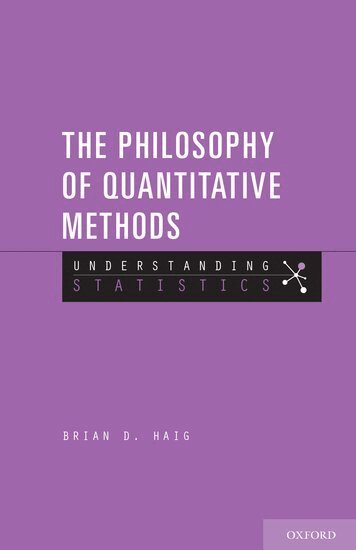
    The Philosophy of Quantitative Methods

    Understanding Statistics

    AvBrian D. Haig

    Häftad, Engelska, 2018

    Del i serien Understanding Statistics

    851 kr

    Beställningsvara. Skickas inom 5-8 vardagar. Fri frakt över 249 kr.

    Beskrivning

    The Philosophy of Quantitative Methods focuses on the conceptual foundations of research methods within the behavioral sciences. In particular, it undertakes a close philosophical examination of a variety of quantitative research methods that are prominent in (or relevant for) the conduct of research in these fields. By doing so, the deep structure of these methods is examined in order to overcome the non-critical approaches typically found in the existing literature today.In this book, Brian D. Haig focuses on the more well-known research methods such as exploratory data analysis, statistical significant testing, Bayesian confirmation theory and statistics, meta-analysis, and exploratory factor analysis. These methods are then examined with a philosophy consistent of scientific realism. In addition, each chapter provides a helpful Further Reading section in order to better assist the reader in extending their own thinking and research methods specific to their needs.

    Produktinformation

    • Utgivningsdatum:2018-03-15
    • Mått:211 x 137 x 12 mm
    • Vikt:277 g
    • Format:Häftad
    • Språk:Engelska
    • Serie:Understanding Statistics
    • Antal sidor:168
    • Förlag:OUP USA
    • ISBN:9780190222055

    Utforska kategorier

    • Filosofiska discipliner inom Filosofi och religion
    • Psykologisk metod inom Psykologi och pedagogik
    • Beteendeteori inom Psykologi och pedagogik

    Mer om författaren

    Brian D. Haig is a Professor in the Department of Psychology at the University of Canterbury. He has published extensively on the conceptual foundations of behavioral research methods. He is the author of Investigating the Psychological World (MIT Press, 2014) and, with Colin W. Evers, Realist Inquiry in Social Science (Sage, 2016). He is a Fellow of the Association for Psychological Science and the New Zealand Psychological Society.

    Innehållsförteckning

    • Chapter 1: Introduction Chapter 2: Exploratory Data Analysis Chapter 3: Tests of Statistical Significance Chapter 4: Bayesianism Chapter 5: Meta-Analysis Chapter 6: Exploratory Factor Analysis Chapter 7: Conclusions