Urban Development - Böcker
Visar alla böcker i serien Urban Development. Handla med fri frakt och snabb leverans.
5 produkter
5 produkter
Financing Transit-Oriented Development with Land Values
Adapting Land Value Capture in Developing Countries
Häftad, Engelska, 2015
283 kr
Skickas inom 10-15 vardagar
Cities in developing countries are experiencing unprecedented urban growth. Unfortunately, this is often accompanied by the negative impacts of sprawl as a result of rapid motorisation such as congestion, air pollution, greenhouse gas emissions, inefficient use of energy and time, and unequal accessibility. As these cities are often under severe fiscal constraints, they face great challenges in financing capital-intensive mass transit systems to reverse the course of these negative trends. Development-based land value capture (DBLVC) financing schemes being practiced in Asian megacities like Hong Kong SAR, China, and Tokyo have helped them not only to generate funds for transit investment and operational and maintenance costs but also to promote sustainable urban development through transit-oriented development (TOD).Many rapidly growing cities in developing countries have the conditions for introducing DBLVC - namely, strong economic growth, rising real incomes, and increased motorisation and congestion levels - all of which cause land value appreciation within proximity of transit stations or corridors. If adapted well to local contexts, DBLVC schemes have great potential to become an important strategic apparatus of urban finance and planning for cities in developing countries. Through a careful analysis of various case studies, this book provides strategies, policies, and methodologies that policy makers and practitioners can apply in developing their own DBLVC schemes for transit financing.
Regenerating Urban Land
A Practitioner's Guide to Leveraging Private Investment
Häftad, Engelska, 2016
329 kr
Skickas inom 10-15 vardagar
Regenerating Urban Land draws on the experience of eight case studies from around the world. The case studies outline various policy and financial instruments to attract private sector investment in urban regeneration of underutilized and unutilized areas and the requisite infrastructure improvements. In particular, each case study details the project cycle, from the scoping phase and determination of the initial amount of public sector investment, to implementation and subsequent leveraged private-sector funds. This manual analyzes rates of return on the investments and long-term financial sustainability. Regenerating Urban Land guides local governments to systematically identify the sequence of steps and tasks needed to develop a regeneration policy framework, with the participation of the private sector. The manual also formulates specific policies and instruments for expanding private sector participation; structuring effective administrative and legal frameworks; utilizing land readjustment/assembly methods; determining duration of contracts, adequate phasing, and timeline; and balancing the distribution of risk and sustainability measures.
382 kr
Skickas inom 10-15 vardagar
As many cities in East Asia and the Pacific prosper, some urban dwellers are left behind lacking access to housing, services, jobs and social equality.
382 kr
Skickas inom 10-15 vardagar
Solid waste management affects every person in the world. By 2050, the world is expected to increase waste generation by 70 percent, from 2.01 billion tonnes of waste in 2016 to 3.40 billion tonnes of waste annually. Individuals and governments make decisions about consumption and waste management that affect the daily health, productivity, and cleanliness of communities. Poorly managed waste is contaminating the world's oceans, clogging drains and causing flooding, transmitting diseases, increasing respiratory problems, harming animals that consume waste unknowingly, and affecting economic development. Unmanaged and improperly managed waste from decades of economic growth requires urgent action at all levels of society.What a Waste 2.0: A Global Snapshot of Solid Waste Management to 2050 aggregates extensive solid aste data at the national and urban levels. It estimates and projects waste generation to 2030 and 2050. Beyond the core data metrics from waste generation to disposal, the report provides information on waste management costs, revenues, and tariffs; special wastes; regulations; public communication; administrative and operational models; and the informal sector.Solid waste management accounts for approximately 20 percent of municipal budgets in low-income countries and 10 percent of municipal budgets in middle-income countries, on average. Waste management is often under the jurisdiction of local authorities facing competing priorities and limited resources and capacities in planning, contract management, and operational monitoring. These factors make sustainable waste management a complicated proposition; most low- and middle-income countries, and their respective cities, are struggling to address these challenges.Waste management data are critical to creating policy and planning for local contexts. Understanding how much waste is generated--especially with rapid urbanization and population growth--as well as the types of waste generated helps local governments to select appropriate management methods and plan for future demand. It allows governments to design a system with a suitable number of vehicles, establish efficient routes, set targets for diversion of waste, track progress, and adapt as consumption patterns change. With accurate data, governments can realistically allocate resources, assess relevant technologies, and consider strategic partners for service provision, such as the private sector or nongovernmental organizations.What a Waste 2.0 provides the most up-to-date information available to empower citizens and governments around the world to effectively address the pressing global crisis of waste.
430 kr
Skickas inom 7-10 vardagar
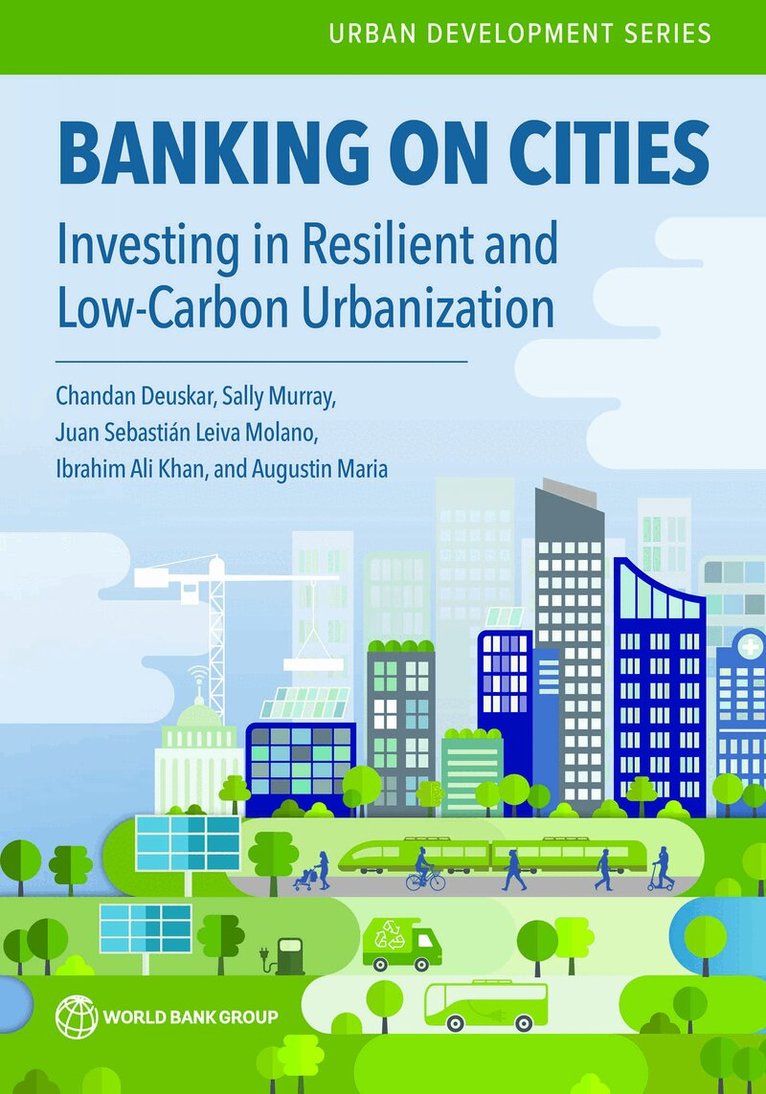
This report estimates the costs of key resilient and low-carbon urban investments in all low- and middle-income countries up to 2050. It discusses how cities can reduce the cost of these investments through efficient investment, and explores which sources of funding and finance are suited to which types of urban investments.