Vanderbilt Issues in Higher Education - Böcker
Visar alla böcker i serien Vanderbilt Issues in Higher Education. Handla med fri frakt och snabb leverans.
8 produkter
8 produkter
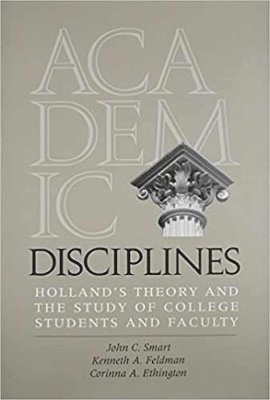
Academic Disciplines
Holland's Theory and the Study of College Students and Faculty
Inbunden, Engelska, 2000
1 098 kr
Skickas inom 5-8 vardagar
Using as a framework the "theory of careers" developed by John L. Holland, the authors of this volume examine the patterns of student stability and change inherent in the college experience, as well as the variations in professional attitudes and behaviors of college faculty. Their goal is to learn more about what colleges and universities might do to facilitate the retention, satisfaction, and learning of their students.For example, why should faculties split over student-oriented teaching strategies, one group favoring the formal, structured classroom, the other a freer, more spontaneous environment? Why do some undergraduates become independent thinkers with strong analytical, mathematical, and scientific competencies while others develop powerful interpersonal and group leadership skills?Holland's theory--at its core a person-environment fit theory--assumes that there are six personality types and six analogous academic environments and that the educational persistence, satisfaction, and achievement of students are a function of the congruence or "fit" between students and their academic environments. The authors also assume that there are circumstances under which the environments of the major field exert more influence on students than do the students' own personality traits. Applying Holland's theory to distinctive clusters of academic disciplines, the authors have found that the answers to such fundamental questions as those asked above emanate from a basic understanding of the influences of academic disciplines and the manner by which they shape the patterns of thought and behavior of both college students and faculty.Academic Disciplines will benefit researchers and graduate students who study college students and faculty, as well as administrators and policymakers responsible for the performance of colleges and universities.
1 098 kr
Skickas inom 5-8 vardagar
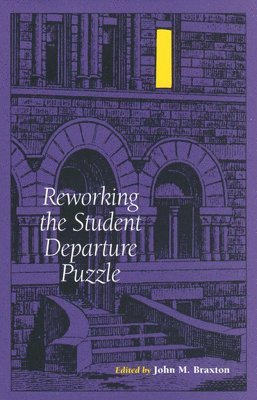
More than a quarter of the students who enter four-year institutions and half of those who enter two-year schools depart at the end of their first year. This phenomenon is known as the ""departure puzzle,"" and for years, the most important body of work on student retention has come from sociologist Vincent Tinto. In Reworking the Student Departure Puzzle, leading scholars of the college student experience - including Tinto himself - reevaluate Tinto's interactionalist perspective, which holds that students unable to connect with either the academic or social subsystems of their institutions are likely to leave. Recent critiques of this theory have indicated the need for either its serious revision or the development of a new theory altogether. The contributors to this volume offer a variety of both theoretical and methodological perspectives on student departure, with additional chapters covering minority student retention, the link between college choice and student persistence, and the effect of the classroom experience on the student's choice. The recommendations made here will not only reinvigorate research on this important topic but will also lead administrators to better mana
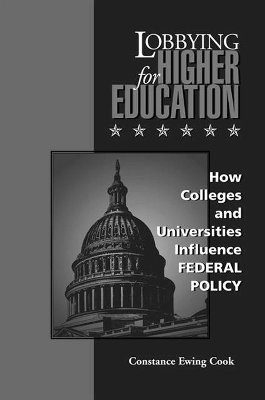
Lobbying for Higher Education
How Colleges and Universities Influence Federal Policy
Inbunden, Engelska, 1998
1 214 kr
Skickas inom 3-6 vardagar
Historically, many faculty and administrators in higher education have regarded themselves as above the fray--part of the national interest, not a special interest--and considered lobbying a dirty business unworthy of their lofty enterprise. Now that academia no longer enjoys all the respect and good will that federal policy makers once afforded it, that attitude has changed. The Republican sweep of the 1994 Congressional elections served as a wake-up call for the higher education community. In response, it made a spirited effort to gain attention for its own policy preferences.Lobbying for Higher Education is about how the major higher education associations and the constituent American colleges and universities try to influence federal policy, especially congressional policy. In clear prose Cook explains how the higher education community organizes itself in Washington, how it lobbies, and how its major interest groups are perceived both by their own members and by public officials. The book focuses on the crucial development in 1995-1996 of a new lobbying paradigm, which included the greater use of campus-based resources and ad hoc coalitions. The most engrossing part of its story is higher education's creative response to the policy turmoil and disruption of the status quo that resulted from the shift in congressional party control.The author, Constance Cook, uses sources unique to this project: over 1,500 survey responses from college and university presidents (a 62% return rate) and nearly 150 interviews with institutional and association leaders. Fortuitously, the 1994 electoral upheaval provided her with an opportunity to capture, analyze, and interpret the responses of her subjects in a period of unusually sweeping change.Lobbying for Higher Education is a timely book with an interesting and important story at its core.
1 098 kr
Skickas inom 5-8 vardagar
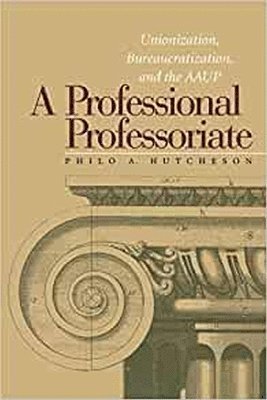
Starting with the question "How have professors and educational institutions responded to pressures to be professional yet act bureaucratically," Philo Hutcheson uses federal and AAUP records and surveys and blends historical research and sociological analysis to develop a full understanding of the problem. With the dramatic expansion of the professoriate following World War II came increasing tensions between the professor's perceived traditional status as an autonomous professional on the one hand and new role as a bureaucrat subject to institutional authority and responsible for departmental and committee assignments on the other. In this increasingly conflicted realm, the AAUP functioned as a key intermediary, dealing with such issues as tenure, salary, contracts, and even faculty strikes. Hutcheson examines how tensions between the requirements of institutional bureaucracies and the norms of the academic profession resulted in contentiousness and conflict within the national AAUP, between administrators and faculty members on individual campuses, within the ranks of faculties themselves, and even deep in the consciences of many concerned individuals. The book analyzes the association's ability to respond effectively and to balance the values of collegial representation with the powers of collective bargaining. It thus offers a detailed and authoritative examination of the AAUP's search for ways to sustain professionalism while dealing with the fundamental changes in the nature of the professoriate in the post-World War II era.
Creating Contexts for Learning and Self-Authorship
Constructive-Developmental Pedagogy
Inbunden, Engelska, 2000
1 214 kr
Skickas inom 3-6 vardagar
In her thoughtful and innovative new book, Marcia B. Baxter Magolda writes of "bridging the worlds between educator and students." There is perhaps no task more fundamental to effective teaching and learning. All too often a distinct gap develops or cannot be overcome between instructor and student, one that leaves each struggling to understand the other's position. The professional quest for principles of structure and process that can help close this divide is both evolving and unending. This book is intended to help college faculty create conditions in which students learn to construct knowledge in their disciplines and achieve self-authorship. A significant, and often overlooked, dimension mediating learning and self-authorship centers on learners' ways of knowing, or their assumptions about the nature, limits, and certainty of knowledge. A learner who assumes that all knowledge is certain expects to hear answers from an authority figure; in contrast, a learner who views knowledge as relative expects to explore multiple viewpoints. By taking a constructive-developmental approach, Baxter Magolda demonstrates how students' ability to construct knowledge is intertwined with the development of their assumptions about knowledge itself and their role in creating it. She shows how the structure of constructive-developmental teaching hinges on three principles: validating students' ability to know, situating learning in students' experience, and defining learning as teachers and students mutually constructing meaning. Unlike most of the literature on the subject, this book takes abstract pedagogical principles and translates them into practical methods. By observing four semester-length college courses in mathematics, zoology, human development, and education and intensively interviewing students and their instructors, Baxter Magolda provides much-needed, concrete principles that will lead to valuable improvements in the classroom environment. With an enhanced level of understanding of the teaching-learning relationship, professors will be able to teach better, and students will be able to learn better, thus preparing them to meet the demands inherent in adulthood and preparing them to take an active role in creating a better society. Those actively involved in higher education, whether college faculty or students in graduate programs, as well as anyone focused on education in general will find much of interest in this book.
556 kr
Skickas inom 5-8 vardagar
Starting with the question "How have professors and educational institutions responded to pressures to be professional yet act bureaucratically," Philo Hutcheson uses federal and AAUP records and surveys and blends historical research and sociological analysis to develop a full understanding of the problem. With the dramatic expansion of the professoriate following World War II came increasing tensions between the professor's perceived traditional status as an autonomous professional on the one hand and new role as a bureaucrat subject to institutional authority and responsible for departmental and committee assignments on the other. In this increasingly conflicted realm, the AAUP functioned as a key intermediary, dealing with such issues as tenure, salary, contracts, and even faculty strikes. Hutcheson examines how tensions between the requirements of institutional bureaucracies and the norms of the academic profession resulted in contentiousness and conflict within the national AAUP, between administrators and faculty members on individual campuses, within the ranks of faculties themselves, and even deep in the consciences of many concerned individuals. The book analyzes the association's ability to respond effectively and to balance the values of collegial representation with the powers of collective bargaining. It thus offers a detailed and authoritative examination of the AAUP's search for ways to sustain professionalism while dealing with the fundamental changes in the nature of the professoriate in the post-World War II era.
590 kr
Skickas inom 5-8 vardagar
At the end of the eighteenth century, just eighteen colleges existed in the United States, with an average enrollment of fewer than seventy. One hundred years later, over 450 American colleges and universities boasted enrollments up more than one hundredfold. The role of educational institutions in the life of the nation had been utterly transformed.As the bridge between the two eras, the nineteenth-century college has been among the most controversial subjects in the history of American higher education. While earlier historians portrayed the "old-time" college as an impediment to modernization, later scholars affirmed the broad role of the colleges in the education of the American people.The American College in the Nineteenth Century combines the best recent scholarship with an interpretive introduction to provide a fresh view of the development of American colleges. The contributors consider these institutions within four new contexts: first, the dramatic transformation in the college students' experience from oppressive discipline to relative freedom; second, the regional variations among the developing American colleges (for example, a South dominated by state colleges, a Midwest by denominational schools); third, the revolution in the century's third quarter as colleges became multipurpose institutions; and fourth, universities that became dominant by the end of the century, incorporating rather than displacing the colleges.Innovative in its examination of the nature and function of these uniquely American institutions, The American College in the Nineteenth Century is a vital addition to the scholarship of the period.Contributors: David B. Potts, Leon Jackson, Julie Ann Bubolz, Michael Sugrue, James Findlay, Margaret A. Nash, Peter Dobkin Hall, James Turner, Paul Bernard, and Willard J. Pugh.
Creating Interdisciplinarity
Interdisciplinary Research and Teaching among College and University Faculty
Inbunden, Engelska, 2001
1 098 kr
Skickas inom 5-8 vardagar
Interdisciplinarity, a favorite buzzword of faculty and administrators, has been appropriated to describe so many academic pursuits that it is virtually meaningless. With a writing style that is accessible, fluid, and engaging, Lisa Lattuca remedies this confusion with an original conceptualization of interdisciplinarity based on interviews with faculty who are engaged in its practice. Whether exploring the connections between apparently related disciplines, such as English and women's studies, or such seemingly disparate fields as economics and theology, Lattuca moves away from previous definitions based on the degrees of integration across disciplines and instead focuses on the nature of the inquiry behind the work. She organizes her findings around the processes through which faculty pursue interdisciplinarity, the contexts (institutional, departmental, and disciplinary) in which faculty are working, and the ways in which those contexts relate to and affect the interdisciplinary work. Her findings result in useful suggestions for individuals concerned with the meaning of faculty work, the role and impact of disciplines in academe today, and the kinds of issues that should guide the evaluation of faculty scholarship.