Victorian Architects - Böcker
Visar alla böcker i serien Victorian Architects. Handla med fri frakt och snabb leverans.
6 produkter
6 produkter
503 kr
Skickas inom 7-10 vardagar
This is the first biography of John Francis Bentley (1839-1902), best known as architect of Westminster Cathedral, since his daughter Winefride de l’Hôpital’s Westminster Cathedral and its Architect (1919). Bentley was born in Doncaster, Yorkshire, and went to London to work in the office of Henry Clutton, a distinguished High Victorian architect who became a Roman Catholic in 1856. Bentley also converted, and, after setting up his own practice in 1860, came to be widely recognised as the best Catholic architect of his time. He built comparatively few complete churches, but did extensive work in adding to and furnishing other architects’ churches. He had remarkable skill in the design of woodwork, metalwork, stained glass, and organ cases, all of which are covered in the book. His finest parish church is Holy Rood, Watford, but the climax of his career was the commission in 1894 to design Westminster Cathedral, which was almost complete when he died in 1902.
488 kr
Skickas inom 7-10 vardagar
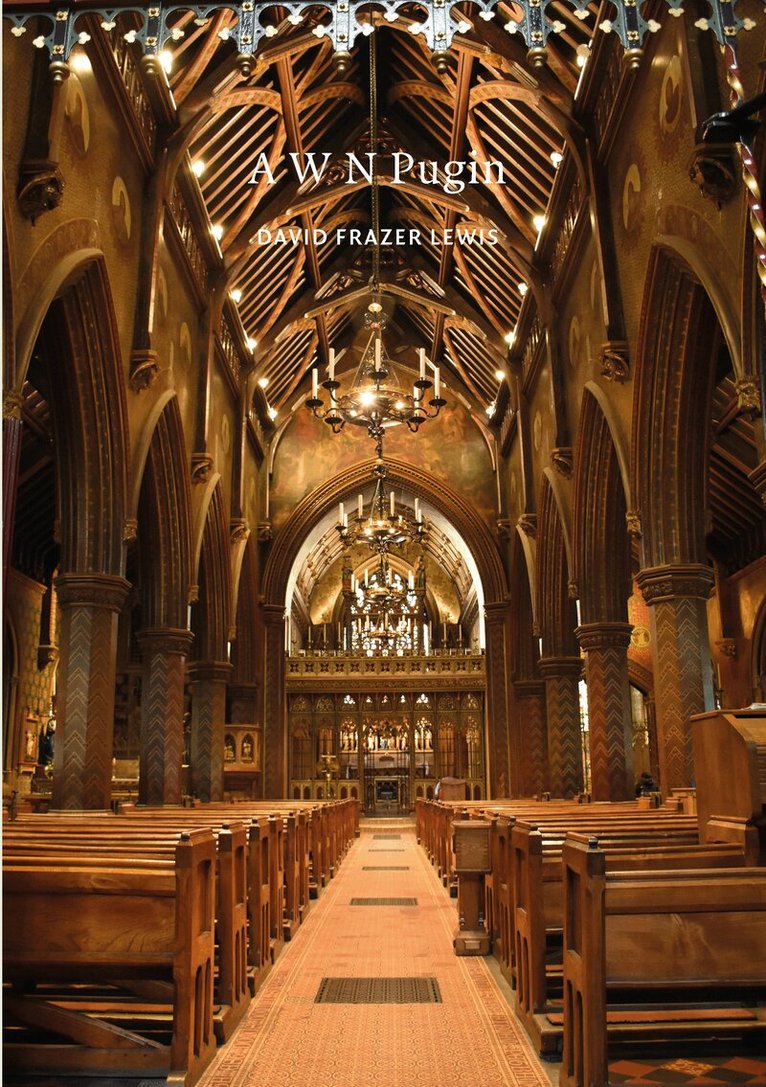
A.W.N. Pugin transformed the Gothic Revival from an architectural style into an international movement. He decorated and furnished the Houses of Parliament, creating one of the icons of modern British identity in the process. His church designs were vastly influential, and although he was staunchly Roman Catholic, he did much to set the aesthetic tone of modern Anglicanism. The house he designed for himself at Ramsgate transformed the Victorian Gothic villa, demonstrating the ways a thoroughly modern house could draw integral lessons from the Middle Ages. And although his whole ideal was woven around a conception of English identity, his influence was international. Architects in the United States, northern Europe, and across the British Empire followed his lead, drawing from elements of his aesthetic and ideals, and in doing so, altered the look and feel of the nineteenth-century city. Despite the popularity of Pugin’s work, this is the first single-volume overview of his architecture to be published since 1971. It summarises much new scholarship and provides a good introduction to his career as well as new insight for those who might already be familiar with it.
591 kr
Skickas inom 7-10 vardagar
This is the first monograph of George Edmund Street, a prolific High Victorian architect of churches and other buildings, the best known of which is the Royal Courts of Justice (the Law Courts). He was born in Essex and, after being articled in Winchester, worked in the office of George Gilbert Scott before setting out on his own account. His earliest works were in Cornwall, but he went on to design many churches, parsonages and schools in Oxfordshire, Berkshire and Buckinghamshire, having been appointed Oxford diocesan architect. Moving to London opened up commissions far and wide, as far north as Aberdeenshire, and also abroad. He paid great attention to the fittings and furnishings of his churches, taking a particular detailed interest in stained glass and embroidery. He was renowned for always completing all his own drawings personally, to the frustration of his pupils and assistants, including Philip Webb and Norman Shaw, who successively became his chief assistant before branching out on their own. His early death at the age of 57 is often attributed to the strain of building the Law Courts, which were completed after his death.Geoff Brandwood, who died suddenly in November 2021, was the author of monographs on Sharpe, Paley & Austin and on Temple Moore. He was a former chairman of the Victorian Society.2024 marks the 200th anniversary of the birth of George Edmund Street.
445 kr
Skickas inom 7-10 vardagar
Part of a generation that came to prominence in the 1860s, the ‘rogue architects’ are a byword for Victorian Gothic at its most wayward and flamboyant. Their work ranges from town halls to country houses and from hotels to churches. It has drawn much attention, both from contemporary observers and 20th century commentators, such as Harry Goodhart-Rendel (who coined the term), Ian Nairn and John Summerson. But much about the rogues’ architecture – its inspiration, their aims, why they built where and how they did and why it caused such a stir – has been poorly understood until now. Based on extensive primary research and presenting a lot of material never published before, this book presents comprehensive studies of three of rogue architecture’s most important exponents – Robert Lewis Roumieu, Joseph Peacock and Bassett Keeling. Their careers, although all very different, provide valuable insights into a rich and complex episode in British architectural history. These studies are prefaced by an introductory chapter, which places them in context and looks at the numerous other architects who stand comparison with them, not only throughout Britain but also in France and America. It is handsomely illustrated with new photographs and archive material, including drawings from the RIBA Collection.
445 kr
Skickas inom 7-10 vardagar
Matthew Digby Wyatt (1820-77) was a polymath – architect, administrator, designer, writer and connoisseur. From his role as project manager to the Great Exhibition of 1851 to his final years advising the South Kensington Museum on its collections, he played a key part in mid-Victorian developments in architecture, design and museum display. He worked with leading figures of his time, including I. K. Brunel, George Gilbert Scott, Herbert Minton and Henry Cole. Owen Jones was his lifelong friend.This is the first full-length study of Wyatt’s work. It includes detailed discussion of his work at the Crystal Palace (in Hyde Park and at Sydenham), at Paddington Station, and in the design of the India Office in Whitehall, now part of the Foreign Office. It also assesses his writings and book designs. All these achievements are set in the context of the shifting energies and debates of his age, to which he made a distinctive and enduring contribution.
445 kr
Skickas inom 7-10 vardagar
Edwin Rickards was the most flamboyant of Edwardian architects: his buildings were said by John Summerson to fizz like champagne. During a short working life, launched at the age of 25 by winning the competition to design Cardiff City Hall with his partners H.V. Lanchester and James Stewart, he completed four spectacular baroque buildings.Rickards’ work was unique in Edwardian architecture for his personal combination of French and especially Austrian sources. Working closely with H.C. Fehr and Henry Poole, leading practitioners of the New Sculpture, he designed two of the major monuments of the period. As well as being one of the best freehand draughtsmen in London, he was also a prodigious caricaturist. With a foot in the demi-monde and an endless appetite for architectural and personal adventure, Rickards was an unforgettable figure to everyone who met him.Illustrated throughout with stunning new photography by Robin Forster and by Rickards’ own sketches and drawings, this book portrays his close friendship with the novelist Arnold Bennett who described him, along with H.G Wells, as one of ‘the two most interesting, provocative, and stimulating men I have yet encountered’, and his meteoric career that ended with his early death.