Victorian Literature & Culture - Böcker
Visar alla böcker i serien Victorian Literature & Culture. Handla med fri frakt och snabb leverans.
13 produkter
13 produkter
572 kr
Skickas inom 10-15 vardagar
In ""Victorian Connections"", each contributor was asked to write about anything in the Victorian period, with only one proviso: that the essay seek to draw connections with other disciplines, fields, periods, methodologies or authors. The compliment the essays pay to each other - the way they complement each other - lies in their diversity. Another feature of the book is the way it grounds its work in a particular historical and institutional context. That context is then illustrated in the succeeding essays. These essays, at once theoretically literate and historically rigorous, define the shape that Victorian studies will be taking in the immediate future.
854 kr
Skickas inom 10-15 vardagar
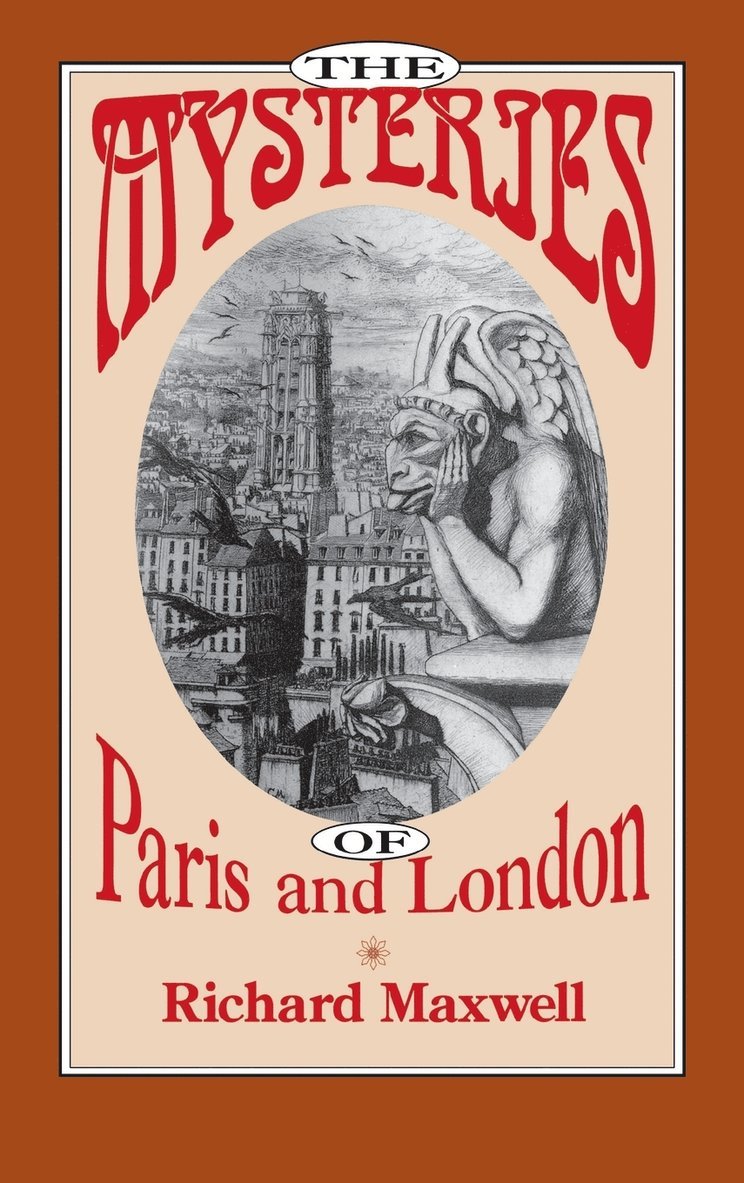
In this study, Richard Maxwell uses 19th-century urban fiction - in particular the novels of Hugo and Dickens - to define a genre: the novel of urban mysteries. His title comes from the ""mystery mania"" that captured both sides of the channel with the runaway success of Eugene Sue's ""Les Mysteres de Paris"" and G.W.M. Reynold's ""Mysteries of London"". He argues that within these extravagant but fact-obsessed narratives the archaic form of allegory became a means for understanding modern cities. Dominant among allegorical figures were labyrinths, panoramas, crowds and paperwork, and it was thought that to understand a figure was to understand the city with which it was linked. Novelists such as Hugo and Dickens were able to use such figures without necessarily mirroring ideology. Drawing from an array of disciplines, ideas and contexts, the book examines allegorical theory from the Renaissance through to the 20th century, journalistic practice, the conventions of scientific inquiry, popular psychiatry, illustration and modernized wonder tales (such as Victorian adaptations of the ""Arabian Nights""). It explores the ability of the written word to produce and present social knowledge.
854 kr
Skickas inom 10-15 vardagar
854 kr
Skickas inom 10-15 vardagar
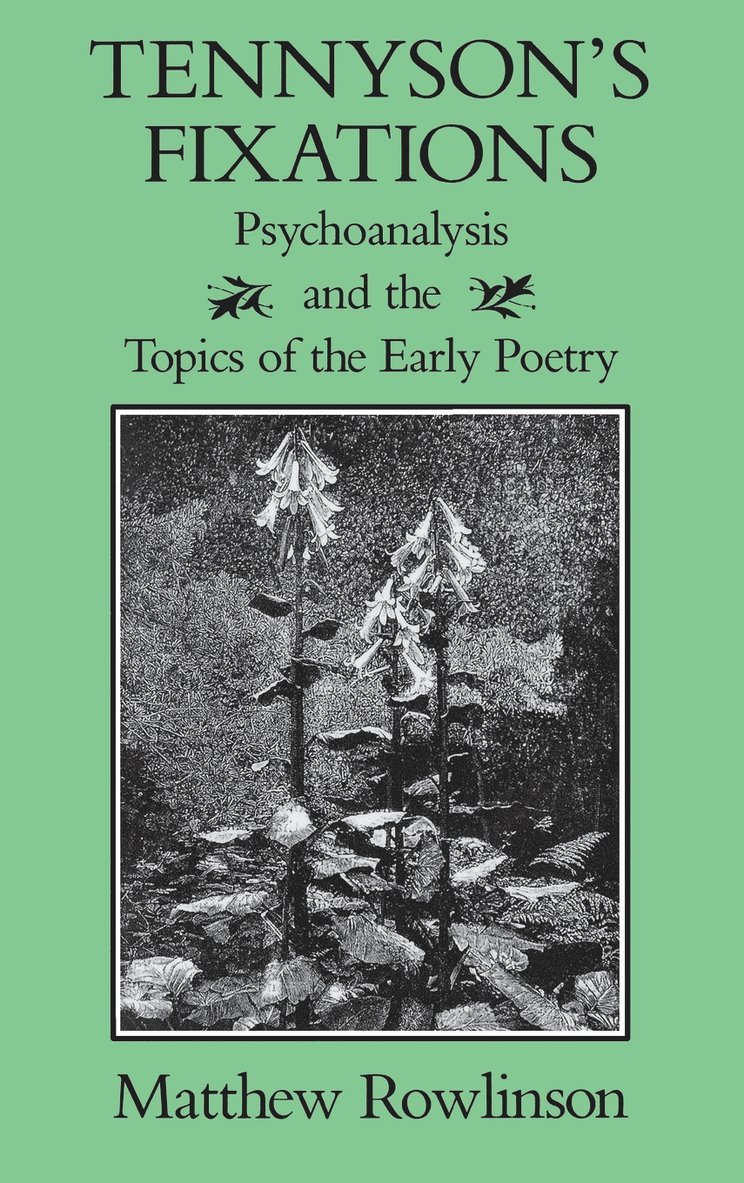
Matthew Rowlinson proposes a revitalized and properly analytic formalism as the appropriate model for a reading of Tennyson. In a series of attentive close readings, he probes the nature of place and the structuring of desire in Tennyson's work. Focusing on the poet's most important early writings - fragments and poems produced between 1824 and 1833 - Rowlinson conflates deconstructive theory with psychoanalytic insights. The author begins by observing that the subjectivities articulated in these poems, from the strangely passive poet-seer of the ""Armageddon"" fragments to the embowered singers of ""Mariana,"" ""The Lady of Shalott,"" and ""The Hesperides"" to the absconding monarch of ""Ulysses,"" are all constituted in relation to ruined, abandoned, or inaccessible places. The placing of the subject allegorizes its relation to the signifier as well as to the discursive structures within which the signifier comes into being. On this premise, Rowlinson takes up Lacan's claim that it is through the signifier that it is through the signifier that all human desire is mediated. In the placement of the subjects he reads a distinctively Tennysonian articulation of desire. Following Paul de Man, Rowlinson demonstrates that allegory comes into being only with a structure of repetition. He has developed a formalist poetics that provides a psychoanalytic account of the most basic figurative and formal devices - allegory, metaphor, rhyme, and metre - and he offers an explication and critique of major concepts in Lacanian and Freudian psychoanalytic theory, including the gaze, the castration complex, the death drive, and the compulsion to repeat. By returning to the deconstruction, the author has resumed the challenges English studies took up in the 1970s and left incomplete in its rush to historicism. His readings offer fresh insights at the level of theory.
1 043 kr
Skickas inom 7-10 vardagar
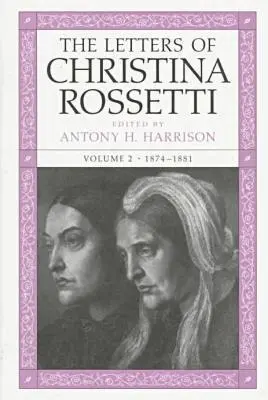
As we have reached the centenary of Christina Rosetti's death, she has become considered as one of the major poets of the Victorian era. Leading critics have demonstrated how studies of Rossetti's work, her daily life, her relationship with the Pre-Raphaelites, and her interactions with other women authors of the period can help the people understand the cultural situation of Victorian women writers. When complete in four volumes, this project will make available all of Rossetti's extant letters. The letters in this second volume ""expose a woman of powerful intellect, complex emotions, unshakeable convictions and loving heart"". Rossetti, 43 years old in 1874, is now an established poet with a strong literary reputation among her contemporaries. But, as Harrison points out in his introduction to the volume, ""two thirds of her life was over, and its losses were mounting"". The marriage of William Michael, the death of her sister, Maria, Dante Gabriel's addiction to chloral and the illness that led to his death in 1882, and the deaths of close personal and family friends overshadow these years. Her own affliction with Graves' disease contributed to her becoming reclusive and a semi-invalid. She nonetheless continued to work and publish.
485 kr
Skickas inom 10-15 vardagar
Every non-canonical male aesthete in Victorian England once competed with what Talia Schaffer calls the female aesthetes, whose critical and popular success made them formidable contemporaries. Not only did these women make significant contributions to the development of feminist ideologies, they pioneered new literary strategies that were incorporated by their canonical successors. In this text, Schaffer analyzes writers such as Lucas Malet (Mary Harrison), Ouida (Marie Louise de la Ramee), Alice Meynell, Rosamund Marriott Watson, Una Ashworth Taylor, Elizabeth Robins Pennell, Mary and Jane Findlater, and John Oliver Hobbes (Pearl Craigie). These women used aestheticism to forge a compromise between the two models of female identity available to them - the New Woman and the Angel in the House. They developed plots, ideas, and styles that would later be adopted, parodied, or revised by canonical writers such as Oscar Wilde, Virginia Woolf, Thomas Hardy and Henry James. They used the ""pretty"" language of aestheticism as a strategic cover behind which they could attempt radical experiments, many of which prefigure modernist innovations. Talia Schaffer hopes that recovering the lost work of the female aesthetes will force us to reconsider the central tenets of late-Victorian literary theory.
705 kr
Skickas inom 7-10 vardagar
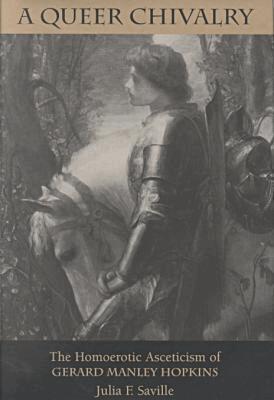
The Jesuit poet Gerard Manley Hopkins was a practitioner of strict asceticism in its broadest definition - the refusal of physical pleasure or comfort in the interests of moral or spiritual gain. As a result, his commentators have felt obliged to take a stand approving or disapproving of this rigorous self-discipline. Many idealize his allegiance to the Society of Jesus as motivated by his determination to conquer his attraction to other men, and thus as the source of the spiritual strength from which his eucharistic and Christological verse derived. Others decry his monasticism as the regrettably oppressive regimen from which he was able to escape only occasionally through his sensuous, sometimes overtly homoerotic verse. Julia F. Saville uses Lacanian theories of sublimation and courtly love to reconfigure this long-standing rift in the field of Hopkins criticism. This study displaces hagiographic interpretations of the poet's life, arguing that Hopkins's poetics of homoerotic asceticism shaped his work in such a way that his career should be viewed not as a steady linear progression but as an ongoing process of negotiating his desire. It also constitutes a map tracing the alternating practices of self-discipline and self-indulgence, self-expression and self-silencing performed by Hopkins's verse. The result is a reading of asceticism that does not advocate or condemn its practice. What is needed, Saville argues, is a reading that explains first the dialectic capacity of asceticism both to constrain and to liberate, to cause discomfort and to give satisfaction, and second, the ethical value of recognizing and encouraging this dialectical operation.
1 051 kr
Skickas inom 3-6 vardagar
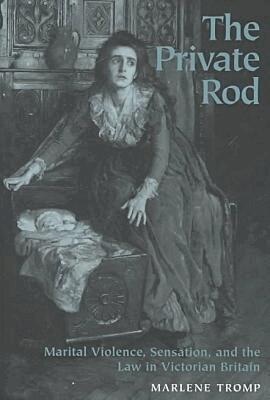
Sensation novels, a genre characterized by scandalous narratives, and emotionally and socially provocative dialogue and plots, had their heyday in England in the 1860s and 1870s, in the midst of growing concern about codes of behaviour in marriage. Largely excluded from the academic canon of the late 20th century, sensation novels had an impact on Victorian culture that we have only recently begun to evaluate. Exploring the central metaphor of marital violence in these novels, Marlene Tromp uncovers the relationship between the representations of such violence in fiction and in the law. Her investigation demonstates that sensational constructions of gender, marriage, ""brutal"" relationships and even murder were gradually incorporated into legal debates and realist fiction as the Victorian understanding of what was ""real"" changed. Sensation fiction's reconfiguration of literary and social norms, evident in works by Charles Dickens, Wilkie Collins and Mary Elizabeth Braddon, is also explicitly evoked in the ""realist"" representations of domestic violence in novels by Margaret Oliphant and George Eliot. Despite the apparent gulf between fiction and the law, Tromp explores these texts as mutually constitutive forms through which a major shift in the understanding of domesticity took place. The Victorians responded to marital violence by debating its terms in both Parliament and the circulating libraries, incorporating the language of each realm into the other. By the end of the century, this cross-pollinating conversation threatened the tenuous legal and social fiction of peace and safety in the middle-class home, and new readings of the relationship between domesticity and violence emerged.
854 kr
Skickas inom 10-15 vardagar
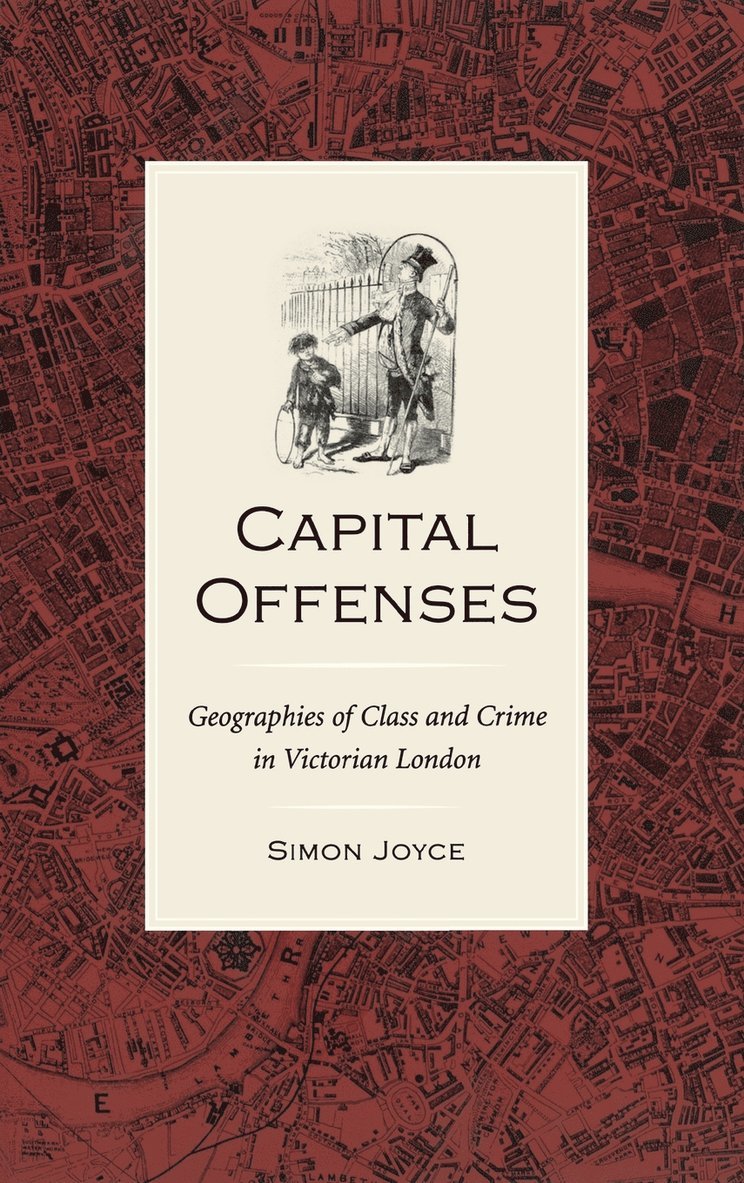
As London became the first major city of the 19th century, new models of representation emerged in the journalism, poetry, fiction and social commentary of the period. Simon Joyce argues that such writing reflected a persistant worry about the problem of crime but was never able to contain it. Such commentators as Wordsworth, Dickens, Mayhew, Stevenson, Conan Doyle, Booth and Wilde all struggled with the same questions about how to represent London and the relations among its varied populations, yet their accounts often undermined one another. Whereas Victorian social science presumed a correlation between criminal activity, geographical residence and social class, the popular literature of the period often sought just as strenuously to deny the link, giving rise to privileged and pathological offenders like Dorian Gray and Dr Jekyll. This is turn shifted attention away from the urban slums that had been the setting for the so-called Newgate novels of the 1830s and 1840s. By 1900, crime appears as a distinctively modern problem, requiring large-scale solutions and government intervention in place of an older approach that was rooted in personal morality or philanthropic paternalism. Illustrating ""literary geography"" - in which physical space is not merely a backdrop for the plot but an integral element in shaping textual meaning - this work reveals how certain geographical patterns can not only give weight to interpretive meanings already suggested in the texts but also enable us to read them in a new and surprising light.
721 kr
Skickas inom 7-10 vardagar
Frances Power Cobbe (1822-1904) is the most important nineteenth-century British writer and activist not heretofore treated in a full-length biography. An independent professional woman, she worked to improve conditions for delinquent girls and for the sick poor, promoted university degrees for women, roused support for the Union during the American Civil War, advocated for victims of marital violence, campaigned for women's suffrage, and engaged in a long-running battle with leading physicians decrying the use of animals in medical experiments. She was centrally located among the circle of London intellectuals who engaged the era's significant debates and was a respected religious and moral thinker as well. Bridging the gap between ""high"" and ""low"" journalism, she published in prestigious journals as well as in popular monthly magazines. At long last, Sally Mitchell gives this remarkable woman her due. The only source of information about Cobbe's life has been her 1894 autobiography--and even that is considered by many scholars to be less than forthcoming. Over the past several years, Mitchell has unearthed extensive material by or related to Cobbe.
1 043 kr
Skickas inom 7-10 vardagar
Christina Rossetti (1830-1894) has come to be considered one of the major poets - not just one of the major women poets - of the Victorian era, eclipsing her famous brother. Leading critics have demonstrated how studies of Rossetti's work, her daily life, her relationships with the Pre-Raphaelites, and her interactions with other women authors of the period can help us understand the unique cultural situation of Victorian women writers. The Letters of Christina Rossetti, four volumes, makes available all of Rossetti's extant letters, almost two-thirds of which have never before been published. These letters come from over one hundred private and institutional collections, scattered from Scotland to Australia. The fourth and final volume of the Letters covers the last eight years of Christina Rossetti's life. In 1887 Rossetti, at the age of fifty-six, was living with her two aged, ailing aunts. In addition to managing the household and nursing her aunts, she published an enlarged edition of her collected poems and, in 1892, wrote her greatest book of devotional prose, The Face of the Deep. She also oversaw the production of a new and enlarged edition of Sing-Song, published in 1893. As a stay-at-home semi-invalid, she maintained a very large correspondence with friends and family members. Her most intimate relationship was with her sole remaining sibling, William Michael Rossetti, but other correspondents include Amelia Bernard Heimann, Caroline Gemmer, Frederic Shields, Rose Donne Hake, Olivia Garnett, Ellen Proctor, Lisa Wilson, Arthur Symons, and Mackenzie Bell, who became her first biographer. In these letters we discover Rossetti's views on subjects as diverse as the artistry of her poems, her health, aging, death, gender roles, money, cats, flowers, games, and her own supposed sinfulness. In May of 1892 Christina Rossetti was diagnosed with breast cancer. The cancer was removed, but she suffered a recurrence in September 1894 and died on December 29th of that year.
645 kr
Skickas inom 7-10 vardagar
Although the cultural and literary influence of Christina Rossetti has recently been widely acknowledged, the belatedness of this critical attention has left wide gaps in our understanding of her poetic contribution. Often focusing solely on her early work and neglecting her later volumes, many critics minimized her relevance by measuring her stature through either her early poems or her relationships with well-known Victorian literary figures. In Christina Rossetti: The Patience of Style, Constance W. Hassett argues against this diminishment by reopening Rossetti's canon, challenging both critics and readers to trade their silent appreciation of her most familiar verse for a patient and active scrutiny of her body of work, which contains some of the finest lyric poetry of the nineteenth century. Keeping her primary focus on the poems themselves, Hassett traces Rossetti's career through her five poetry collections, Goblin Market and Other Poems (1862), The Prince's Progress and Other Poems (1866), Sing-Song: A Nursery Rhyme Book (1872), A Pageant and Other Poems (1881), and Verses (1893). In a comprehensive account of Rossetti's evolving style and genre, Hassett analyzes the strengths and failures of the poetry, its attention to the resources of rhythm and the shifts of diction, its momentum and reserve, and the rationale for its revision. The book also explores Rossetti's innovative poetry for children, her daring reconfiguration of religion and poetry in a late-life commentary on the Apocalypse, and the influences both of female precursors she admired and outgrew and of the male circle of Pre-Raphaelite poets. For art historians of the Pre-Raphaelites, scholars of women's writing and gender studies, students of children's literature, and researchers in religious studies, not to mention readers in Victorian poetry, Christina Rossetti: The Patience of Style will serve as an indispensable and eye-opening guide.
493 kr
Skickas inom 5-8 vardagar
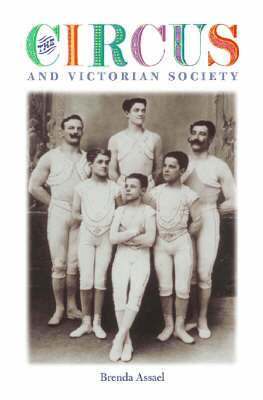
It was during the Victorian era that the circus, whose origins lay in the fairground world, emerged as a commercialized entertainment that we would recognize today. This development was intricately tied to a widespread demand for circus acts by a broad range of classes. In The Circus and Victorian Society, Brenda Assael examines this interest in the circus as an artistic form within the context of a vibrant, and sometimes not so respectable, consumer market. In doing so, she provides not only the first scholarly history of the Victorian circus but also a new view of nineteenth-century popular culture, which has usually been seen as the preserve only of the working class. The Victorian circus ring was a showcase for equestrian battle scenes, Chinese jugglers, clowns, female acrobats, and child performers. Although such acts exhibited wondrous qualities, unabashed displays of physical power, and occasionally subversive humor, Assael reveals how they were also rendered as grotesque, lewd, or dangerous. The consuming public's desire to see the very kinds of displays that reformers wished to regulate put the circus establishment in a difficult position. Wishing to create a respectable reputation for itself while also functioning as a profitable business, the industry was engaged in a struggle that required the appeasement of both the regulator and the consumer. This conflict not only informs us of the complicated role that the circus played in Victorian society but also provides a unique view into a collective psyche fraught by contradiction and anxiety.