W. Hodding Carter III Books – serie
Visar alla böcker i serien W. Hodding Carter III Books. Handla med fri frakt och snabb leverans.
2 produkter
2 produkter
345 kr
Kommande
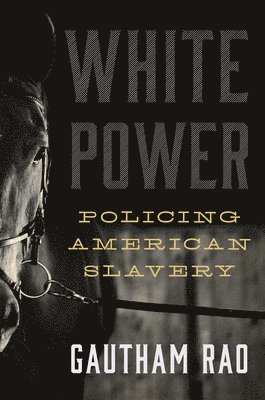
Beginning in the colonial era and growing through the American Revolution and the Southern plantation system, slaveholders’ violent police regime continued after Emancipation, through Reconstruction, to today. Moving across time, space, and place, White Power uncovers how slaveholders created their own white supremacist police and government to deny Black people rights, power, and humanity.Legal historian Gautham Rao introduces us to laws that empowered white people to forcibly exercise their desired racial superiority over Black people, shows how they spread from the South throughout the nation, and traces the rebellions, fugitivity, activism, and legal systems that challenged them. Rao’s narrative includes slaveholders, lawmakers, and the Ku Klux Klan, dramatic escapes by runaway enslaved people, abolitionist activism in courtroom showdowns, and pitched battles between white paramilitaries and enslaved rebels. He offers a new interpretation of the history of policing in the US, centering the institution and legacy of slavery and speaking to the origins of today’s persistence of white vigilance, white supremacist militia groups, and white racist cops determined to maintain power over Black people by force. Equally determined, however, was Black Americans’ refusal to accept it.
389 kr
Kommande
Today’s Supreme Court justices bristle at the label “politicians in robes,” insisting that they operate above the fray of partisan politics. But for the first century of the nation’s history, the Court was unmistakably a political institution, both by design and in practice. Justices were fully expected to engage in partisan politics—there was no concern that such engagement would lead to corruption or undue bias—and they remained deeply involved in civic debate and the electoral process while on the bench. In addition to hearing cases in the capital, each justice spent much of his time “riding circuit” and presiding over federal trial courts. On circuit and in Washington, nineteenth-century justices wrote for partisan newspapers, drafted legislation, advised partisan allies, campaigned for colleagues, and even ran for political offices from the bench. Through these political interactions, members of the Court helped shape debates about the Constitution’s meaning at a time when most Americans did not believe in judicial supremacy. In this sweeping history, Rachel A. Shelden, one of America’s leading voices on the history of the Court, brings readers inside the social and political world of its justices, recovering their essential role in the era’s turbulent politics. She also charts shifts at the turn of the twentieth century, when members of the Court and the legal community refashioned the judiciary as an apolitical institution, setting the stage for an increasingly more powerful—and more isolated—modern Court. The Political Supreme Court is required reading for anyone interested in the legal and political underpinnings of today’s judicial power.