Writing Architecture - Böcker
Visar alla böcker i serien Writing Architecture. Handla med fri frakt och snabb leverans.
19 produkter
19 produkter
304 kr
Tillfälligt slut
289 kr
Tillfälligt slut
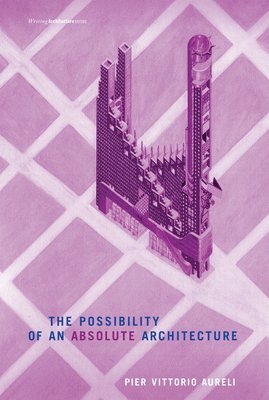
Architectural form reconsidered in light of a unitary conception of architecture and the city.In The Possibility of an Absolute Architecture, Pier Vittorio Aureli proposes that a sharpened formal consciousness in architecture is a precondition for political, cultural, and social engagement with the city. Aureli uses the term absolute not in the conventional sense of "pure," but to denote something that is resolutely itself after being separated from its other. In the pursuit of the possibility of an absolute architecture, the other is the space of the city, its extensive organization, and its government. Politics is agonism through separation and confrontation; the very condition of architectural form is to separate and be separated. Through its act of separation and being separated, architecture reveals at once the essence of the city and the essence of itself as political form: the city as the composition of (separate) parts. Aureli revisits the work of four architects whose projects were advanced through the making of architectural form but whose concern was the city at large: Andrea Palladio, Giovanni Battista Piranesi, Étienne Louis-Boullée, and Oswald Mathias Ungers. The work of these architects, Aureli argues, addressed the transformations of the modern city and its urban implications through the elaboration of specific and strategic architectural forms. Their projects for the city do not take the form of an overall plan but are expressed as an "archipelago" of site-specific interventions.
324 kr
Tillfälligt slut
289 kr
Tillfälligt slut
279 kr
Tillfälligt slut
372 kr
Skickas inom 5-8 vardagar
289 kr
Tillfälligt slut
255 kr
Tillfälligt slut
304 kr
Tillfälligt slut
439 kr
Skickas inom 5-8 vardagar
239 kr
Tillfälligt slut
The first digital turn in architecture changed our ways of making; the second changes our ways of thinking.Almost a generation ago, the early software for computer aided design and manufacturing (CAD/CAM) spawned a style of smooth and curving lines and surfaces that gave visible form to the first digital age, and left an indelible mark on contemporary architecture. But today's digitally intelligent architecture no longer looks that way. In The Second Digital Turn, Mario Carpo explains that this is because the design professions are now coming to terms with a new kind of digital tools they have adopted—no longer tools for making but tools for thinking. In the early 1990s the design professions were the first to intuit and interpret the new technical logic of the digital age: digital mass-customization (the use of digital tools to mass-produce variations at no extra cost) has already changed the way we produce and consume almost everything, and the same technology applied to commerce at large is now heralding a new society without scale—a flat marginal cost society where bigger markets will not make anything cheaper. But today, the unprecedented power of computation also favors a new kind of science where prediction can be based on sheer information retrieval, and form finding by simulation and optimization can replace deduction from mathematical formulas. Designers have been toying with machine thinking and machine learning for some time, and the apparently unfathomable complexity of the physical shapes they are now creating already expresses a new form of artificial intelligence, outside the tradition of modern science and alien to the organic logic of our mind.
267 kr
Tillfälligt slut
388 kr
Skickas
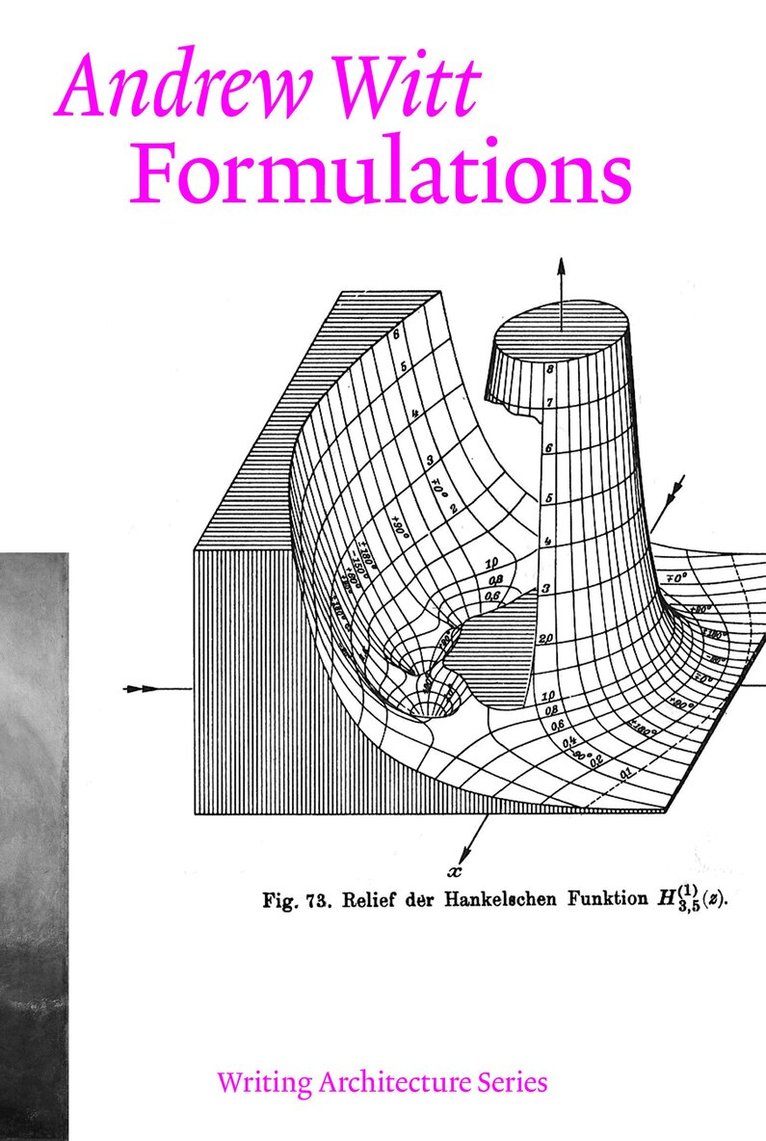
An investigation of mathematics as it was drawn, encoded, imagined, and interpreted by architects on the eve of digitization in the mid-twentieth century.In Formulations, Andrew Witt examines the visual, methodological, and cultural intersections between architecture and mathematics. The linkages Witt explores involve not the mystic transcendence of numbers invoked throughout architectural history, but rather architecture’s encounters with a range of calculational systems—techniques that architects inventively retooled for design. Witt offers a catalog of mid-twentieth-century practices of mathematical drawing and calculation in design that preceded and anticipated digitization as well as an account of the formal compendia that became a cultural currency shared between modern mathematicians and modern architects.Witt presents a series of extensively illustrated “biographies of method”—episodes that chart the myriad ways in which mathematics, particularly the mathematical notion of modeling and drawing, was spliced into the creative practice of design. These include early drawing machines that mechanized curvature; the incorporation of geometric maquettes—“theorems made flesh”—into the toolbox of design; the virtualization of buildings and landscapes through surveyed triangulation and photogrammetry; formal and functional topology; stereoscopic drawing; the economic implications of cubic matrices; and a strange synthesis of the technological, mineral, and biological: crystallographic design. Trained in both architecture and mathematics, Witt uses mathematics as a lens through which to understand the relationship between architecture and a much broader set of sciences and visual techniques. Through an intercultural exchange with other disciplines, he argues, architecture adapted not only the shapes and surfaces of mathematics but also its values and epistemic ideals.
319 kr
Skickas
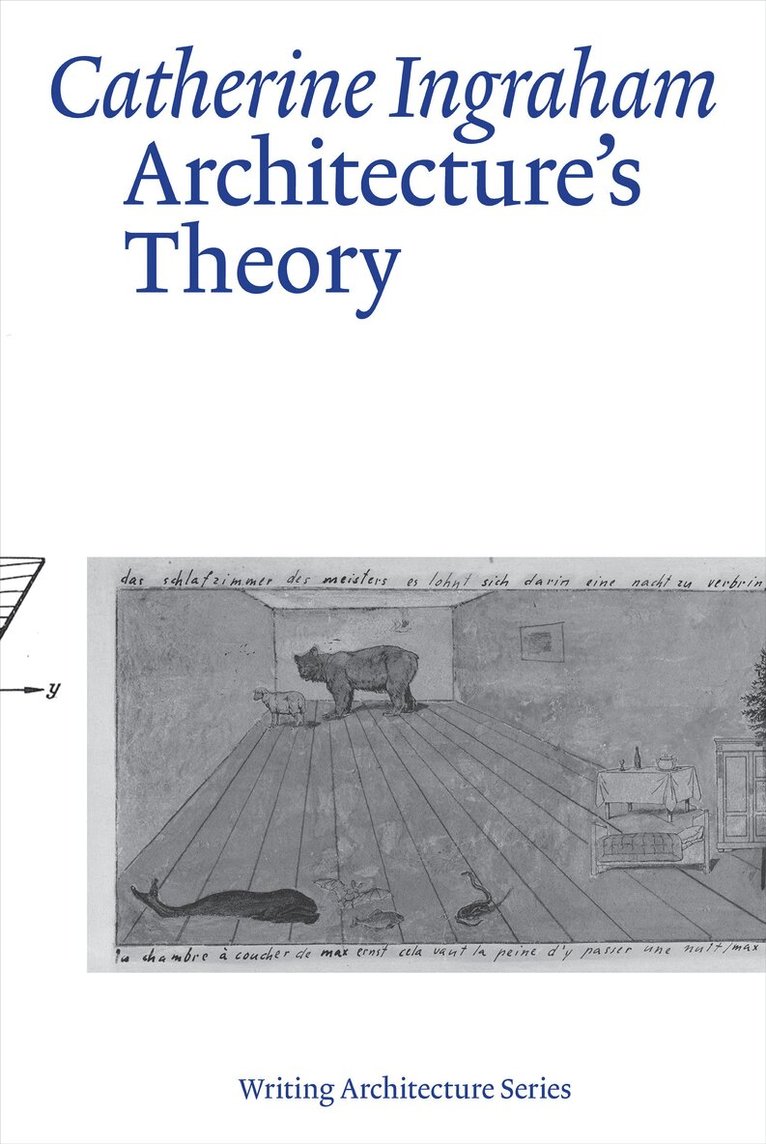
A collection of illuminating essays exploring what theory makes of architecture and what architecture makes of theory in philosophical and materialized contexts.From poststructuralism and deconstruction to current theories of technology and nature, critical theory has long been closely aligned with architecture. In turn, architecture as a thinking profession materializes theory in the form of built work that always carries symbolic loads. In this collection of essays, Catherine Ingraham studies the complex connectivity between architecture's discipline and practice and theories of philosophy, art, literature, history, and politics. She argues that there can be no architecture without theory.Whether considering architecture’s relationship to biomodernity or exploring the ways in which contemporary artists and designers engage in figural play, Ingraham offers provocative interpretations that enhance our understanding of both critical theory and architectural practice today. Along the way, she engages with a wide range of contemporary theorists, including Giorgio Agamben, Judith Butler, Jacques Derrida, Graham Harman, and Timothy Morton, considering buildings around the world, including the Palace of Culture in Warsaw, the Viceroy’s House complex in New Delhi, Mack Scogin and Merrill Elam's Wolfsburg Science Center project in Germany, and the Superdome in New Orleans. Approaching its subject matter from multiple angles, Architecture’s Theory shows how architecture's theoretical and artifactual practices have a unique power to alter culture.
329 kr
Skickas
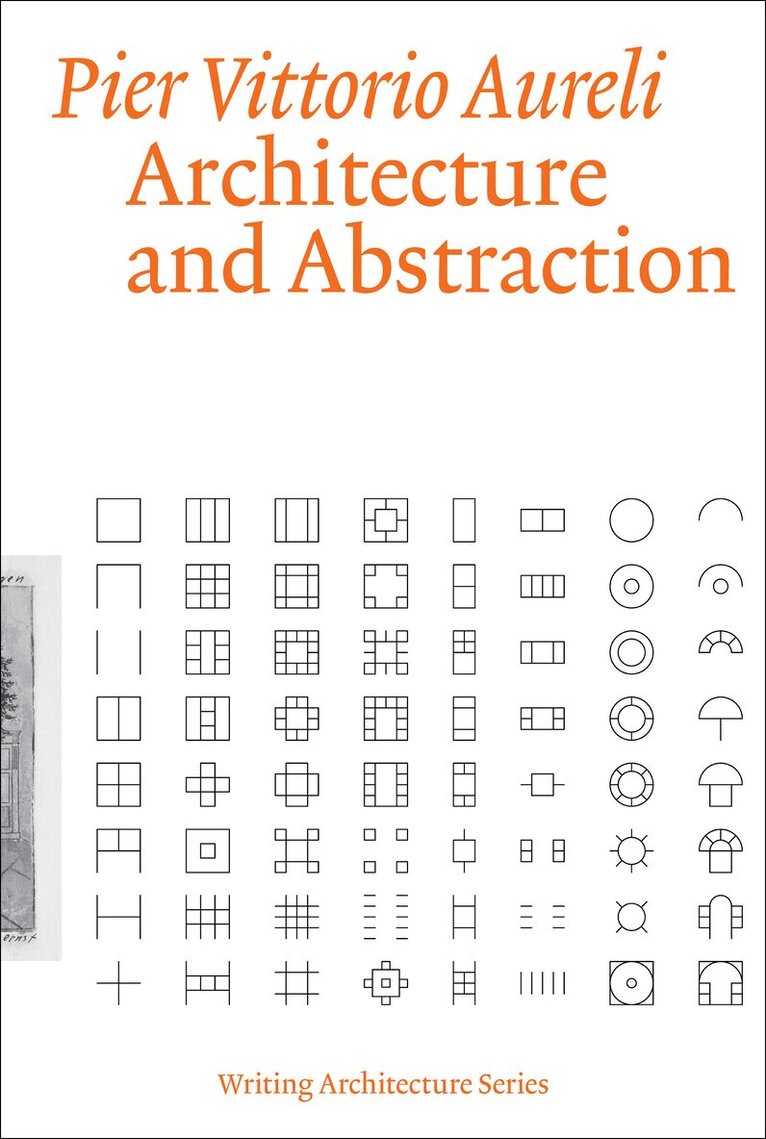
A landmark study of abstraction in architectural history, theory, and practice that challenges our assumptions about the meaning of abstract forms.In this theoretical study of abstraction in architecture—the first of its kind—Pier Vittorio Aureli argues for a reconsideration of abstraction, its meanings, and its sources. Although architects have typically interpreted abstraction in formal terms—the purposeful reduction of the complexities of design to its essentials—Aureli shows that abstraction instead arises from the material conditions of building production. In a lively study informed by Walter Benjamin, Karl Marx, Alfred Sohn-Rethel, and other social theorists, this book presents abstraction in architecture not as an aesthetic tendency but as a movement that arises from modern divisions of labor and consequent social asymmetries. These divisions were anticipated by the architecture of antiquity, which established a distinction between manual and intellectual labor, and placed the former in service to the latter. Further abstractions arose as geometry, used for measuring territories, became the intermediary between land and money and eventually produced the logic of the grid. In our own time, architectural abstraction serves the logic of capitalism and embraces the premise that all things can be exchanged—even experience itself is a commodity. To resist this turn, Aureli seeks a critique of architecture that begins not by scaling philosophical heights, but by standing at the ground level of material practice.
323 kr
Tillfälligt slut
648 kr
Skickas inom 5-8 vardagar
580 kr
Skickas inom 5-8 vardagar
564 kr
Skickas inom 5-8 vardagar