Writings of Herman Melville – Serie
Visar alla böcker i serien Writings of Herman Melville. Handla med fri frakt och snabb leverans.
3 produkter
3 produkter
1 463 kr
Skickas inom 7-10 vardagar
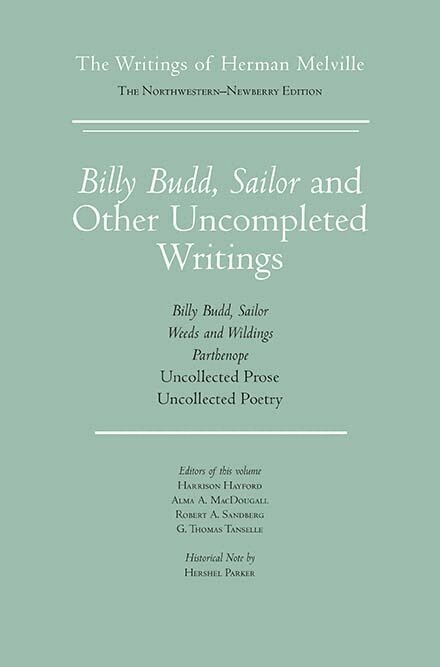
The gripping tale of a handsome and charismatic young sailor who runs afoul of his ship’s master-at-arms, is falsely accused of inciting a mutiny, and hung, Billy Budd, Sailor is often treated as a masterpiece, a canonical work. But that assessment is at least partly founded on the assumption that the story was complete and ready for publication when it was left among the manuscripts on Melville’s writing desk when he died in 1891. As Hershel Parker has pointed out, “It is a wonderfully teachable story—as long as it is not taught as a finished, complete, coherent, and totally interpretable work of art.” Furthering Melville’s goal of getting his last literary projects into print, even in their imperfect forms, this last volume in the edition presents the poetry and prose that Melville was unable to finish, his sometimes ineffectual, sometimes heroic purposes betrayed by death.These unfinished writings include, besides Billy Budd, two projected volumes containing poems and prose pieces, Weeds and Wildings and Parthenope; three prose pieces, “Rammon,” “Story of Daniel Orme,” and “Under the Rose”; and some three dozen poems of varying lengths. Some of these pieces were surely composed late in Melville’s career, during his retirement, but others may date to as early as the 1850s. Except for Billy Budd, many of these works have not been readily available in reliable texts, when available at all.This volume, the result of the editors’ meticulous study of the manuscripts, offers new reading texts, with significant corrections of words, phrases, and titles, the inclusion of heretofore unpublished lines of verse, and the return to their original locations of the two poems, “The Enviable Isles” and “Pausilippo,” that Melville had extracted for use in John Marr (1888) and Timoleon (1891). Hershel Parker’s Historical Note traces how these writings fit into the trajectory of Melville’s career, and the rest of the Editorial Appendix presents the scholarly evidence and decisions made in creating the reading texts. As a whole, the Northwestern-Newberry Edition of The Writings of Herman Melville, now complete in fifteen volumes, offers for the first time the total body of Melville’s extant writings in a critical text, faithful to his intentions.
616 kr
Skickas inom 11-20 vardagar
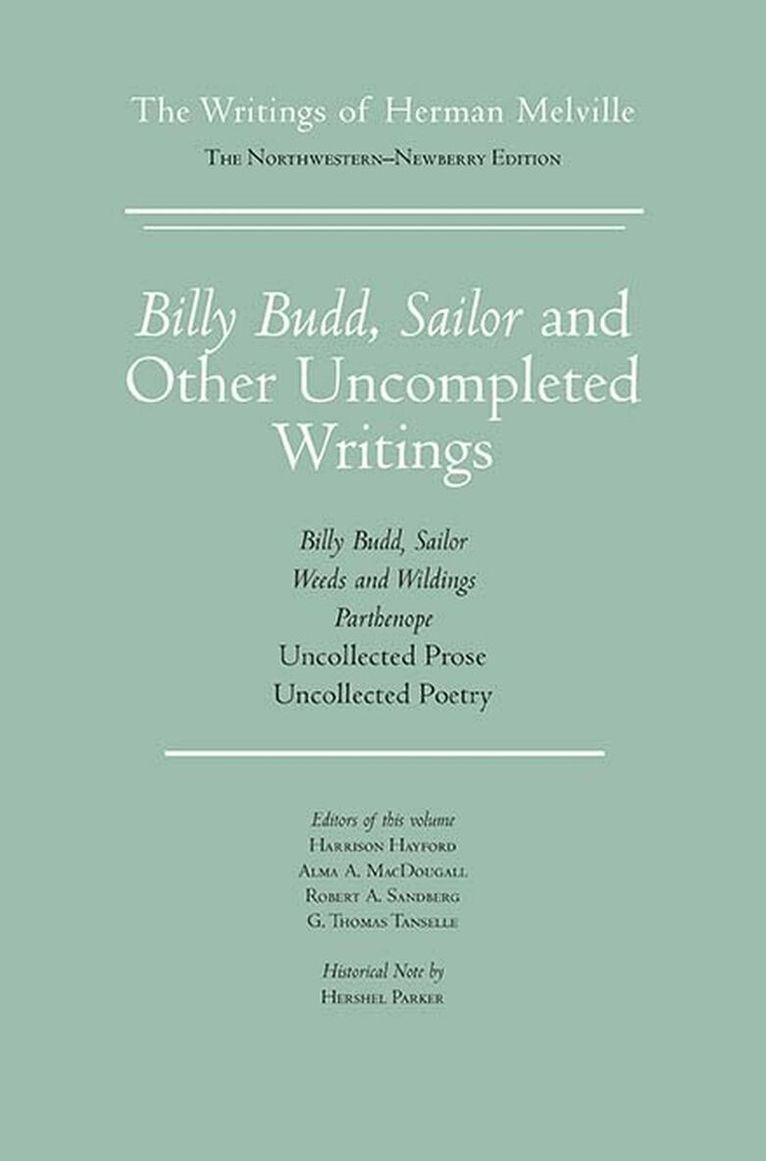
The gripping tale of a handsome and charismatic young sailor who runs afoul of his ship's master-at-arms, is falsely accused of inciting a mutiny, and hung, Billy Budd, Sailor is often treated as a masterpiece, a canonical work. But that assessment is at least partly founded on the assumption that the story was complete and ready for publication when it was left among the manuscripts on Melville's writing desk when he died in 1891. As Hershel Parker has pointed out, -It is a wonderfully teachable story--as long as it is not taught as a finished, complete, coherent, and totally interpretable work of art.- Furthering Melville's goal of getting his last literary projects into print, even in their imperfect forms, this last volume in the edition presents the poetry and prose that Melville was unable to finish, his sometimes ineffectual, sometimes heroic purposes betrayed by death. These unfinished writings include, besides Billy Budd, two projected volumes containing poems and prose pieces, Weeds and Wildings and Parthenope; three prose pieces, Rammon, Story of Daniel Orme, and Under the Rose; and some three dozen poems of varying lengths. Some of these pieces were surely composed late in Melville's career, during his retirement, but others may date to as early as the 1850s. Except for Billy Budd, many of these works have not been available in reliable texts, when available at all. This volume, the result of the editors' meticulous study of the manuscripts, offers new reading texts, with significant corrections of words, phrases, and titles, the inclusion of heretofore unpublished lines of verse, and the return to their original locations of the two poems, The Enviable Isles and Pausilippo, - that Melville had extracted for use in John Marr (1888) and Timoleon (1891). Hershel Parker's Historical Note traces how these writings fit into the trajectory of Melville's career, and the rest of the Editorial Appendix presents the scholarly evidence and decisions made in creating the reading texts. As a whole, the Northwestern-Newberry Edition of The Writings of Herman Melville, now complete in fifteen volumes, offers for the first time the total body of Melville's extant writings in a critical text, faithful to his intentions.
220 kr
Skickas inom 7-10 vardagar
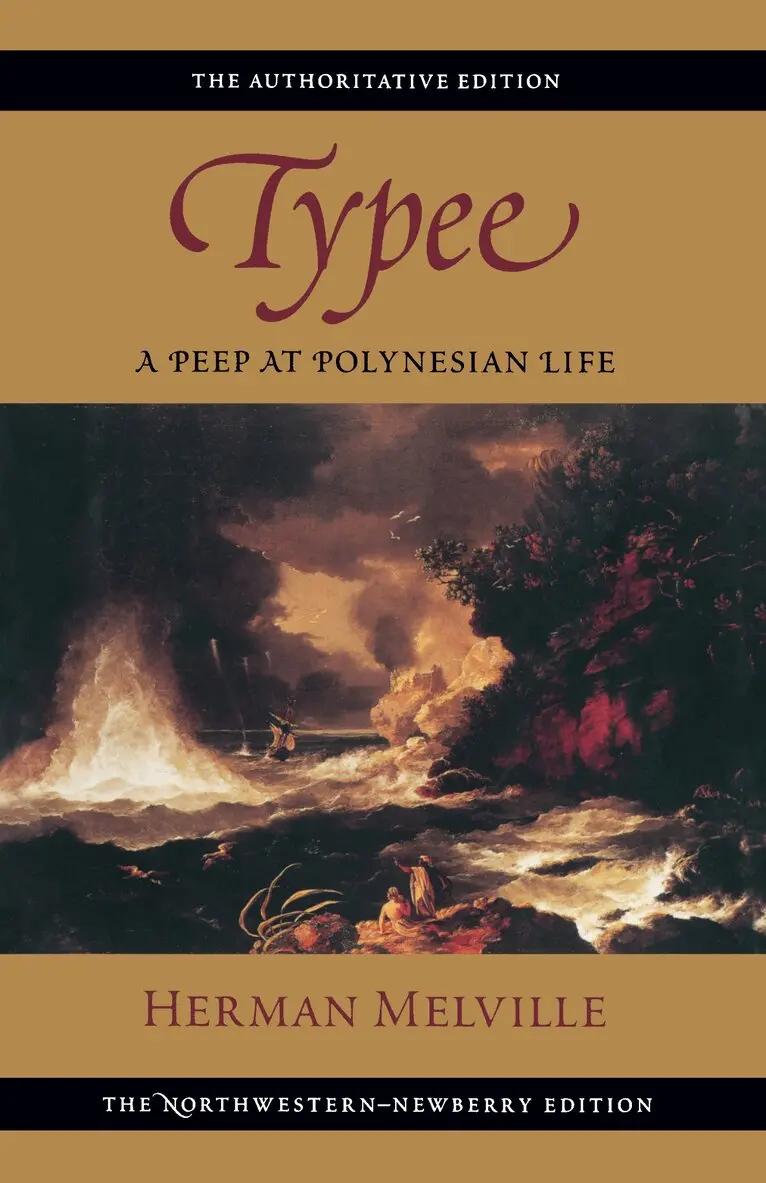
Almost from the time of its publication in 1846, Melville's first book, based on his own travels in the South Seas, has been recognized as a classic in the literature of travel and adventure. Although initially rejected as too fantastic to be true, ""Typee"" was immensely popular and regarded in Melville's lifetime as his best work. It established his reputation as the literary discoverer of the South Seas and inspired the likes of Jack London and Robert Louis Stevenson. Two common sailors jump ship and are held in benign captivity by Polynesian natives. Through the narrator's eyes we see a literate (if romanticized) portrait of the people and their culture presented in vivid, even scientific, detail. Melville's racy style and irreverence towards Christian missionaries caused a scandal and critics denounced the narrator's suggestion that the native life might be superior to that of modern civilization. An adventure story above all, albeit one with a philosophical bent, ""Typee"" is a combination of elements that even early in Melville's career hinted at the towering ambition he would fulfill with ""Moby Dick"".