
WWII Historic Battlefields - Böcker
Visar alla böcker i serien WWII Historic Battlefields. Handla med fri frakt och snabb leverans.
3 produkter
3 produkter
345 kr
Tillfälligt slut
Just after its seventieth anniversary, the Battle of the Bulge has lost none of its impact. The largest battle fought by US troops on the continent of Europe started in a surprise attack on December 16, 1944, by four German armies, spearheaded by the cream of the German Panzer forces. Under the cover of bad weather and heavy snow, Hitler’s last roll of the dice was intended to retake Antwerp, split the Allies, divide their political leadership, and force peace in the West, thus allowing the German forces to concentrate on defeating the Red Army. Strategic pipedream or not, the attack was furious and drained the Eastern Front of reinforcements: 12 armored and 29 infantry divisions, some 2,000 tanks and assault guns—mainly PzKpfw IVs (800), Panthers (750) and Tigers (250 including some of the new King Tigers)— spearheaded the assault, which smashed into the American First and Ninth Armies. Near-complete surprise was achieved thanks to a combination of Allied overconfidence, preoccupation with offensive plans, and poor reconnaissance. The Germans attacked where least expected—the forested Ardennes—a weakly defended section of the Allied line, taking advantage of the weather conditions, which grounded the Allies’ overwhelmingly superior air forces. The Allied response was magnificent. Initial reverses brought out the best of Eisenhower’s armies, which fought with determination and grit against the enemy and the elements. The harsh battles are best summed up by the defense of the northern shoulder around the Elsenborn Ridge, the battle for St. Vith, and in the south the siege of Bastogne, where the town’s commander, Gen. McAuliffe, rejected German calls for surrender with the pithy reply: “Nuts.” Within ten days the German attack had been nullified. Patton, at the time planning an attack further south, wheeled his Third Army round in a brilliant maneuver that relieved Bastogne and set up a counterattack which would drive the Germans back behind the Rhine. The Ardennes Battlefields includes details of what can be seen on the ground today—hardware, memorials, museums, and cemeteries—using a mixture of media to provide an overview of the campaign: maps old and new highlight what has survived and what hasn’t; then and now photography allows fascinating comparisons with the images taken at the time; aerial photos give another angle to the story. The fifth book by Leo Marriott and Simon Forty provides a different perspective to this crucial battlefield.
266 kr
Skickas
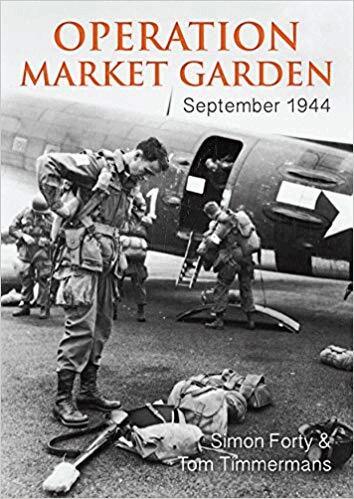
The battle of Normandy ended as the Allied armies crossed the Seine at the end of August 1944, a month after Operation Cobra had broken the stalemate. The Allies harried the retreating Germans, who left their tanks and heavy weapons south of the Seine, and by mid-September the Allies were coming up against the defences of Germany itself, the impressive Westwall.As far as the Allies were concerned, the Germans were beaten. The scent of immediate victory was in the air, the only question was where to apply the coup de grace. Logistics demanded that this should be a single thrust rather than Eisenhower’s broad front approach. Montgomery—the architect of victory in Normandy—proposed a daring plan to circumvent the Westwall, thrust towards Berlin, and make use of the newly created 1st Allied Airborne Army. The plan was simple: use the Paratroopers to hold key bridges along a single route along which British XXX Corps would make an advance that would be “rapid and violent, and without regard to what is happening on the flanks.” US 101st Airborne would land north of Eindhoven; 82nd Airborne at Nijmegen; British 1st Airborne at Arnhem—the so-called “bridge too far.”Unfortunately, the plan was flawed, the execution imperfect, and the Germans far from beaten. In spite of the audacious actions of the Paratroopers who would cover themselves with glory, Operation Market Garden showed that the German ground forces would still provide the Allies with stiff opposition in the West.And then, in 1977, A Bridge Too Far came out. With levels of realism that wouldn’t be approached for twenty years, the movie produced a view of the battle that subverted reality and permeated public perception. Just as George C. Scott produced the definitive Patton, so A Bridge Too Far provided an unnuanced view of the battles that historians have battled to correct ever since.As with its companion volumes on D-Day, the Bocage, and the Ardennes battlefields, this book provides a balanced, up-to-date view of the operation making full use of modern research. With over 500 illustrations including many maps, aerial and then and now photography, it will provide the reader with an easy-to-read, up-to-date examination of each part of the operation, benefitting from on-the-ground research by Tom Timmermans, who lives in Eindhoven.
344 kr
Skickas inom 3-6 vardagar
Two months after D-Day, just as the battle of Normandy was reaching its climax, with all eyes on the Falaise Pocket, the Allies unleashed the second invasion of France not in the Pas de Calais but the French Riviera. Immaculately planned, effectively undertaken, the Allies quickly broke out of their bridgehead, drove 400 miles into France in three weeks, and liberated 10,000 square miles of French territory while inflicting 143,250 German casualties. On September 10 they linked up with Patton’s Third Army and advanced into the Vosges Mountains, taking Strasbourg and holding the area against the Germans’ final big attack in the west: Operation Nordwind in January 1945. US Seventh Army and 6th Army Group undertook a successful campaign placing a third Allied army group with its own independent supply lines, in northeastern France at a time when the two northern Allied army groups were stretched to the limit. Without this force the Allies would have struggled to hold the frontage to Switzerland and Third Army would have been exposed to attack in its southern flank—something that could have had disastrous repercussions particularly during the Ardennes offensive of December 1944.The images of palm trees and azure seas obscure our view of this campaign. It was no cakewalk. The Germans knew the Allies were coming and had strong defences in the area. A shortage of landing craft, vehicles, and matériel meant that the US Seventh and French First armies were restricted in the assault. The heavy fog and anti-glider defences made for a difficult airborne assault, but it was carried out effectively, the amphibious assault was textbook in execution and the invasion of southern France ended up as a significant victory. But the story of 6th Army Group wasn’t finished. Taking up a position on the east flank of Third Army it fought its way through the Vosges and withstood the Germans’ last throw: Operation Nordwind—the vain attempt to relieve pressure on the Ardennes assault by attacking in the Vosges. Heavy fighting pressed hard towards Strasbourg but the Allies were ultimately victorious, inflicting severe losses on the Germans.