Yeats Collected Letters Series – serie
Visar alla böcker i serien Yeats Collected Letters Series. Handla med fri frakt och snabb leverans.
5 produkter
5 produkter
3 830 kr
Skickas inom 7-10 vardagar
rich and distinguished work of scholarship Conor Cruise O'Brien, The Listener wonderfully edited by John Kelly ... nothing goes unexplained. The notes provide, often wittily, historical details about the 1880's and 1890's that no one has previously compiled. Kelly has performed many extraordinary feats of research. The biographical notes at the end are well written and helpful, and the analytical index on Yeats is just what is needed. Richard Ellman, The New Republic it is no exaggeration to claim that it marks a milestone in Yeats scholarship. The significance of this first volume lies not only in the content of the letters alone, but also in the sheer mass of beckground erudition assembled in this volume ... for a long, long time this monumental edition of Yeat's letters will be enlightening and delighting us. John P. Frayne, Journal of English and Germanic Philology This first volume sets a superlative standard for the books to come. Virtually every editorial and typographical decision taken here contributes to the usefulness, legibility, and attractiveness of the work. The Modern Language Review
4 118 kr
Skickas inom 7-10 vardagar
The letters in this volume, the majority never before published, vividly document the period in which Yeats, having left the family house in Bedford Park, began a new life in Bloomsbury; as he later recalled, `a new scene was set, new actors appeared'. With his association with the Savoy magazine and its circle of decadents, he achieved the financial emancipation that enabled him to begin his first affair with Olivia Shakespear. 1896 also saw the beginning of the most important and creative friendship of his life, that with Lady Gregory; other influential friendships, such as those with Synge and W. T. Horton, were forged. In 1898, Yeats's friendship with George Moore expanded, only to contract with the disastrous collaboration on Diarmuid and Grania.It was a period of considerable unhappiness for Yeats. His love for Maud Gonne was hopeless; in December 1898, she was to tell him of her long-standing affair with Lucian Millevoye (by whom she had two children). The crisis produced a run of confused and incoherent letters to Lady Gregory. The letters also document Yeats's greatest early period of political activity. He organized the centenary celebrations of the 1798 uprising, while combating double agents within the Irish Revolutionary Brotherhood. In 1897, he began planning a National Theatre and letters chart a massive expansion of theatrical activity. Letter by letter, we see how private concerns, artistic quarrels and exhausting political life forced him to develop a public persona. Rich and readable notes provide a narrative of these years, explaining allusions and setting the correspondence in its cultural and political contexts, as well as relating it to the emergence of Yeats's canon. The Collected Letters of W. B. Yeats is redefining the territory of modern literary history and this volume, with its valuable biographical and thematic appendices, is indispensable to anyone interested in the development of modern poetry, Irish drama and cultural history.
4 693 kr
Skickas inom 7-10 vardagar
The letters in this volume, the majority never before published, vividly document a tunultuous period in Yeats's life. They chart his transformation from a late Romantic, `Celtic' poet into a powerful and astringent modernist, the foundation of the Abbey Theatre and development of his own palywriting career, the emotional devastation of his beloved Maud Gonne's marriage to a man he despised, the encouragement of promising young writers including Joyce and Synge, and the impact of his first exposure to the United States. Letter by letter we see how private concerns and public controversies forced him to redefine his views on artistic freedom and responsibility, and to reshape his style. Rich and readable notes provide a narrative of these years, explaining allusions, and setting the correspondence in its cultural and political contexts as well as relating it to Yeats's canon as a whole. This book will be indispenable to anyone interested in the development of modern poetry, drama, and cultural history.
Del 4 - Yeats Collected Letters Series
The Collected Letters of W. B. Yeats
Volume IV, 1905-1907
Inbunden, Engelska, 2005
5 146 kr
Skickas inom 7-10 vardagar
This volume covers a tumultuous period in Yeats's public and personal life, beginning with the acrimonious collapse of Maud Gonne's marriage to Major MacBride (who not only accused Yeats of being her lover but also threatened to shoot him). Dramas at the Abbey Theatre were hardly less intense, both on and off the stage: the euphoria which followed the successful opening of the new theatre quickly dispersed in a relentless cycle of quarrels and schisms. Yeats's attempts to turn an enthusiastic but ill-disciplined amateur society into a professional company led to a permanent division in the company, while the vagaries of Annie Horniman, the irascible patron of the theatre, put the whole movement under permanent tension. Violence actually broke out in January 1907 when the audience rioted at the production of John Synge's The Playboy of the Western World, believing it to be a libel on Ireland. Through all this we see Yeats maturing as an artist: discussing the writing and revising of his poems and plays, preparing the first elaborate American edition of his poems, and undertaking an ambitious eight-volume Collected Works through which he hoped to define his artistic personality. The letters not only record this energetic and often bruising period, but also bear witness to Yeats's indomitable fighting spirit and artistic integrity.
2 186 kr
Skickas inom 5-8 vardagar
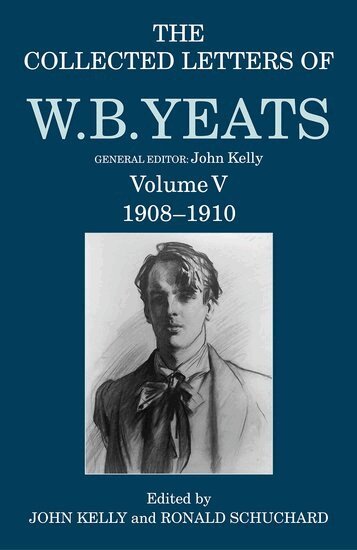
Shortly after the death of Algernon Swinburne in April 1909 Yeats announced to his sister that he was now 'King of the Cats'. Yet, as the letters in this volume demonstrate, although widely recognized as the leading poet in English, he was far less sure of himself than this triumphant boast suggests. Indeed, this volume tracks Yeats's unrelenting but often agonised attempts to redefine his positon as a poet in a time of aesthetic and personal transition and uncertainty, struggling, as he put it, to fashion 'an art of my own day' and amid 'doubtings, shrinkings, hatreds, reconciliations'. His letters about the eight-volume Collected Works, completed in these years, show him attempting to get his 'general personality' into his readers' minds, but always as 'a preliminary to new work'. What constituted 'personality', general or otherwise, was a contested area and in letter after letter he hammers out its relationship to 'character' in a debate which was to convert him from a late Romantic into an early Modernist. If many letters are concerned with the revision and reappraisal of old work, more reveal the insistent, and often frustrating, attempts to find new expression, particularly in the writing of The Player Queen, a process which, as he told a correspondent, convinced him that no fixed identity was possible. Developments in his personal life contributed to the sense of uncertainty and transition. In the spring of 1908 he began an affair with a new mistress, Mabel Dickinson, but ironically we find this rekindling and intensifying his feelings for his old love Maud Gonne, and for the first time they came close to a physical relationship, although she insisted that their 'spiritual marriage' would be purer if unconsummated. But the return to mystical sublimation was, after nearly twenty years of courtship, no longer satisfying to him; the situation, as he confessed in a letter, had set his 'nerves tight as a violin string but not one that makes sweet music'.More discordant music came from the Abbey Theatre. Early in 1908 the Fay brothers, founder members and mainstays of the Company resigned, and for a time it seemed that the whole project might come to an end. Over the next three years, as his correspondence eloquently reports, Yeats worked tirelessly to make sure this did not happen, encouraging new actors and playwrights, overseeing the evolution of a repertory structure, taking rehearsals often for weeks on end, battling with Fays for their misuse of the Irish National Theatre's name in America, mediating in the quarrels of the players, deflecting where he could the cantankerousness of the Theatre's patron, Annie Horniman, and, on her withdrawal of her subsidies, helping Lady Gregory in fund-raising, and in a final successful bid to renew the Abbey's patent. His exertions in the Theatre were much increased by the terminal illness of his friend and colleague John Synge (which, he confesses, 'for the first time in my life made death a reality to me'). The serious illness of Lady Gregory brought home to him his dependence on her and the ambience of her house, Coole Park; the massive mental breakdown of his companion Arthur Symons broke a remaining tie with the 1890s and the passing of his uncle and fellow occultist, George Pollexfen, severed his major link with Sligo. But, if these old relationships altered or disappeared, new ones were forged. Ezra Pound at last succeeded in meeting him and began encouraging him in his quest for 'an art of my own day', while Yeats himself fostered the talents of younger writers, notably the playwrights Lennox Robinson, T. C. Murray, St. John Ervine, and Lord Dunsany. By the end of the period, Yeats, who we see brought to edge of a nervous breakdown in 1909, and defying the Establishment in producing Shaw's Blanco Posnet, became a man of affairs: pressed to apply for Professorships at Trinity College and the new National University, elected a founding member of the British Academy of Letters, and the recipient of a Civil List pension. The recasting of The Golden Helmet, first produced in the early months of his volume, as The Green Helmet of two years later, indicates how the discussions and soul-searching disclosed by his letters had begun to bear fruit. Less now a play satirizing Irish divisions and jealousies than a celebration of Nietzschean tragic joy and Castiglionean sprezzatura, it indicates the qualities Yeats had learned to prize over the intervening three years.