Zones of Violence - Böcker
Visar alla böcker i serien Zones of Violence. Handla med fri frakt och snabb leverans.
4 produkter
4 produkter
1 585 kr
Skickas inom 3-6 vardagar
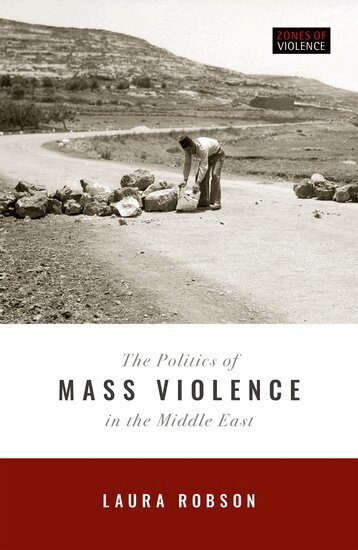
The Middle East today is characterized by an astonishingly bloody civil war in Syria, an ever more highly racialized and militarized approach to the concept of a Jewish state in Israel and the Palestinian territories, an Iraqi state paralyzed by the emergence of class- and region-inflected sectarian identifications, a Lebanon teetering on the edge of collapse from the pressures of its huge numbers of refugees and its sect-bound political system, and the rise of a wide variety of Islamist paramilitary organizations seeking to operate outside all these states. The region's emergence as a 'zone of violence', characterized by a viciously dystopian politics of identity, is a relatively recent phenomenon, developing only over the past century; but despite these shallow historical roots, the mass violence and dispossession now characterizing Syria, Lebanon, Israel/Palestine, and Iraq have emerged as some of the twenty-first century's most intractable problems. In this study, Laura Robson uses a framework of mass violence - encompassing the concepts of genocide, ethnic cleansing, forced migration, appropriation of resources, mass deportation, and forcible denationalization - to explain the emergence of a dystopian politics of identity across the Eastern Mediterranean in the modern era and to illuminate the contemporary breakdown of the state from Syria to Iraq to Israel.
Frontiers of Violence in North-East Africa
Genealogies of Conflict since c.1800
Inbunden, Engelska, 2011
1 648 kr
Skickas inom 5-8 vardagar
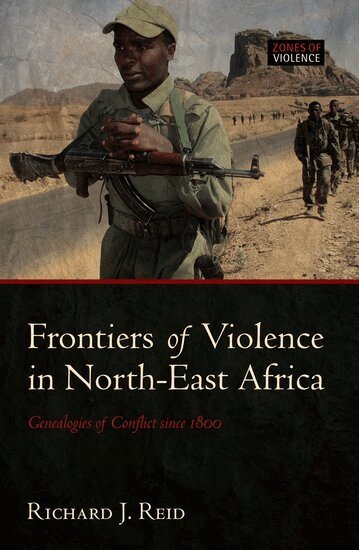
Northeast Africa has one of the richest histories in the world, and yet also one of the most violent. Richard Reid offers an historical analysis of violent conflict in northeast Africa through the nineteenth and twentieth centuries, incorporating the Ethiopian and Eritrean highlands and their escarpment and lowland peripheries, stretching between the modern Eritrean Red Sea coast and the southern and eastern borderlands of present day Ethiopia. Sudanese and Somali frontiers are also examined insofar as they can be related to ethnic, political, and religious conflict, and the violent state- and empire-building processes which have defined the region since c.1800. Reid argues that this modern warfare is not solely the product of modern political 'failure', but rather has its roots in a network of frontier zones which are both violent and creative. Such borderlands have given rise to markedly militarised political cultures which are rooted in the violence of the nineteenth century, and which in recent decades are manifest in authoritarian systems of government. Reid thus traces the history of Amhara and Tigrayan imperialisms to the nationalist and ethnic revolutions which represented the march of volatile borderlands on the hegemonic centre. He suggests a new interpretation of Ethiopian and Eritrean history, arguing that the key to understanding the region's turbulent present lies in an appreciation of the role of the armed, and politically fertile, frontier in its deeper past.
1 056 kr
Skickas inom 5-8 vardagar
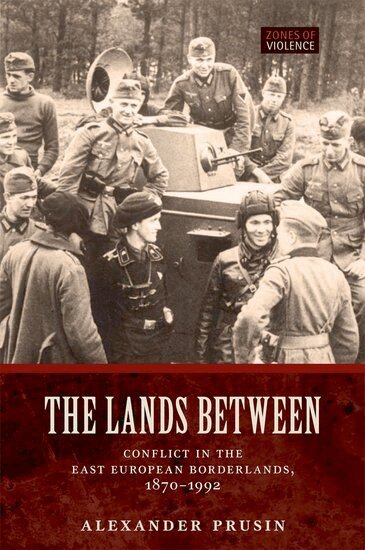
The Lands Between investigates the causes and dynamics of conflict in the 'borderlands' of Eastern Europe: the modern Baltic republics of Estonia, Latvia, and Lithuania, the western provinces of Byelorussia and Ukraine, and the republic of Moldova - areas that have changed hands in the course of the twentieth-century on several occasions. Alexander V. Prusin looks at these 'borderlands' as a whole, synthesizing narrower national histories into a wider-ranging study that highlights the common factors feeding conflict across the region. He also takes a long-term view, from the modernizing of the Russian and Austro-Hungarian empires in the late nineteenth century, through to the break-up of the Soviet Union, with a particular focus on the 'era of conflict' between the outbreak of the First World War and the Soviet pacification of the area in the mid-1950s. While admitting the importance of socio-economic cleavages and ethnic rivalries in creating conflict, Prusin argues that the borderlands' ethno-cultural diversity was in basic conflict with the policies of the authorities that dominated the region, whether these authorities were imperial or (after 1919) nation states. Since collective identities in the borderlands were based on ethno-communal rather than national association, connections between ethnic groups across state borders raised suspicions that their allegiances and identities were not necessarily compatible with those envisioned by the ruling authority. In wartime, when the state's economic and human resources became strained to the limit, suspicion of the groups deemed less loyal blurred the concept of internal and external enemies and entailed pressure on allegedly "corrosive" ethnic elements. Efforts to impose some sort of supranational identity upon the patchwork of ethnically-mixed settlements thus became the standard practice through the first half of the twentieth-century, accelerating the conflict between the state and the population and making the potential for extreme violence so much greater. Simultaneously, as war progressed, violence was sustained and exacerbated by popular participation and acquired its own destructive logic, mutating into a vicious cycle of ethnic conflicts and civil wars.
1 810 kr
Skickas inom 5-8 vardagar
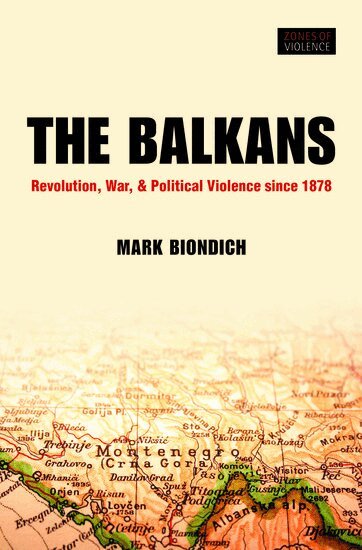
The Balkans has long been a place of encounter among different peoples, religions, and civilizations, resulting in a rich cultural tapestry and mosaic of nationalities. But it has also been burdened by a traumatic post-colonial experience. The transition from traditional multinational empires to modern nation-states has been accompanied by large-scale political violence that has resulted in the deaths of hundreds of thousands and the permanent displacement of millions more. Mark Biondich examines the origins of these conflicts, while treating the region as an integral part of modern European history, shaped by much the same forces and intellectual impulses. It reminds us that political violence and ethnic cleansing have scarcely been unique to the Balkans. As Biondich shows, the political violence that has bedevilled the region since the late nineteenth century stemmed from modernity and the ideology of integral nationalism, employed by states that were dominated by democratizing or authoritarian nationalizing elites committed to national homogeneity. Throughout this period, the Balkan proponents of democratic governance, civil society, and multiculturalism were progressively marginalized. The history of revolution, war, political violence, and ethnic cleansing in the modern Balkans is above all the story of this tragic marginalization.