423 kr
Beställningsvara. Skickas inom 7-10 vardagar. Fri frakt över 249 kr.
Fler format och utgåvor
Beskrivning
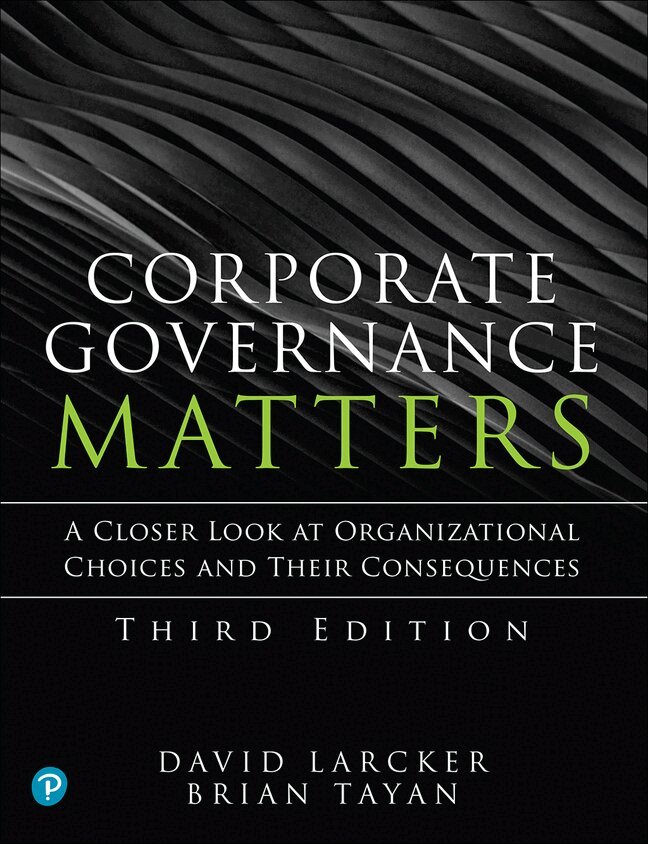
Fully updated for the latest research, trends, and regulations, Corporate Governance Matters, Third Edition, offers comprehensive and objective information for everyone seeking to improve corporate governance--from directors to institutional investors to policymakers and researchers.
To help you design highly effective governance, David Larcker and Brian Tayan thoroughly examine current options, reviewing what is and isn't known about their impact on organizational performance. Throughout, they take a strictly empirical and non-ideological approach that reflects rigorous statistical and research analysis and real-life examples. They address issues ranging from board structure, processes, operations, and functional responsibilities to institutional investors, outside stakeholders, and alternative forms of governance.
New discussions of:
- Environmental, Social, and Governance (ESG) activity and ratings
- Stakeholder interests
- CEO activism
- CEO misbehavior
- Cybersecurity risks
Extensively revised coverage of:
- Executive compensation
- Leadership and succession planning
- Director recruitment, evaluation, turnover, and more
Produktinformation
- Utgivningsdatum:2000-01-08
- Mått:180 x 230 x 26 mm
- Vikt:820 g
- Format:Häftad
- Språk:Engelska
- Antal sidor:528
- Upplaga:3
- Förlag:Pearson Education
- ISBN:9780136660026
Utforska kategorier
Mer om författaren
David Larcker is James Irvin Miller Professor of Accounting (Emeritus) at Stanford Graduate School of Business; Director of the Corporate Governance Research Initiative; and Senior Faculty, Arthur and Toni Rembe Rock Center for Corporate Governance. David's research focuses on executive compensation, corporate governance, and managerial accounting. He has published many research papers and is frequently quoted in both the popular and business press. He received his BS and MS in engineering from the University of Missouri–Rolla and his PhD in business from the University of Kansas. He previously was on the faculty of the Kellogg Graduate School of Management at Northwestern University and The Wharton School at the University of Pennsylvania. Professor Larcker presently serves on the Board of Trustees for the Wells Fargo Funds. Brian Tayan is a member of the Corporate Governance Research Initiative at Stanford Graduate School of Business. He has written broadly on the subject of corporate governance, including studies and other materials on boards of directors, succession planning, executive compensation, financial accounting, and shareholder relations. Previously, Brian worked as a financial analyst at Stanford University's Office of the CEO and as an investment associate at UBS Private Wealth Management. He received his MBA from the Stanford Graduate School of Business and his BA from Princeton University.
Innehållsförteckning
- Preface xviii Chapter 1 Introduction to Corporate Governance 1 Self-Interested Executives 4 Defining Corporate Governance 8 Corporate Governance Standards 9 Best Practice or Best Practices? Does “One Size Fit All”? 12 Relationship between Corporate Governance and Firm Performance 13 Endnotes 15 Chapter 2 International Corporate Governance 19 Capital Market Efficiency 19 Legal Tradition 22 Accounting Standards 23 Enforcement of Regulations 25 Societal and Cultural Values 26 Individual National Governance Structures 28 United States 29 United Kingdom 31 Germany 35 Japan 37 South Korea 40 China 41 India 43 Brazil 44 Russia 46 Endnotes 47 Interlude 53 Chapter 3 Board of Directors: Duties and Liability 55 Board Responsibilities 55 Board Independence 56 The Operations of the Board 57 Board Committees 60 Duration of Director Terms 64 Director Elections 64 Removal of Directors 66 Legal Obligations of Directors 66 Fiduciary Duty 67 Environmental, Social, and Governance (ESG) 70 Disclosure Obligations under Securities Laws 71 Legal Enforcement of State Corporate Law (Fiduciary Duties) 72 Legal Enforcement of Federal Securities Laws 73 Director Indemnification and D&O Insurance 73 Endnotes 75 Chapter 4 Board of Directors: Selection, Compensation, and Removal 79 Market for Directors 79 Criteria for Director Recruitment 80 Active CEOs 81 International Experience 82 Special Expertise 82 Diverse Directors 84 Professional Directors 85 Disclosure Requirements for Director Qualifications 86 Director Recruitment Process 87 Director Compensation 90 Ownership Guidelines 95 Board Evaluation 96 Removal of Directors 98 Endnotes 102 Chapter 5 Board of Directors: Structure and Consequences 109 Board Structure 110 Chairman of the Board 113 Lead Independent Director 116 Outside Directors 119 Board Independence 122 Independent Committees 125 Bankers on the Board 126 Financial Experts on Board 127 Politically Connected Boards 127 Employee Representation 129 Boards with “Busy” Directors 131 Interlocked (or Connected) Boards 134 Committee Overlap 135 Board Size 136 Board Diversity 136 Female Directors 138 Summary 139 Endnotes 141 Interlude 150 Chapter 6 Strategy, Performance Measurement, and Risk Management 151 Organizational Strategy 151 Strategy Implementation Process 154 Business Model Development and Testing 156 Example 1: Fast-Food Chain and Employee Turnover 156 Example 2: Financial Services Firm and Investment Advisor Retention 158 Key Performance Measures 159 How Well Are Boards Doing with Performance Measures and Business Models? 162 Risk and Risk Management 164 Risk and Risk Tolerance 165 Risk to the Business Model 166 Risk Management 169 Oversight of Risk Management 172 Assessing Board Performance on Risk Management 174 Cybersecurity 175 Endnotes 177 Chapter 7 CEO Selection, Turnover, and Succession Planning 181 Labor Market for Chief Executive Officers 181 Labor Pool of CEO Talent 184 CEO Turnover 186 Newly Appointed CEOs 191 Models of CEO Succession 193 External Candidate 193 President and/or Chief Operating Officer 195 Horse Race 196 Inside–Outside Model 197 The Succession Process 197 How Well Are Boards Doing with Succession Planning? 201 Executive Search Firms 203 Endnotes 205 Chapter 8 Executive Compensation and Incentives 211 The Controversy over Executive Compensation 212 Competing Theories of CEO Pay 213 Components of Compensation 214 Determining Compensation 218 Compensation Consultants 221 Compensation Levels 221 Ratio of CEO Pay to Other Top Executive Pay 226 Ratio of CEO Pay to Average Employee Pay 229 Compensation Mix 230 Short-Term Incentives 233 Long-Term Incentives 235 Benefits and Perquisites 237 Compensation Disclosure 238 Say-on-Pay 239 Competing Theories of CEO Pay 242 Endnotes 243 Chapter 9 Executive Equity Ownership 251 Equity Ownership and Firm Performance 251 Equity Ownership and Risk 254 Equity Ownership and Agency Costs 259 Accounting Manipulation 260 Manipulation of Equity Grants 261 Other Examples of Value Extraction through Timing 263 Equity Sales and Insider Trading 264 Rule 10b5-1 267 Hedging 269 Pledging 273 Repricing and Exchange Offers 274 Endnotes 277 Chapter 10 Financial Reporting and External Audit 285 The Audit Committee 285 Accounting Quality, Transparency, and Controls 286 Financial Reporting Quality 288 Non-GAAP Reporting 290 Financial Restatements 291 Models to Detect Accounting Manipulations 297 The External Audit 299 Audit Quality 302 Structure of Audit Industry 302 Impact of Sarbanes–Oxley 305 External Auditor as CFO 307 Auditor Rotation 308 Endnotes 310 Chapter 11 The Market for Corporate Control 319 The Market for Corporate Control 320 Stock Market Assessment of Acquiring and Target Firms 324 Who Gets Acquired? 324 Who Gets the Value in a Takeover? 327 Antitakeover Protections 330 Antitakeover Actions 331 Poison Pills 333 Staggered Board 335 State of Incorporation 337 Dual-Class Shares 339 Warding Off Unwanted Acquirers 341 Endnotes 344 Chapter 12 Shareholders and Shareholder Activism 351 The Role of Shareholders 351 Blockholders and Institutional Investors 354 Institutional Investors and Proxy Voting 357 Activist Investors 359 Pension Funds 361 ESG and Socially Responsible Investing 363 Individual Activist Investors 364 Activist Hedge Funds 366 The Rise of Index Investing 370 Shareholder Democracy and Corporate Engagement 371 Majority Voting in Uncontested Director Elections 371 Proxy Access 372 Proxy Voting 372 Corporate Engagement 374 Proxy Advisory Firms 375 Endnotes 381 Chapter 13 Stakeholders and Stakeholder Activism 391 Pressure to Incorporate Stakeholder Interests 392 Legal and Economic Implications 397 Director and CEO Views on Stakeholders 401 ESG Metrics and Disclosure 402 External Assessment of ESG 407 Endnotes 417 Chapter 14 Corporate Governance and ESG Ratings 425 Third-Party Ratings 425 Credit Ratings 426 Commercial Corporate Governance Ratings 428 ISS: Corporate Governance Quotient 428 ISS: Governance Risk Indicators 430 ISS: QualityScore 430 MSCI ESG Governance Metrics 431 Testing the Predictability of Corporate Governance Ratings 432 Governance Rating Systems by Academic Researchers 433 The Viability of Governance Ratings 438 ESG Ratings 439 MSCI ESG 440 Sustainalytics 441 Vigeo Eiris 442 HIP (Human Impact + Profit) 442 ISS E&S Disclosure QualityScore 442 TruValue Labs 443 Evaluation of ESG Ratings 443 Endnotes 444 Chapter 15 Alternative Models of Governance 449 Family-Controlled Corporations 449 Venture-Backed Companies 452 Private Equity-Owned Companies 458 Nonprofit Organizations 462 Endnotes 466 Chapter 16 Summary and Conclusions 473 Testing Remains Insufficient 474 The Current Focus Is Misdirected 475 Important Variables Are Clearly Missing 476 Context Is Important 477 Rights of Shareholders and Stakeholders 478 Endnotes 478 Index 481