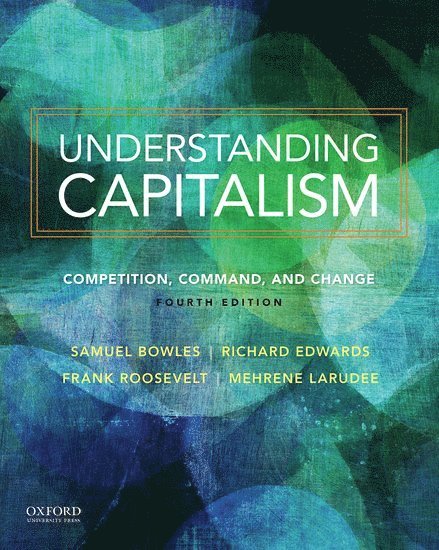
Understanding Capitalism
Competition, Command, and Change
AvSamuel Bowles,Frank Roosevelt
1 676 kr
Beställningsvara. Skickas inom 5-8 vardagar. Fri frakt över 249 kr.
Beskrivning
Produktinformation
- Utgivningsdatum:2017-12-14
- Mått:251 x 201 x 22 mm
- Vikt:1 061 g
- Format:Häftad
- Språk:Engelska
- Antal sidor:592
- Upplaga:4
- Förlag:OUP USA
- ISBN:9780190610937
Utforska kategorier
Mer om författaren
Samuel Bowles is Research Professor at the Santa Fe Institute and Professor of Economics at the University of Siena, Italy. Richard Edwards is Professor of Economics at the University of Nebraska-Lincoln.Frank Roosevelt is Professor Emeritus of Economics at Sarah Lawrence College.Mehrene Larudee is Visiting Associate Professor at Hampshire College.
Recensioner i media
A good contested exchange alternative to a traditional textbook. Ideal for use in an economics class with an interdisciplinary focus.
Innehållsförteckning
- PART 1: POLITICAL ECONOMY CHAPTER 1: Capitalism Shakes the WorldThe Permanent Technological RevolutionWhich Came First: Technology or Capitalism?The Enrichment of Material LifeGrowing InequalityThe Population Explosion and the Growth of CitiesThe Changing Nature of WorkThe Transformation of the FamilyThreats to the EcosystemThe Effects of Climate ChangeContaminationNew Roles for GovernmentGlobalizationConclusion CHAPTER 2: People, Preferences, and SocietyConstraints, Preferences, and Beliefs"Economic Man" ReconsideredHuman Nature and Cultural DifferencesThe Economy Produces PeopleConclusion: The Cooperative Species CHAPTER 3: A Three-Dimensional Approach to EconomicsEconomic Systems and CapitalismThree-Dimensional EconomicsCompetitionCommandChangeNeoclassical EconomicsValues in Political EconomyEfficiencyFairnessDemocracyBalancing efficiency, fairness, and democracyConclusion CHAPTER 4: The Surplus Product: Conflict and ChangeEconomic Interdependence, Production, and ReproductionProductionLinks Between Production and ReproductionA Labor Process Example: Making PancakesThe Surplus ProductA Model of Production and ReproductionWho Gets the Surplus?Enlarging the SurplusApplication of Model to LaborThe Surplus Product and ChangeConclusion CHAPTER 5: Capitalism as an Economic SystemClass and Class Relationships Classes and Economic SystemsSlaveryFeudalismDistinctions among Economic SystemsCapitalismCommoditiesPrivately Owned Capital GoodsWage LaborCapitalism, the Surplus Product, and ProfitsConclusion CHAPTER 6: Government and the EconomyRules of the Game: Government and the Capitalist EconomyThe Emergence of Modern Legal Forms of Corporate BusinessFrom Competition to MonopolyFrom National to TransnationalDemocratic Government as Collective Provision for the General WelfareGovernment and the Distribution of Income, Wealth, and Welfare in the 19th CenturyContention between Capital and Labor over RulesVoter turnout in the U.S. and around the worldDemocracy in the 20th CenturyConclusion CHAPTER 7: U.S. Capitalism: Accumulation and ChangeAccumulation as a Source of ChangeThe Accumulation of ProcessCompetition for ProfitsSocial Structures of AccumulationChanging Strategies for Profit-Making Consolidation and Decay of an SSA The Stages of American Capitalism in the United StatesCompetitive capitalism (1860s-1898)Competitive capitalism (1860s-1898)Corporate capitalism (1898-1939)Regulated capitalism (1939-1991)Transnational capitalism (1991- )U.S. Capitalism: Labor Organizing and Labor MarketsThe Rise and Fall of Labor UnionsSegmented labor marketsU.S. Capitalism Today is TransnationalImmigrationShifts in what U.S. Labor ProducesFragmenting Global ProductionRules for the Global EconomyTax Motives for TNCs to Go GlobalCorporate Stock Buybacks and Falling Productive InvestmentConclusion PART 2: MICROECONOMICS CHAPTER 8: Supply and Demand: How Markets WorkThe Nature of MarketsDemand and SupplyDemandSupplyDemand and Supply InteractingShifts in Demand or SupplyConclusion CHAPTER 9: Competition and Coordination: The Invisible HandAdam Smith and Laissez-Faire EconomicsCoordinationCoordination by Rules and by CommandThe Limits of Coordination by CommandThe Invisible HandThe Invisible Hand in Action Problems with the Invisible Hand Market FailureNegative externalities as market failuresPositive externalities as market failuresMonopoly as a market failureCoordination FailureThe Prisoner's Dilemma and the Benefits of CooperationThe Tragedy of the CommonConclusion CHAPTER 10: Capitalist Production and ProfitsWhat Are Profits?Profits from a Production ProcessCalculating Profit and Other Property Incomes in the Whole EconomyProfit in a Grain-Growing Capitalist EconomyCalculating the Rate of ProfitThe Corporate Profit Rate in the U.S.Corporations and Other Businesses: Who Gets the Profit or Bears the Loss?CorporationsDeterminants of Total Profit and the Profit RateExample: The Good Cod Fishing CompanyProfit per Unit of OutputConflict Over the Profit RateIntermediate Inputs per Unit of Output as Profit Rate DeterminantsUnit Labor Cost as a Profit Rate DeterminantUnderstanding the Profit RateConclusion CHAPTER 11: Competition and ConcentrationCompetition for ProfitsThe Forms of CompetitionPrice CompetitionPrice as a markup over costEconomies of scale and price competitionOther advantages of large sizeCapacity utilizationBreakthroughsMonopoly PowerInvesting to CompeteThe Dynamics of CompetitionToward Equal Profit Rates?Toward Economic Concentration?Large Size and Monopoly PowerTrends in ConcentrationAntitrust EnforcementConclusion CHAPTER 12: Wages and WorkWork, Sloth, and Social OrganizationThe Capitalist Firm as a Command EconomyThe Conflict between Workers and EmployersLabor Discipline: Carrots and SticksThe Labor Market, the Wage, and the Intensity of LaborCost of Job LossAvoiding the Cost of Job LossAdditional Implications of the Labor Extraction CurveConclusion CHAPTER 13: Technology, Control, and Conflict in the WorkplaceThe Social Organization of the WorkplaceSimple ControlTechnical ControlBureaucratic ControlTechnology and the Labor ProcessConflict in the WorkplaceTechnical Change and Workplace ConflictUnionsDiscrimination in the WorkplaceProfitability Versus EfficiencyMarkets and HierarchiesDemocratic FirmsConclusion PART 3: MACROECONOMICS CHAPTER 14: The Mosaic of InequalityWell-Being and InequalityInfluences on Well-being and the EconomyMeasuring Living Standards and InequalityGrowing InequalityWealth InequalityUnequal ChancesRace and InequalityDiscrimination in HiringProblem of Differential PayWomen's Work, Women's WagesConclusion: Explaining the Mosaic of Inequality CHAPTER 15: Progress and Poverty on a World ScalePoverty and ProgressProductivity and IncomeVicious Circles of Low ProductivityIntellectual Property RightsOther Government Interventions to Promote DevelopmentRequisites for Economic DevelopmentEight Essential ConditionsOther Factors in DevelopmentForeign Investment and DevelopmentInvestment Decisions by Transnational CorporationsTransnational Investment and Tax HavensThe High Cost of Low-Priced Clothing Conclusion CHAPTER 16: Aggregate Demand, Employment, and UnemploymentCounting the UnemployedWhat Determines Employment and Output?Aggregate Supply and Aggregate DemandMeasuring Total OutputTerms for Measuring the Macroeconomy Measuring Aggregate Supply and Aggregate DemandA Basic Macroeconomic ModelUnemployment and Government Fiscal PolicyEffects of Deficit Spending on EmploymentMultiplier Effect of Deficit Spending The Business Cycle and the Built-in StabilizersConscious Policy ChangesAutomatic Built-in StabilizersInvestment, Aggregate Demand, and Monetary PolicyWages, Aggregate Demand, and UnemploymentWhen is an Employment Situation Wage-Led?Implications for Economic PolicyConclusion CHAPTER 17: The Dilemmas of Macroeconomic PolicyThe High-Employment Profit SqueezeThe High Employment Wage PushThe Materials Cost PushThe Profit SqueezeExports, Imports, and Aggregate DemandThe Demand for Exports and ImportsThe Foreign Exchange RateInternational Trade and Macroeconomic PolicyPromoting Net ExportsCompeting in Global MarketsMonetary and Fiscal Policy at OddsWhat Determines the Interest Rate?Borrowing and the Exchange RateThe Conflict between Monetary and Fiscal PolicyInstitutions for Achieving Full EmploymentInstitutional Obstacles to Full EmploymentInstitutions for Achieving Full EmploymentConclusion CHAPTER 18: Financial and Economic CrisisThe Great Recession and the Subprime CrisisUnderstanding the Great RecessionWhy to Buy a HomeHome Prices Start to RiseHow to Buy a HomeSecuritization of MortgagesRefinancingDeregulationLiars' LoansCollateral DamageDerivatives of Other KindsBailouts and BuyoutsUnemployment and PovertyLessons from the History of Economic CrisesNonfinancial causes of crisis: over-investment, under-consumptionUnderconsumption as a cause of stagnation or crisisAsset markets differ from goods marketsWhy are asset markets prone to price bubbles?Feedback LoopsReflexivityMisinformationDeregulation and financial fragilityLarge firms exacerbate the problem Weakening the social safety netRegulation in a capitalist economyRegulating the financial sectorThe Dodd-Frank ActInequality, concentration and crisisConclusion CHAPTER 19: Government and the Economy in Transnational CapitalismMore Spending, Less Health Government in the U.S.: Too Big?Government Spending: Comparing the U.S. with Other CountriesOld age pensionsInfluencing the RulesTaxationRules that Affect Business Costs and ProfitsContracting Out Government ServicesGovernment Contracting: Profits and the Public InterestDecline in Competitive Bidding for Government ContractsGovernment Contracting for Private Prison ServicesLaws and Norms on SentencingRethinking Private Prisons and Mass IncarcerationSelling to Government, Maximizing ProfitMedical services in Private PrisonsChanging the RulesFeedback Loops in Taxing Transnational CorporationsConflict Over RulesProposals for Alternative RulesDemocracy and InequalityFeedback Loops Between Inequality and PowerSupranational rules and rule changes TNC Power over Foreign Government Decisions Conflict Over RulesProposals for Alternative RulesCapitalism and InequalityDemocracy and InequalityConclusion List of VariablesSources of Economic InformationGlossaryIndex
Mer från samma författare
Foundations of Human Sociality
Joseph Henrich, Robert Boyd, Samuel Bowles, Colin Camerer, Ernst Fehr, Herbert Gintis
2 367 kr
Foundations of Human Sociality
Joseph Henrich, Robert Boyd, Samuel Bowles, Colin Camerer, Ernst Fehr, Herbert Gintis
694 kr
Du kanske också är intresserad av
- Nyhet
- Signerad!
- Signerad!
- -30%
- Nyhet
- Signerad!
- Signerad!
SIGNERAD - Där färgen får styra : En berättelse i akvarell
Maximilian Svensson, Linda Newnham
319 kr