• Fri frakt över 249 kr
  • •
  • Snabba leveranser
  • •
  • Billiga böcker
Kundservice

Du är på sajten för privatpersoner.

Företag, bibliotek eller offentlig verksamhet?

Du handlar på classic.bokus.com, där alla dina funktioner finns intakta.
Till classic.bokus.com
Bokus logotyp. Gå till startsidan.
  • Erbjudanden
  • Nyheter
  • Student
  • Topplistor
  • Barn & ungdom
  • Bokus Play
  • E-böcker
  • Pocketböcker
  • Spel & pussel

10% rabatt på allt med kod: NYSTART10 →

Sidfot

Mina sidor

    Hjälp

    • Kundservice
    • Vanliga frågor och svar
    • Frakt och leverans
    • Retur vid ångerrätt
    • Reklamera vara
    • Betalning
    • Köpvillkor
    • Allmänna villkor
    • Information om webbplatsens tillgänglighet

    Om Bokus

    • Om oss
    • Pressrum
    • För studenter
    • För företag
    • För bibliotek och offentlig verksamhet
    • För leverantörer
    • Hållbarhet

    Populärt

    • Aktuella erbjudanden
    • Presentkort
    • Studentlitteratur
    • Nya böcker
    • Topplistor
    • Signerade böcker
    • Engelska böcker

    Inspiration

    • Boktips
    • BookTok
    • Populära bokserier
    • Barnbokskaraktärer
    • Populära författare
    Logotyp för Bokus
    Följ oss på Facebook (extern länk)Följ oss på Instagram (extern länk)Följ oss på YouTube (extern länk)Följ oss på TikTok (extern länk)
    bokus @ CookiesAnpassa cookiesIntegritetspolicyKöpvillkor
    Till Citymail hemsida (extern länk)Till Budbee hemsida (extern länk)Till Postnord hemsida (extern länk)Till Schenker hemsida (extern länk)Till Early Bird hemsida (extern länk)Till Walleys hemsida (extern länk)
    1. Ekonomi och Ledarskap
    2. Nationalekonomi

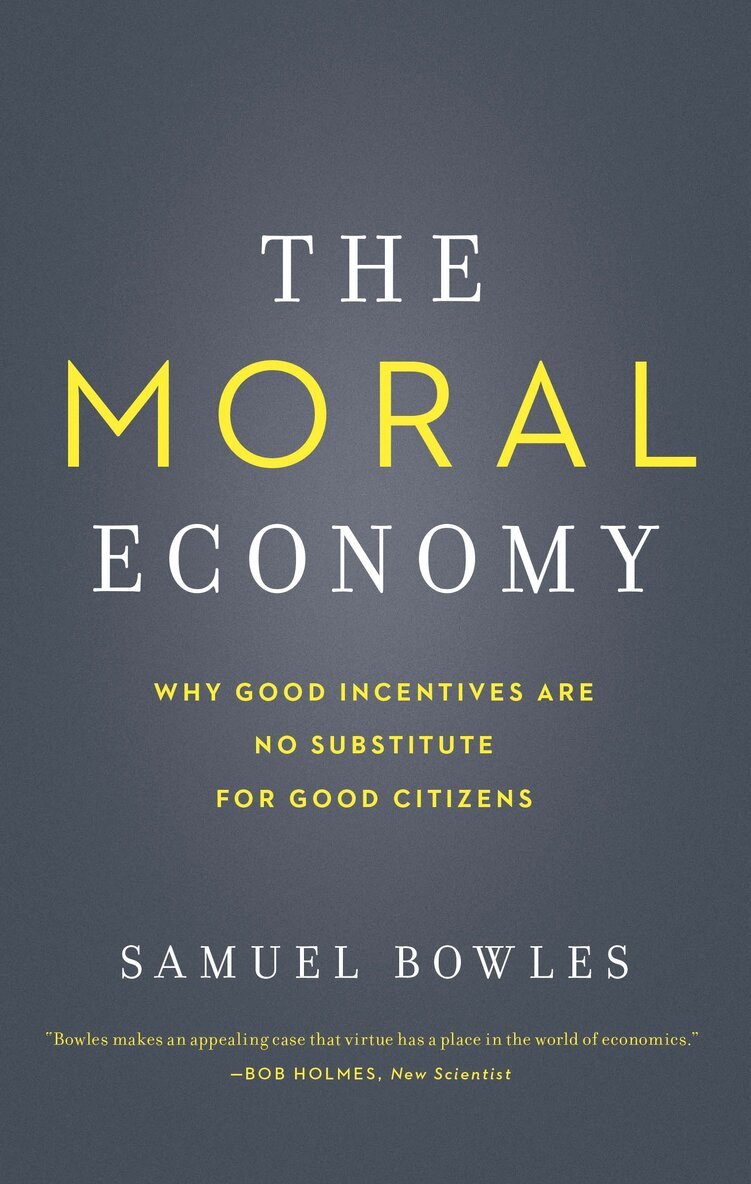
    Moral Economy

    Why Good Incentives Are No Substitute for Good Citizens

    AvSamuel Bowles

    Häftad, Engelska, 2017

    Del i serien Castle Lecture Series

    186 kr

    Beställningsvara. Skickas inom 5-8 vardagar. Fri frakt över 249 kr.

    Beskrivning

    Why do policies and business practices that ignore the moral and generous side of human nature often fail?Should the idea of economic man—the amoral and self-interested Homo economicus—determine how we expect people to respond to monetary rewards, punishments, and other incentives? Samuel Bowles answers with a resounding “no.” Policies that follow from this paradigm, he shows, may “crowd out” ethical and generous motives and thus backfire.  But incentives per se are not really the culprit. Bowles shows that crowding out occurs when the message conveyed by fines and rewards is that self-interest is expected, that the employer thinks the workforce is lazy, or that the citizen cannot otherwise be trusted to contribute to the public good. Using historical and recent case studies as well as behavioral experiments, Bowles shows how well-designed incentives can crowd in the civic motives on which good governance depends.

    Produktinformation

    • Utgivningsdatum:2017-10-24
    • Mått:130 x 203 x 20 mm
    • Vikt:318 g
    • Format:Häftad
    • Språk:Engelska
    • Serie:Castle Lecture Series
    • Antal sidor:288
    • Förlag:Yale University Press
    • ISBN:9780300230512

    Utforska kategorier

    • Nationalekonomi inom Ekonomi och Ledarskap
    • Filosofiska discipliner inom Filosofi och religion

    Mer om författaren

    Samuel Bowles directs the Behavioral Sciences Program at the Santa Fe Institute and is the author of Microeconomics: Behavior, Institutions, and Evolution; A Cooperative Species: Human Reciprocity and Its Evolution (with Herbert Gintis);andThe New Economics of Inequality and Redistribution.

    Recensioner i media

    "In his tightly argued and illuminating book, Bowles makes the case that appeals made to our self-interest can undercut instinctive moral impulses; and that when these impulses are weakened crucial institutions work sub-optimally, if not at all."—Robert Armstrong, Financial Times"Bowles makes an appealing case that virtue has a place in the world of economics . . . adds to a tide of research (such as the work of economist Elinor Ostrom and evolutionary biologist David Sloan Wilson) showing that selfishness is not the only human virtue in the real world."—Bob Holmes, New Scientist“A welcome alternative. . . Bowles persuasively argues that when economists take as given (and thus plan for) a world of utility-maximising agents, they actually help create such a world.”—Rebecca L. Spang, Times Literary Supplement  Won an Honorable Mention for the 2017 Robert Lane Award given by the Organized Political Sections of the APSA"The Moral Economy plows new ground in exploring how the actions we take are motivated by their meaning. Samuel Bowles is proposing a paradigm shift in how we think about our lives and about economics."—George Akerlof, Nobel Laureate in Economics"The Moral Economy convincingly shows that economic incentives and legal constraints alone will not produce a flourishing society because good – morally motivated – people are indispensable. A thought-provoking work!"—Ernst Fehr, Professor of Economics at the University of Zurich"The Moral Economy is a brilliant book. Rarely have such big ideas been communicated in such a compact package. This book should change the way political leaders, policy makers, and social scientists of all stripes do their work and understand the work that they do."—Barry Schwartz, author of Practical Wisdom and Why We Work"In this wonderful book, Sam Bowles explores—with intellectual breadth and analytical acuity—the importance of altruism and a sense of fairness in creating and sustaining decent societies. His prose is lucid, arguments compelling, and conclusions important. This is social science at its very best."—Joshua Cohen, Apple University"Sam Bowles is a visionary thinker who has done more than anyone else I know to unite the social sciences. In this superb book his combination of wisdom and rigor shines through, offering important lessons for anyone who hopes to motivate, govern, or even inspire actual humans."—Joshua Greene, author of Moral Tribes and director of the Moral Cognition Lab, Harvard University