• Fri frakt över 249 kr
  • •
  • Snabba leveranser
  • •
  • Billiga böcker
Kundservice

Du är på sajten för privatpersoner.

Företag, bibliotek eller offentlig verksamhet?

Du handlar på classic.bokus.com, där alla dina funktioner finns intakta.
Till classic.bokus.com
Bokus logotyp. Gå till startsidan.
  • Erbjudanden
  • Student
  • Topplistor
  • Barn & ungdom
  • Bokus Play
  • E-böcker
  • Ljudböcker
  • Pocketböcker
  • Spel och pussel

5% studentrabatt – använd koden KURSBOK27 →

Sidfot

Mina sidor

    Hjälp

    • Kundservice
    • Vanliga frågor och svar
    • Frakt och leverans
    • Retur vid ångerrätt
    • Reklamera vara
    • Betalning
    • Köpvillkor
    • Allmänna villkor
    • Information om webbplatsens tillgänglighet

    Om Bokus

    • Om oss
    • Pressrum
    • För studenter
    • För företag
    • För bibliotek och offentlig verksamhet
    • För leverantörer
    • Hållbarhet

    Populärt

    • Aktuella erbjudanden
    • Presentkort
    • Studentlitteratur
    • Nya böcker
    • Topplistor
    • Signerade böcker
    • Engelska böcker

    Inspiration

    • Boktips
    • BookTok
    • Barnbokskaraktärer
    • Populära författare
    Logotyp för Bokus
    Följ oss på Facebook (extern länk)Följ oss på Instagram (extern länk)Följ oss på YouTube (extern länk)Följ oss på TikTok (extern länk)
    bokus @ CookiesAnpassa cookiesIntegritetspolicyKöpvillkor
    Till Citymail hemsida (extern länk)Till Budbee hemsida (extern länk)Till Postnord hemsida (extern länk)Till Schenker hemsida (extern länk)Till Early Bird hemsida (extern länk)Till Walleys hemsida (extern länk)
    1. Samhälle och politik
    2. Samhälle och kultur
    3. Kultur och medier
    4. Referensverk och tvärvetenskap

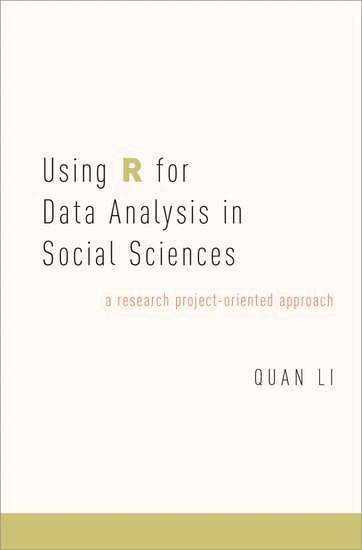
    Using R for Data Analysis in Social Sciences

    A Research Project-Oriented Approach

    AvQuan Li

    Häftad, Engelska, 2018

    642 kr

    Beställningsvara. Skickas inom 5-8 vardagar. Fri frakt över 249 kr.

    Fler format och utgåvor

    Inbunden

    2 278 kr

    E-bok

    604 kr

    E-bok

    604 kr

    Beskrivning

    Statistical analysis is common in the social sciences, and among the more popular programs is R. This book provides a foundation for undergraduate and graduate students in the social sciences on how to use R to manage, visualize, and analyze data. The focus is on how to address substantive questions with data analysis and replicate published findings.Using R for Data Analysis in Social Sciences adopts a minimalist approach and covers only the most important functions and skills in R to conduct reproducible research. It emphasizes the practical needs of students using R by showing how to import, inspect, and manage data, understand the logic of statistical inference, visualize data and findings via histograms, boxplots, scatterplots, and diagnostic plots, and analyze data using one-sample t-test, difference-of-means test, covariance, correlation, ordinary least squares (OLS) regression, and model assumption diagnostics. It also demonstrates how to replicate the findings in published journal articles and diagnose model assumption violations. Because the book integrates R programming, the logic and steps of statistical inference, and the process of empirical social scientific research in a highly accessible and structured fashion, it is appropriate for any introductory course on R, data analysis, and empirical social-scientific research.

    Produktinformation

    • Utgivningsdatum:2018-07-05
    • Mått:231 x 155 x 22 mm
    • Vikt:522 g
    • Format:Häftad
    • Språk:Engelska
    • Antal sidor:368
    • Förlag:OUP USA
    • ISBN:9780190656225

    Utforska kategorier

    • Referensverk och tvärvetenskap inom Samhälle och politik
    • Statsvetenskap och politisk teori inom Samhälle och politik
    • Databaser inom Data och IT

    Mer om författaren

    Dr. Quan Li is Professor of Political Science at Texas A&M University. His research has appeared in over thirty articles in numerous journals and two coauthored books, Democracy and Economic Openness in an Interconnected System: Complex Transformations and Politics and Foreign Direct Investment. He has served on the editorial boards of American Journal of Political Science, Journal of Politics, International Studies Quarterly, and International Interactions.

    Recensioner i media

    "In this useful new book, Quan Li is your expert guide to the R Project for Statistical Computing and the Replication Movement-two massive, ongoing revolutions in quantitative social analysis. If you missed some of the revolutions, do not miss this book."-Gary King, Weatherhead University Professor and director of the Institute for Quantitative Social Science, Harvard University"Using R for Data Analysis in Social Sciences is a tremendous resource for students encountering R and quantitative methods for the first time. Professor Li teaches students nuts and bolts R skills while laying the foundation for statistical inference in the context of motivating questions about politics. Students learn how to describe data, apply the logic of statistical inference, and estimate, diagnose, and interpret linear regression models usingdata from published research. Along the way, Professor Li instills good programming habits and reinforces the importance of replication in the social sciences. This practical approach to data analysis meansUsing R for Data Analysis in Social Sciences will become students' go-to resource and a standard text assigned in undergraduate methods courses in the social sciences." -Suzanna Linn, Professor of Political Science, Penn State University"For any student who is interested in computational social science, this book provides useful guidance into the process of managing, visualizing, and analyzing data. It is unique and clever and contains practical insights into using an open-source R programming environment. The chapter with replication exercises will guide you through applying various statistical methods to conduct independent research. "-In Song Kim, Assistant Professor ofPolitical Science, MIT

    Innehållsförteckning

    • List of Figures List of Tables 1. Learn about R and Write First Toy Programs 2. Get Data Ready: Import, Inspect, and Prepare Data 3. One-Sample and Difference of Means Tests 4. Covariance and Correlation 5. Regression Analysis 6. Regression Diagnostics and Sensitivity Analysis 7. Replicate Findings in Published Analyses 8. Appendix: A Brief Introduction to Analyzing Discrete Data