Inbunden, Engelska, 2006
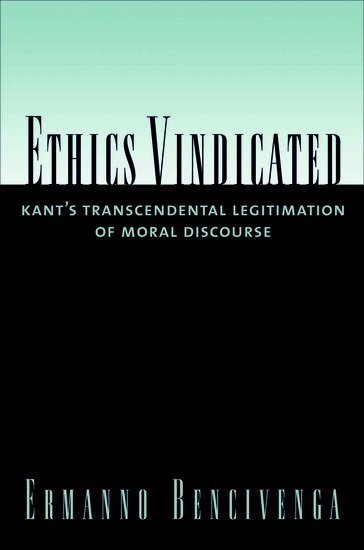
Ethics Vindicated
1316 kr
Beställningsvara. Skickas inom 5-8 vardagar. Fri frakt över 249 kr.
Beskrivning
Can we regard ourselves as having free will? What is the place of values in a world of facts? What grounds the authority of moral injunctions, and why should we care about them? Unless we provide satisfactory answers to these questions, ethics has no credible status and is likely to be subsumed by psychology, history, or rational decision theory. According to Ermanno Bencivenga, this outcome is both common and regrettable. Bencivenga points to Immanuel Kant for the solution. Kant's philosophy is a sustained, bold, and successful effort aiming at offering us the answers we need. Ethics Vindicated is a clear and thorough account of this effort that builds on Bencivenga's previous interpretation of transcendental philosophy (as articulated in his Kant's Copernican Revolution) and draws on the entire Kantian corpus. Free choice is rational choice, hence it is also what reason would consider a good choice; evil behavior is not free—when we behave irrationally, we lose all control of our conduct and become obtuse wheels in the hands of irresistible nature. Which does not mean, however, that we should not take responsibility for our evil actions; on the contrary, that is exactly the right thing to do, despite the absurdity of the stance it involves. And this very absurdity teaches us an important Kantian lesson on how to negotiate the bounds of sense: how there is not a single line demarcating sense from nonsense, but rather a variety of shades of (non)sense, experienced in the wake of an ideal of perfect meaningfulness but forever falling short of that ideal. In pursuing this troubling suggestion, Bencivenga sheds additional light on Kant's understanding of the human form of life; specifically, on its irremediably conflictual, undecidable character, and on the primacy unrealizable norms have in it.
Produktinformation
- Utgivningsdatum: 2006-11-30
- Mått: 213 x 142 x 25 mm
- Vikt: 388 g
- Format: Inbunden
- Språk: Engelska
- Antal sidor: 208
- Förlag: OUP USA
- ISBN: 9780195307351
Utforska kategorier
Betyg & recensioner
0 recensioner
Inga recensioner tillgängliga.