Inbunden, Engelska, 2027
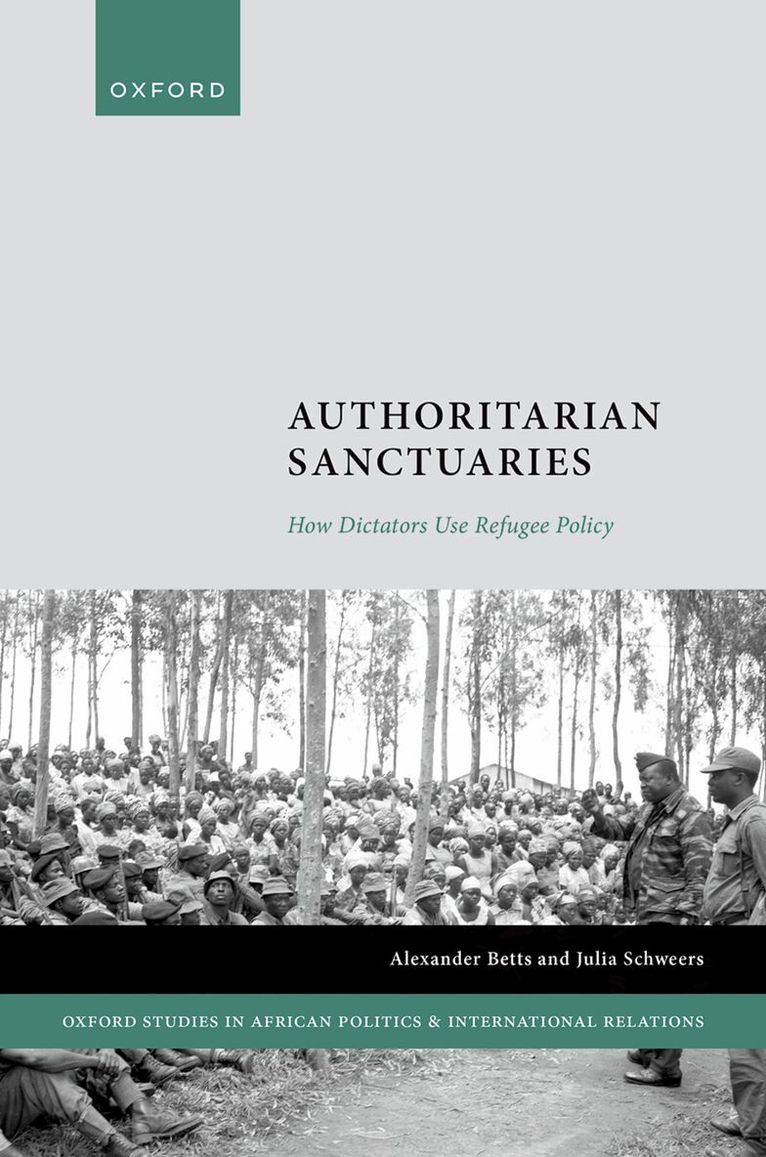
Authoritarian Sanctuaries
Av Alexander Betts, Julia Schweers
1576 kr
Kommande
Beskrivning
Authoritarian states host the majority of the world’s refugees, and have done so throughout the history of the modern refugee system. Despite being generally illiberal and frequently repressive, dictators have often been surprisingly willing to welcome and integrate large numbers of refugees. In order to make sense of this apparent paradox, Authoritarian Sanctuaries looks inside the black box of autocratic refugee policy-making. Focusing on East Africa, it explores the political history of four authoritarian, longstanding refugee-hosting countries: Sudan, Ethiopia, Uganda, and Rwanda, from the 1960s to the present day, revealing how a series of otherwise brutally repressive dictators have been celebrated for their ostensibly liberal refugee policies. Alexander Betts and Julia Schweers argue that dictators are often open and welcoming towards refugees when doing so enables them to access resources that help keep them in power. They explain the logic of authoritarian sanctuary by showing that, in contrast to liberal democracies, the political costs of hosting refugees in autocracies are low due to the absence of elections, while hosting refugees confers benefits that are otherwise scarce in authoritarian regimes: external funding and legitimacy, people who can be recruited into government, and a means to threaten rival states. By revealing the distinctive mechanisms that shape autocratic refugee policy, and how they have varied with temporal changes in international order, the book offers vital insights and cautionary tales for liberal internationalists aspiring to shape progressive refugee policies around the world. Oxford Studies in African Politics and International Relations is a series for scholars and students working on African politics and International Relations and related disciplines. Volumes concentrate on contemporary developments in African political science, political economy, and International Relations, such as electoral politics, democratization, decentralization, gender and political representation, the political impact of natural resources, the dynamics and consequences of conflict, comparative political thought, and the nature of the continent's engagement with the East and West. Comparative and mixed methods work is particularly encouraged. Case studies are welcomed but should demonstrate the broader theoretical and empirical implications of the study and its wider relevance to contemporary debates. The focus of the series is on sub-Saharan Africa, although proposals that explain how the region engages with North Africa and other parts of the world are of interest. Series Editors: Nic Cheeseman (University of Birmingham), Peace Medie (University of Bristol), and Ricardo Soares de Oliveira (Sciences Po, Paris).This is an open access title. It is available to read and download as a free PDF version on Oxford Academic and is made available under a Creative Commons Attribution-Non Commercial-No Derivatives 4.0 International licence.
Produktinformation
- Utgivningsdatum: 2027-01-31
- Mått: 156 x 234 x undefined mm
- Format: Inbunden
- Språk: Engelska
- Serie: Oxford Studies in African Politics and International Relations
- Antal sidor: 336
- Förlag: OUP OXFORD
- ISBN: 9780197926482
Utforska kategorier
Betyg & recensioner
0 recensioner
Inga recensioner tillgängliga.