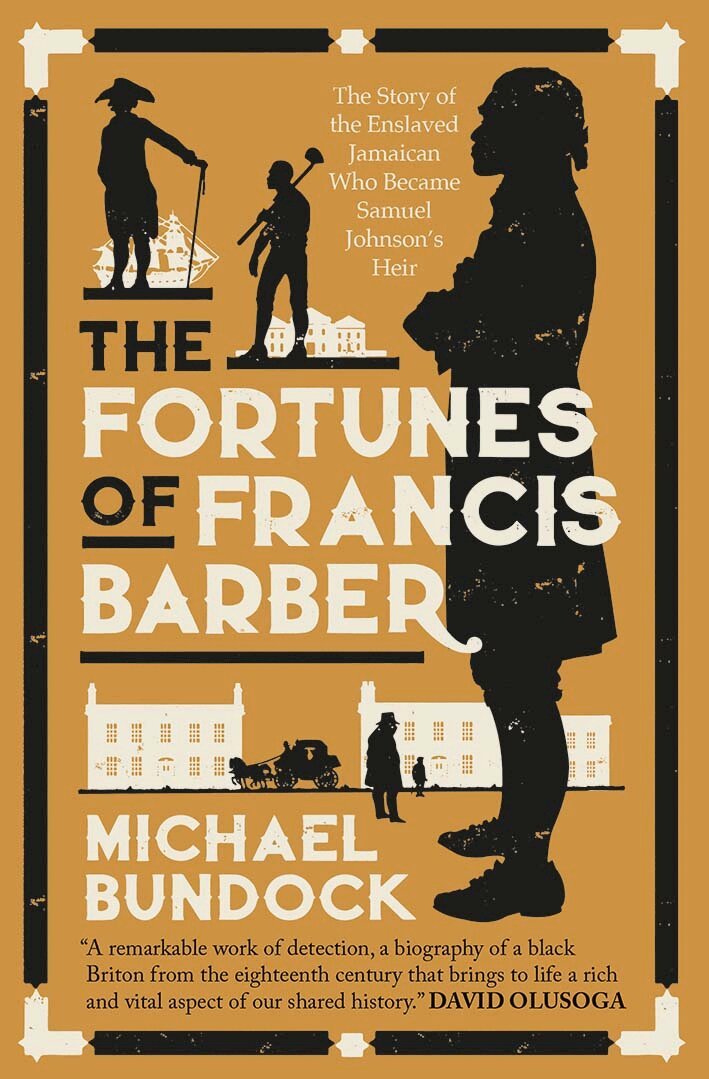
“Bundock is elegant and precise in this detailed account of the life of Samuel Johnson’s black servant and eventual heir.”—Sunday Times, “Best Paperbacks of 2021”“Barber’s story receives expert, sensitive treatment in Bundock’s biography.”—Tony Barber, Financial Times“Another outsider who has attracted a supremely skilled biography this year is Francis Barber, the Jamaican slave who became valet to Samuel Johnson. A model of how to use one apparently insignificant life to break open a historical moment that could otherwise be approached only through historical documents . . . allows Bundock to explore what life felt like for a black man in Georgian England.”—Kathryn Hughes, The Guardian“Elegant, precise, formidably informed. Bundock clears away a fog of falsehoods and rebalances the story.”—John Carey, Sunday Times“[Bundock] imaginatively recreates the textures of life in 18th-century England and shows an admirable determination to question received wisdom.”—Henry Hitchings, The Guardian“Michael Bundock’s accomplished biography tells the story of Dr. Samuel Johnson’s black servant and friend, Francis Barber, giving a much needed biography to a man who has hitherto been relegated to footnote status. . . . Bundock’s scrupulous research finally puts the record straight.”—Paula Byrne, The Times“Bundock weaves into the absorbing tale of Barber’s life a wealth of material relating to black people in England, especially in London, throughout the 18th century. . . . He writes with clarity, sympathy and tact.”—Freya Johnston, Literary Review”The Fortunes of Francis Barber is concise, clear-headed, sympathetic and scholarly.”—Charles Nicholl, London Review of Books“This is an indispensable volume, by far the most readable and comprehensive and authoritative account of Francis Barber’s life that’s ever been written—or that ever could be written, at least with the source materials we currently have.”—Open Letters Monthly“[A] fine biography.”—Kathryn Sutherland, Times Literary Supplement“The most thorough account yet of the child slave who ended up living with Johnson as a father figure.”—Andre Paine, Clerkenwell Post“Michael Bundock has produced a splendidly researched book that valiantly attempts to wrest its subject from the shadows.”—Juliette Foster, Surrey Life“A remarkable work of detection, a biography of a black Briton from the eighteenth century that brings to life a rich and vital aspect of our shared history.”—David Olusoga“At last, the biography that Francis Barber deserves. A meticulous yet imaginative book which teases out the full humanity of Dr. Johnson’s servant—and of the affection and hostility he generated among contemporaries.”—James Walvin, author of The Zong: A Massacre, the Law and the End of Slavery“Michael Bundock has written the first biography in over one hundred years of Francis Barber, Samuel Johnson’s black servant and heir. Acknowledging the groundwork laid over a century ago, Bundock goes well beyond earlier commentators in exploring the evolving relationship between Johnson and Barber.”—Vincent Carretta, University of Maryland“Like James Boswell before him, Michael Bundock is a lawyer, and in his biography of Samuel Johnson’s servant that background serves him well. Reading the evidence, some newly discovered, he brings Francis Barber to life, deepens our understanding of Johnson, enriches our sense of quotidian eighteenth-century London, and provides an unusual contribution to black history in England.”—Robert Folkenflik, University of California, Irvine“The Fortunes of Francis Barber is the most complete and accurate account of the life of Francis Barber that has ever been produced or is ever likely to be produced. This book far outstrips all earlier accounts.”—Robert DeMaria, Jr., Vassar College“No longer a footnote to Johnson’s story, Barber emerges as a man whose complicated story gives an inside view of what it was like to be a black man in 18th-century Britain.”—Gretchen Gerzina, author of Black London“Commendable not only for its careful research, but also for harnessing the considerable power of Barber’s untold story. It will appeal to those who care about history, but it should appeal to those who care about humanity as well.”—Sara Collins, author of The Confessions of Frannie Langton