Beställningsvara. Skickas inom 10-15 vardagar. Fri frakt över 249 kr.
Beskrivning
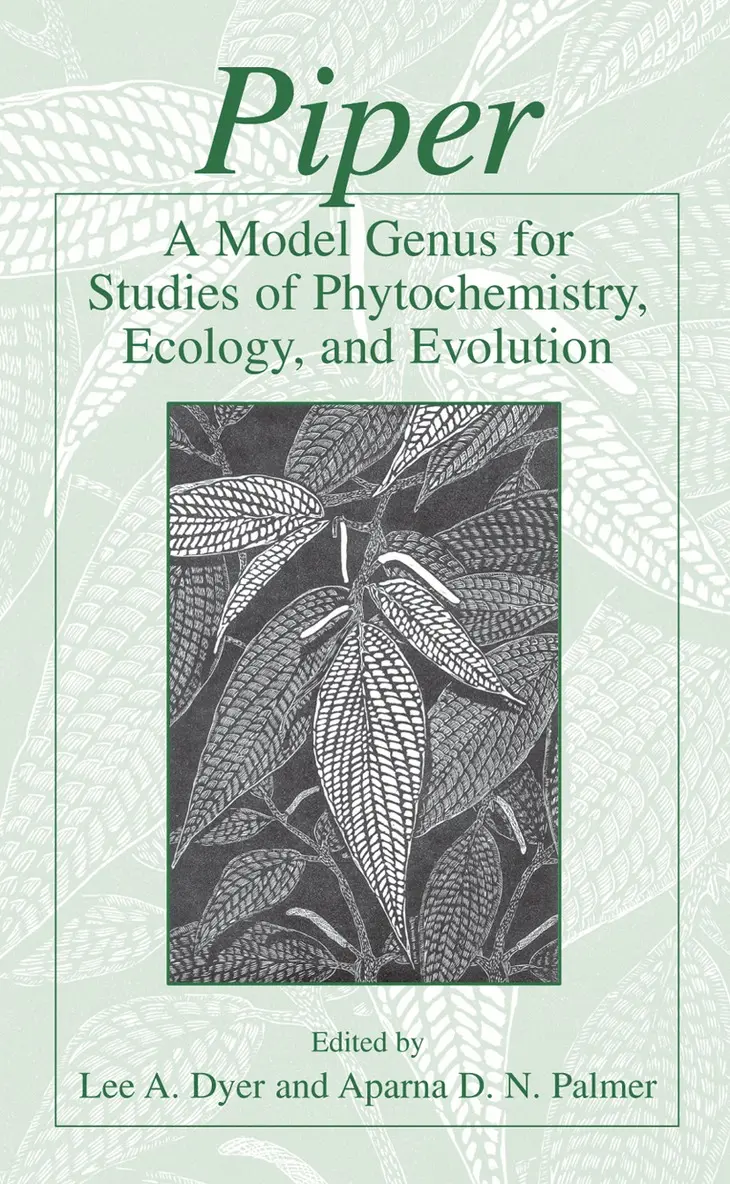
Focusing more on its natural setting, this volume addresses the applied techniques of studying Piper. It synthesizes data and provides an outline for investigations of the chemistry, ecology, and evolution of this taxon, while examining its key themes of Piper as a model genus for ecological and evolutionary studies, and ecological roles.
From the reviews: "This slim volume approaches comparative biology from a perspective rarely seen in book-length treatments. ... The book's premise is that species-rich lineages such as Piper are convenient models for studying questions of general interest using comparative methods. ... The book is generally well edited ... . The book is also attractively produced. ... How well does the book do in attaining its objectives? Fairly well, given the gaps that exist in our knowledge of the genus." (Doyle McKey, Ecology, Vol. 86 (7), 2005)
Innehållsförteckning
1. Introduction.- 2. Mutualism, Antiherbivore Defense, and Trophic Cascades: Piper Ant-Plants as a Mesocosm for Experimentation.- 2.1. Introduction.- 2.2. Study Sites.- 2.3. Plants.- 2.4. Herbivores.- 2.5. Ant Mutualists.- 2.6. Top Predators.- 2.7. Other Endophytic Arthropods, Nematodes, and Annelids.- 2.8. Mutualism Experiments.- 2.9. Tritrophic Interactions and Antiherbivore Defense.- 2.10. Trophic Cascades.- 2.11. Conclusions.- 2.12. Acknowledgments.- 3. Pollination Ecology and Resource Partitioning in Neotropical Pipers.- 3.1. Introduction.- 3.2. Pollination and Resource Partitioning in Piper.- 3.3. Conclusions: Pollination and Resource Partitioning of Pipers in Light of Evolutionary and Conservative Ecology.- 3.4. Guidelines for Future Research on the Pollination of Pipers.- 3.5. Acknowledgments.- 4. Dispersal Ecology of Neotropical Piper Shrubs and Treelets.- 4.1. Introduction.- 4.2. The Piper Bats.- 4.3. Piper Fruiting Phenology and Dispersal Ecology.- 4.4. Coevolutionary Aspects of Bat-Piper Interactions.- 4.5. Conclusions.- 4.6. Acknowledgments.- 5. Biogeography of Neotropical Piper.- 5.1. Introduction.- 5.2. Methods.- 5.3. Results.- 5.4. Discussion.- 5.5. Acknowledgments.- 6. Faunal Studies in Model Piper spp. Systems, with a Focus on Spider-Induced Indirect Interactions and Novel Insect-Piper Mutualisms.- 6.1. Introduction.- 6.2. The Case of Piper obliquum.- 6.3. The Case of Piper urostachyum.- 6.4. Summary and Conclusions.- 6.5. Acknowledgments.- 7. Isolation, Synthesis, and Evolutionary Ecology of Piper Amides.- 7.1. Introduction to Piper Chemistry.- 7.2. Isolation and Quantification of Piper Amides.- 7.3. Synthesis of Piper Amides and Their Analogs.- 7.4. Ecology of Piper Chemistry.- 7.5. Evolution of Piper Chemistry.- 7.6. Applied Piper Chemistry.- 7.7. Future Research on Piper Chemistry.- 7.8. Acknowledgments.- 8. Kava (Piper methysticum): Growth in Tissue Culture and In Vitro Production of Kavapyrones.- 8.1. Introduction.- 8.2. Origins of Kava Use and Discovery by Western Cultures.- 8.3. Description of Kava (Piper methysticum) and Its Growth for Use in Kava Production.- 8.4. Active Phytochemicals Present in Kava Extracts.- 8.5. Issues Regarding the Potential Hepatotoxicity of Kava Extracts.- 8.6. Significance of Tissue Culture Growth in Kava Production and Phytochemical Research.- 8.7. Establishment of Kava Cell Cultures and the Determination of In Vitro Kavapyrone Production.- 8.8. Regeneration of Viable Kava Plants from Kava Cell Cultures.- 8.9. Summary and Perspective.- 9. Phylogenetic Patterns, Evolutionary Trends, and the Origin of Ant—Plant Associations in Piper Section Macrostachys: Burger’s Hypotheses Revisited.- 9.1. Introduction.- 9.2. Taxonomic History of Piper sect. Macrostachys (MIQ.) C.DC..- 9.3. Natural History of Piper sect. Macrostachys.- 9.4. Phylogenetic Relationships in Piper sect. Macrostachys.- 9.5. Burger’s Hypotheses Revisited.- 9.6. Ant-Plant Associations in Piper sect. Macrostachys.- 9.7. Conclusions.- Appendix 9.1.- 10. Current Perspectives on the Classification and Phylogenetics of the Genus Piper L..- 10.1. Introduction.- 10.2. Classification.- 10.3. Phylogeny.- 10.4. Evolutionary Aspects.- 10.5. Acknowledgments.- Appendix 10.1.- 11. Future Research in Piper Biology.- 11.1. Introduction.- 11.2. Plant-Animal Interactions.- 11.3. Abiotic Factors.- 11.4. Geographical Distribution.- 11.5. Summary.