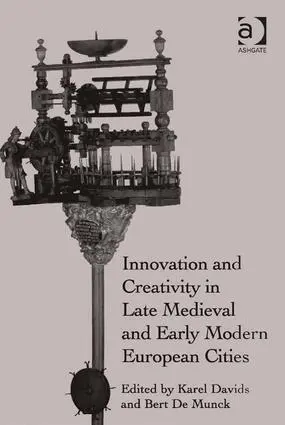
Innovation and Creativity in Late Medieval and Early Modern European Cities (häftad)
Fler böcker inom
Format
Häftad (Paperback / softback)
Språk
Engelska
Antal sidor
438
Utgivningsdatum
2019-12-12
Förlag
Taylor & Francis Ltd
Dimensioner
234 x 156 x 23 mm
Vikt
613 g
ISBN
9780367879419

Innovation and Creativity in Late Medieval and Early Modern European Cities

Häftad,  Engelska, 2019-12-12
650
  • Skickas från oss inom 10-15 vardagar.
  • Fri frakt över 249 kr för privatkunder i Sverige.
Finns även som
Visa alla 3 format & utgåvor
Late medieval and early modern cities are often depicted as cradles of artistic creativity and hotbeds of new material culture. Cities in renaissance Italy and in seventeenth and eighteenth-century northwestern Europe are the most obvious cases in point. But, how did this come about? Why did cities rather than rural environments produce new artistic genres, new products and new techniques? How did pre-industrial cities evolve into centres of innovation and creativity? As the most urbanized regions of continental Europe in this period, Italy and the Low Countries provide a rich source of case studies, as the contributors to this volume demonstrate. They set out to examine the relationship between institutional arrangements and regulatory mechanisms such as citizenship and guild rules and innovation and creativity in late medieval and early modern cities. They analyze whether, in what context and why regulation or deregulation influenced innovation and creativity, and what the impact was of long-term changes in the political and economic sphere.

Visa hela texten

Passar bra ihop

  1. Innovation and Creativity in Late Medieval and Early Modern European Cities
  2. +
  3. Global Ocean of Knowledge, 1660-1860

De som köpt den här boken har ofta också köpt Global Ocean of Knowledge, 1660-1860 av Karel Davids (inbunden).

Köp båda 2 för 2170 kr

Kundrecensioner

Har du läst boken? Sätt ditt betyg »

Fler böcker av författarna

Övrig information

Karel Davids is Chair of Economic and Social History in the Faculty of Arts and the Faculty of Economics at the VU University Amsterdam, the Netherlands. His publications in English include Religion, Technology, and the Great and Little Divergences: China and Europe Compared c.700-1800 (2013); The Rise and Decline of Dutch Technological Leadership. Technology, Economy and Culture in the Dutch Republic, 1350-1800 (2008); and numerous articles on technological, economic and maritime history. Bert De Munck is a Professor in the Department of History at the University of Antwerp, Belgium. He has published on urban history, craft guilds and apprenticeship, vocational training and the circulation of knowledge, and the 'repertoires of evaluation' regarding skills and products. His publications include Gated Communities? Regulating Migration in Early Modern Cities (2012) (co-edited with Anne Winter); Technologies of Learning. Apprenticeship in Antwerp from the 15th Century to the End of the Ancien Régime (2007); and Learning on the Shop Floor. Historical Perspectives on Apprenticeship (2007) (co-edited with Hugo Soly and Steven L. Kaplan).