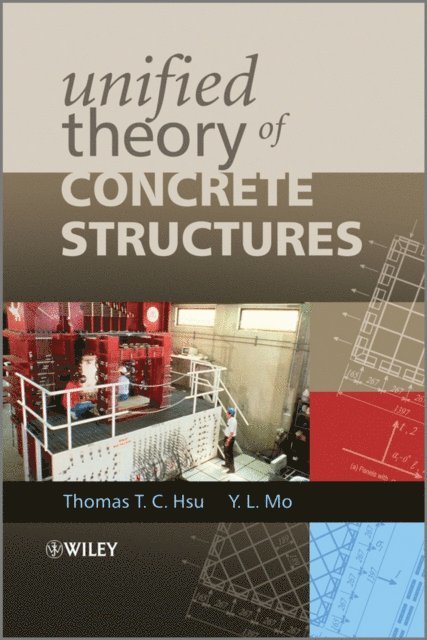
Unified Theory of Concrete Structures
1 850 kr
Beställningsvara. Skickas inom 5-8 vardagar. Fri frakt över 249 kr.
Beskrivning
Produktinformation
- Utgivningsdatum:2010-04-23
- Mått:175 x 248 x 32 mm
- Vikt:1 021 g
- Format:Inbunden
- Språk:Engelska
- Antal sidor:520
- Förlag:John Wiley & Sons Inc
- ISBN:9780470688748
Utforska kategorier
Mer om författaren
Thomas Hsu & Yi-Lung Mo, University of Houston, USAThomas Hsu is Moores Professor of Civil Engineering in the department of civil and environmental engineering at the University of Houston. Professor Hsu has been Principal and Co-Principal Investigator on funded projects for over 30 years, and has received project funding amounting to over $3.5 million, including 14 grants from National Science Foundation totaling $2.2 million. He established the University of Houston's Structural Research Laboratory, which is widely recognized and has supported over thirty Ph. D., M. S., and post-doctoral students. His research work has formed the basis for the shear and torsion design provisions in the American concrete Institute Building Code. His current research interests are in concrete, concrete structures, and structural mechanics. He has won numerous awards for his teaching and research, and has authored? or edited 3 books on reinforced concrete. Yi-Lung Mo is Professor of Civil Engineering in the Department of Civil and Environmental Engineering at the University of Houston. His primary research interests are related to the behavior and design of reinforced/ pre-stressed concrete, steel, hybrid and composite structures subjected to seismic and blast loads. He has authored or edited 3 books on the topics of construction materials and concrete.
Innehållsförteckning
- About the Authors xiPreface xvInstructors’ Guide xvii1 Introduction 11.1 Overview 11.2 Structural Engineering 21.2.1 Structural Analysis 21.2.2 Main Regions vs Local Regions 31.2.3 Member and Joint Design 51.3 Six Component Models of the Unified Theory 61.3.1 Principles and Applications of the Six Models 61.3.2 Historical Development of Theories for Reinforced Concrete 71.4 Struts-and-ties Model 131.4.1 General Description 131.4.2 Struts-and-ties Model for Beams 141.4.3 Struts-and-ties Model for Knee Joints 151.4.4 Comments 202 Equilibrium (Plasticity) Truss Model 232.1 Basic Equilibrium Equations 232.1.1 Equilibrium in Bending 232.1.2 Equilibrium in Element Shear 242.1.3 Equilibrium in Beam Shear 332.1.4 Equilibrium in Torsion 342.1.5 Summary of Basic Equilibrium Equations 372.2 Interaction Relationships 382.2.1 Shear–Bending Interaction 382.2.2 Torsion–Bending Interaction 412.2.3 Shear–Torsion–Bending Interaction 442.2.4 Axial Tension–Shear–Bending Interaction 512.3 ACI Shear and Torsion Provisions 512.3.1 Torsional Steel Design 522.3.2 Shear Steel Design 552.3.3 Maximum Shear and Torsional Strengths 562.3.4 Other Design Considerations 582.3.5 Design Example 602.4 Comments on the Equilibrium (Plasticity) Truss Model 673 Bending and Axial Loads 713.1 Linear Bending Theory 713.1.1 Bernoulli Compatibility Truss Model 713.1.2 Transformed Area for Reinforcing Bars 773.1.3 Bending Rigidities of Cracked Sections 783.1.4 Bending Rigidities of Uncracked Sections 823.1.5 Bending Deflections of Reinforced Concrete Members 843.2 Nonlinear Bending Theory 883.2.1 Bernoulli Compatibility Truss Model 883.2.2 Singly Reinforced Rectangular Beams 933.2.3 Doubly Reinforced Rectangular Beams 1013.2.4 Flanged Beams 1053.2.5 Moment–Curvature (M–φ) Relationships 1083.3 Combined Bending and Axial Load 1123.3.1 Plastic Centroid and Eccentric Loading 1123.3.2 Balanced Condition 1153.3.3 Tension Failure 1163.3.4 Compression Failure 1183.3.5 Bending–Axial Load Interaction 1213.3.6 Moment–Axial Load–Curvature (M−N− φ) Relationship 1224 Fundamentals of Shear 1254.1 Stresses in 2-D Elements 1254.1.1 Stress Transformation 1254.1.2 Mohr Stress Circle 1274.1.3 Principal Stresses 1314.2 Strains in 2-D Elements 1324.2.1 Strain Transformation 1324.2.2 Geometric Relationships 1344.2.3 Mohr Strain Circle 1364.2.4 Principle Strains 1374.3 Reinforced Concrete 2-D Elements 1384.3.1 Stress Condition and Crack Pattern in RC 2-D Elements 1384.3.2 Fixed Angle Theory 1404.3.3 Rotating Angle Theory 1424.3.4 ‘Contribution of Concrete’ (Vc) 1434.3.5 Mohr Stress Circles for RC Shear Elements 1455 Rotating Angle Shear Theories 1495.1 Stress Equilibrium of RC 2-D Elements 1495.1.1 Transformation Type of Equilibrium Equations 1495.1.2 First Type of Equilibrium Equations 1505.1.3 Second Type of Equilibrium Equations 1525.1.4 Equilibrium Equations in Terms of Double Angle 1535.1.5 Example Problem 5.1 Using Equilibrium (Plasticity) Truss Model 1545.2 Strain Compatibility of RC 2-D Elements 1585.2.1 Transformation Type of Compatibility Equations 1585.2.2 First Type of Compatibility Equations 1595.2.3 Second Type of Compatibility Equations 1605.2.4 Crack Control 1615.3 Mohr Compatibility Truss Model (MCTM) 1655.3.1 Basic Principles of MCTM 1655.3.2 Summary of Equations 1665.3.3 Solution Algorithm 1675.3.4 Example Problem 5.2 using MCTM 1685.3.5 Allowable Stress Design of RC 2-D Elements 1725.4 Rotating Angle Softened Truss Model (RA-STM) 1735.4.1 Basic Principles of RA-STM 1735.4.2 Summary of Equations 1745.4.3 Solution Algorithm 1785.4.4 Example Problem 5.3 for Sequential Loading 1815.4.5 2-D Elements under Proportional Loading 1885.4.6 Example Problem 5.4 for Proportional Loading 1945.4.7 Failure Modes of RC 2-D Elements 2025.5 Concluding Remarks 2096 Fixed Angle Shear Theories 2116.1 Softened Membrane Model (SMM) 2116.1.1 Basic Principles of SMM 2116.1.2 Research in RC 2-D Elements 2136.1.3 Poisson Effect in Reinforced Concrete 2166.1.4 Hsu/Zhu Ratios ν12 and ν21 2196.1.5 Experimental Stress–Strain Curves 2256.1.6 Softened Stress–Strain Relationship of Concrete in Compression 2276.1.7 Softening Coefficient ζ 2286.1.8 Smeared Stress–Strain Relationship of Concrete in Tension 2326.1.9 Smeared Stress–Strain Relationship of Mild Steel Bars in Concrete 2366.1.10 Smeared Stress–Strain Relationship of Concrete in Shear 2456.1.11 Solution Algorithm 2466.1.12 Example Problem 6.1 2486.2 Fixed Angle Softened Truss Model (FA-STM) 2556.2.1 Basic Principles of FA-STM 2556.2.2 Solution Algorithm 2576.2.3 Example Problem 6.2 2596.3 Cyclic Softened Membrane Model (CSMM) 2666.3.1 Basic Principles of CSMM 2666.3.2 Cyclic Stress–Strain Curves of Concrete 2676.3.3 Cyclic Stress–Strain Curves of Mild Steel 2726.3.4 Hsu/Zhu Ratios υTC and υCT 2746.3.5 Solution Procedure 2746.3.6 Hysteretic Loops 2766.3.7 Mechanism of Pinching and Failure under Cyclic Shear 2816.3.8 Eight Demonstration Panels 2846.3.9 Shear Stiffness 2876.3.10 Shear Ductility 2886.3.11 Shear Energy Dissipation 2897 Torsion 2957.1 Analysis of Torsion 2957.1.1 Equilibrium Equations 2957.1.2 Compatibility Equations 2977.1.3 Constitutive Relationships of Concrete 3027.1.4 Governing Equations for Torsion 3077.1.5 Method of Solution 3097.1.6 Example Problem 7.1 3147.2 Design for Torsion 3207.2.1 Analogy between Torsion and Bending 3207.2.2 Various Definitions of Lever Arm Area, Ao 3227.2.3 Thickness td of Shear Flow Zone for Design 3237.2.4 Simplified Design Formula for td 3267.2.5 Compatibility Torsion in Spandrel Beams 3287.2.6 Minimum Longitudinal Torsional Steel 3377.2.7 Design Examples 7.2 3388 Beams in Shear 3438.1 Plasticity Truss Model for Beam Analysis 3438.1.1 Beams Subjected to Midspan Concentrated Load 3438.1.2 Beams Subjected to Uniformly Distributed Load 3468.2 Compatibility Truss Model for Beam Analysis 3508.2.1 Analysis of Beams Subjected to Uniformly Distributed Load 3508.2.2 Stirrup Forces and Triangular Shear Diagram 3518.2.3 Longitudinal Web Steel Forces 3548.2.4 Steel Stresses along a Diagonal Crack 3558.3 Shear Design of Prestressed Concrete I-beams 3568.3.1 Background Information 3568.3.2 Prestressed Concrete I-Beam Tests at University of Houston 3578.3.3 UH Shear Strength Equation 3648.3.4 Maximum Shear Strength 3688.3.5 Minimum Stirrup Requirement 3718.3.6 Comparisons of Shear Design Methods with Tests 3728.3.7 Shear Design Example 3758.3.8 Three Shear Design Examples 3799 Finite Element Modeling of Frames and Walls 3819.1 Overview 3819.1.1 Finite Element Analysis (FEA) 3819.1.2 OpenSees–an Object-oriented FEA Framework 3839.1.3 Material Models 3849.1.4 FEA Formulations of 1-D and 2-D Models 3849.2 Material Models for Concrete Structures 3859.2.1 Material Models in OpenSees 3859.2.2 Material Models Developed at UH 3889.3 1-D Fiber Model for Frames 3929.4 2-D CSMM Model for Walls 3939.4.1 Coordinate Systems for Concrete Structures 3939.4.2 Implementation 3949.4.3 Analysis Procedures 3969.5 Equation of Motion for Earthquake Loading 3969.5.1 Single Degree of Freedom versus Multiple Degrees of Freedom 3969.5.2 A Three-degrees-of-freedom Building 3999.5.3 Damping 4009.6 Nonlinear Analysis Algorithm 4029.6.1 Load Control Iteration Scheme 4029.6.2 Displacement Control Iteration Scheme 4039.6.3 Dynamic Analysis Iteration Scheme 4039.7 Nonlinear Finite Element Program SCS 40610 Application of Program SCS toWall-type Structures 41110.1 RC Panels Under Static Load 41110.2 Prestresed Concrete Beams Under Static Load 41310.3 Framed Shear Walls under Reversed Cyclic Load 41410.3.1Framed Shear Wall Units at UH 41410.3.2Low-rise Framed Shear Walls at NCREE 41710.3.3Mid-rise Framed Shear Walls at NCREE 42010.4 Post-tensioned Precast Bridge Columns under Reversed Cyclic Load 42210.5 Framed Shear Walls under Shake Table Excitations 42510.6 A Seven-story Wall Building under Shake Table Excitations 428Appendix 433References 481Index 489
Mer från samma författare
Infrastructure Systems for Nuclear Energy
Thomas T. C. Hsu, Chiun-lin Wu, Jui-Liang Lin
1 847 kr
Infrastructure Systems for Nuclear Energy
Thomas T. C. Hsu, Chiun-lin Wu, Jui-Liang Lin
1 914 kr
Infrastructure Systems for Nuclear Energy
Thomas T. C. Hsu, Chiun-lin Wu, Jui-Liang Lin
Inbunden, 2014
1 640 kr
Du kanske också är intresserad av
High-performance Construction Materials: Science And Applications
SHI CAIJUN, Caijun Shi, Yi-lung Mo
Inbunden, 2008
2 392 kr
Infrastructure Systems for Nuclear Energy
Thomas T. C. Hsu, Chiun-lin Wu, Jui-Liang Lin
1 847 kr
Infrastructure Systems for Nuclear Energy
Thomas T. C. Hsu, Chiun-lin Wu, Jui-Liang Lin
Inbunden, 2014
1 640 kr
Infrastructure Systems for Nuclear Energy
Thomas T. C. Hsu, Chiun-lin Wu, Jui-Liang Lin
1 914 kr
- Nyhet
- Signerad!
- 4 för 3