• Fri frakt över 249 kr
  • •
  • Snabba leveranser
  • •
  • Billiga böcker
Kundservice

Du är på sajten för privatpersoner.

Företag, bibliotek eller offentlig verksamhet?

Du handlar på classic.bokus.com, där alla dina funktioner finns intakta.
Till classic.bokus.com
Bokus logotyp. Gå till startsidan.
  • Erbjudanden
  • Nyheter
  • Student
  • Topplistor
  • Barn & ungdom
  • Bokus Play
  • E-böcker
  • Pocketböcker
  • Spel & pussel

10% rabatt på allt med kod: NYSTART10 →

Sidfot

Mina sidor

    Hjälp

    • Kundservice
    • Vanliga frågor och svar
    • Frakt och leverans
    • Retur vid ångerrätt
    • Reklamera vara
    • Betalning
    • Köpvillkor
    • Allmänna villkor
    • Information om webbplatsens tillgänglighet

    Om Bokus

    • Om oss
    • Pressrum
    • För studenter
    • För företag
    • För bibliotek och offentlig verksamhet
    • För leverantörer
    • Hållbarhet

    Populärt

    • Aktuella erbjudanden
    • Presentkort
    • Studentlitteratur
    • Nya böcker
    • Topplistor
    • Signerade böcker
    • Engelska böcker

    Inspiration

    • Boktips
    • BookTok
    • Populära bokserier
    • Barnbokskaraktärer
    • Populära författare
    Logotyp för Bokus
    Följ oss på Facebook (extern länk)Följ oss på Instagram (extern länk)Följ oss på YouTube (extern länk)Följ oss på TikTok (extern länk)
    bokus @ CookiesAnpassa cookiesIntegritetspolicyKöpvillkor
    Till Citymail hemsida (extern länk)Till Budbee hemsida (extern länk)Till Postnord hemsida (extern länk)Till Schenker hemsida (extern länk)Till Early Bird hemsida (extern länk)Till Walleys hemsida (extern länk)
    1. Naturvetenskap och teknik
    2. Teknik och industri
    3. Elektronik och kommunikationer

    Hot-Carrier Reliability of MOS VLSI Circuits

    AvYusuf Leblebici,Sung-Mo (Steve) Kang

    Inbunden, Engelska, 1993

    Del i serien Springer International Series in Engineering and Computer Science

    2 165 kr

    Beställningsvara. Skickas inom 10-15 vardagar. Fri frakt över 249 kr.

    Fler format och utgåvor

    Häftad

    2 165 kr

    Beskrivning

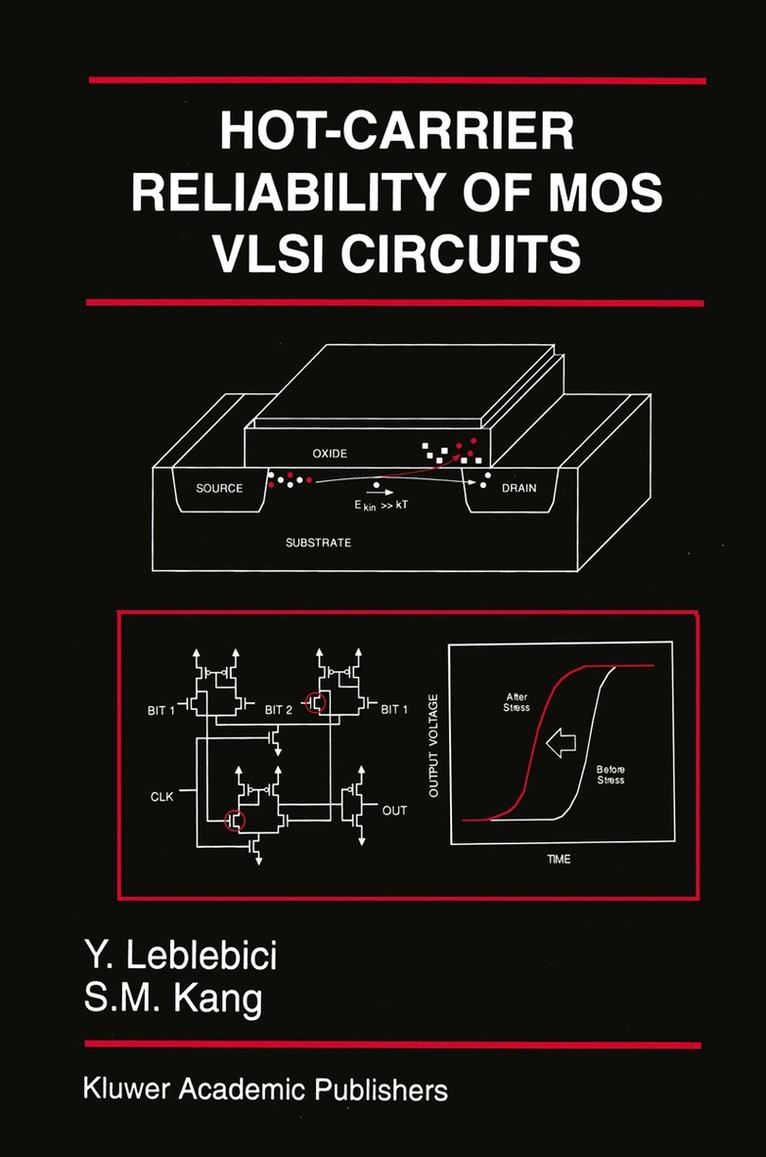
    This volume addresses the issues related to hot-carrier reliability of MOS VLSI circuits, ranging from device physics to circuit design guidelines. It presents a unified view of the physical mechanisms involved in hot-carrier induced device degradation, the prevalent models for these mechanisms, and simulation methods for estimating hot-carrier effects in the circuit environment. The newly emerging approaches to the VLSI design-for-reliability and rule-based reliability diagnosis are also discussed in detail. Hot-Carrier Reliability of MOS VLSI Circuits is primarily for use by engineers and scientists who study device and circuit-level reliability in VLSI systems and develop practical reliability measures and models. VLSI designers will benefit from this book since it offers a comprehensive overview of the interacting mechanisms that influence hot-carrier reliability, and also provides useful guidelines for reliable VLSI design. This volume can be used as an advanced textbook or reference for a graduate-level course on VLSI reliability.

    Produktinformation

    • Utgivningsdatum:1993-06-30
    • Mått:155 x 235 x 18 mm
    • Vikt:521 g
    • Format:Inbunden
    • Språk:Engelska
    • Serie:Springer International Series in Engineering and Computer Science
    • Antal sidor:212
    • Upplaga:1993
    • Förlag:Kluwer Academic Publishers
    • ISBN:9780792393528

    Utforska kategorier

    • Elektronik och kommunikationer inom Naturvetenskap och teknik

    Innehållsförteckning

    • 1. Introduction.- 1.1. The Concept of IC Reliability.- 1.2. Design-for-Reliability.- 1.3. VLSI Reliability Problems.- 1.4. Gradual Degradation versus Catastrophic Failures.- 1.5. Hot-Carrier Effects.- 1.6. Overview of the Book.- References.- 2. Oxide Degradation Mechanisms in Mos Transistors.- 2.1. Introduction.- 2.2. MOS Transistor: A Qualitative View.- 2.3. The Nature of Gate Oxide Damage in MOSFETs.- 2.4. Injection of Hot Carriers into Gate Oxide.- 2.5. Oxide Traps and Charge Trapping.- 2.6. Interface Trap Generation.- 2.7. Bias Dependence of Degradation Mechanisms.- 2.8. Degradation under Dynamic Operating Conditions.- 2.9. Effects of Hot-Carrier Damage on Device Characteristics.- 2.10. Hot-Carrier Induced Degradation of pMOS Transistors.- References.- 3.Modeling of Degradation Mechanisms.- 3.1. Preliminary Remarks.- 3.2. Quasi-Elastic Scattering Current Model.- 3.3. Charge (Electron) Trapping Model.- 3.4. Impact Ionization Current Model.- 3.5. Interface Trap Generation Model.- 3.6. Trap Generation under Dynamic Operating Conditions.- References.- 4. Modeling of Damaged Mosfets.- 4.1. Introduction.- 4.2. Representation of Hot-Carrier Induced Oxide Damage.- 4.3. Two-Dimensional Modeling of Damaged MOSFETs.- 4.4. Empirical One-Dimensional Modeling.- 4.5. An Analytical Damaged MOSFET Model.- 4.6. Consideration of Channel Velocity Limitations.- 4.7. Pseudo Two-Dimensional Modeling of Damaged MOSFETs.- 4.8. Table-Based Modeling Approaches.- References.- 5. Transistor-Level Simulation for Circuit Reliability.- 5.1. Introduction.- 5.2. Review of Circuit Reliability Simulation Tools.- 5.3. Circuit Reliability Simulation Using iSMILE: A Case Study.- 5.4. Circuit Simulation Examples.- 5.5. Evaluation of the Simulation Algorithm.- 5.6. Identification of Critical Devices.- References.- 6. Fast Timing Simulation for Circuit Reliability.- 6.1. Introduction.- 6.2. ILLIADS-R: A Fast Timing and Reliability Simulator.- 6.3. Fast Dynamic Reliability Simulation.- 6.4. Circuit Simulation Examples with ILLIADS-R.- 6.5. iDSIM2: Hierarchical Circuit Reliability Simulation.- References.- 7. Macromodeling of Hot-Carrier Induced Degradation in Mos Circuits.- 7.1. Introduction.- 7.2. Macromodel Development: Starting Assumptions.- 7.3. Degradation Macromodel for CMOS Inverters.- 7.4. Degradation Macromodel for nMOS Pass Gates.- 7.5. Application of the Macromodel to Inverter Chain Circuits.- 7.6. Application of the Macromodel to CMOS Logic Circuits.- References.- 8. Circuit Design for Reliability.- 8.1. Introduction.- 8.2. Device-Level Measures.- 8.3. Circuit-Level Measures.- 8.4. Rule-Based Diagnosis of Circuit Reliability.- References.