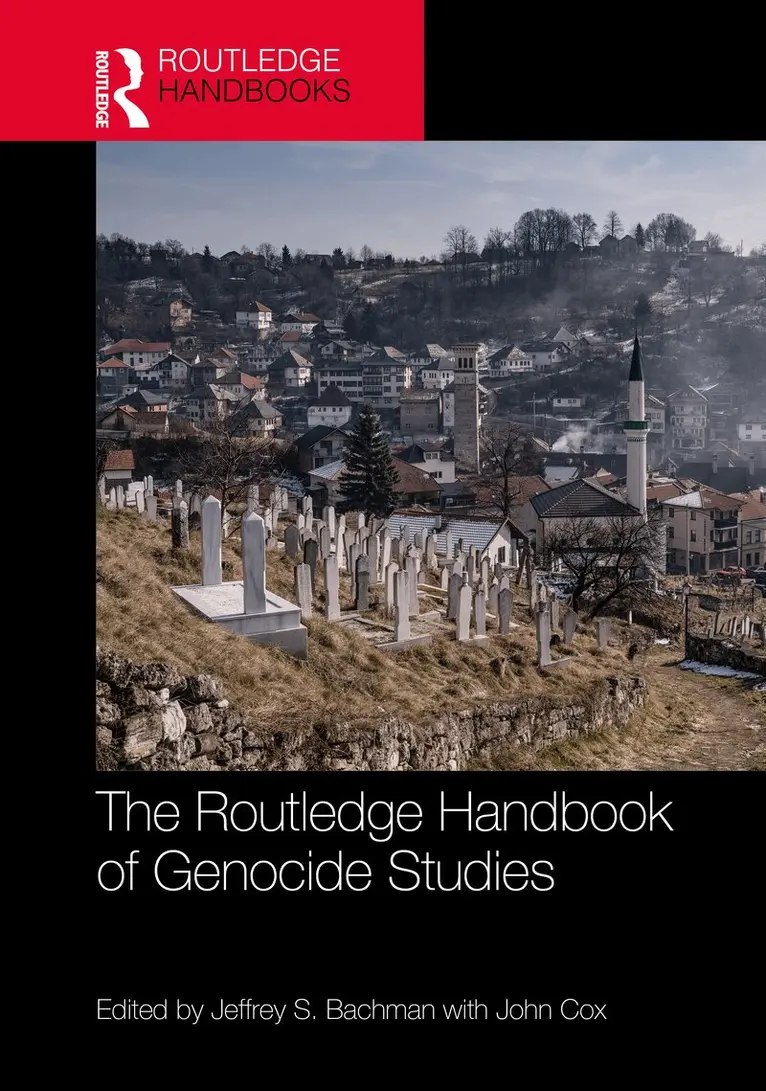
3 323 kr
Kommande
Beskrivning
Produktinformation
- Utgivningsdatum:2026-10-15
- Mått:174 x 246 x undefined mm
- Vikt:453 g
- Format:Inbunden
- Språk:Engelska
- Antal sidor:846
- Förlag:Taylor & Francis Inc
- ISBN:9780815362869
Utforska kategorier
Mer om författaren
Jeffrey S. Bachman is Cohen Endowed Chair in Holocaust and Genocide Studies at Keene State College. He is author of Harry Potter and Genocide: An Introduction to Genocide Studies Through the World of Harry Potter (2026), The Politics of Genocide: From the Genocide Convention to the Responsibility to Protect (2022), and The United States and Genocide: (Re)Defining the Relationship (2017); editor of Genocide Studies: Pathways Ahead (2024) and Cultural Genocide: Law, Politics, and Global Manifestations (2019); and co-editor of A Modern History of Forgotten Genocide and Mass Atrocities (2024).John Cox is Associate Professor of Global Studies and History at the University of North Carolina Charlotte, where he directs the Center for Holocaust, Genocide, and Human Rights Studies. Among Cox’s publications are his 2017 To Kill a People: Genocide in the 20th Century (Oxford University Press) and a recent co-authored book, Genocide: A Thematic Approach (Anthem, 2026). His other works include a book on leftist and Jewish resistance inside Nazi Germany, Circles of Resistance (2009) and the co-edited collection Denial: The Final Stage of Genocide? (Routledge, 2021). John’s articles and book chapters include a 2024 essay for the UCLA Law School on the Gaza genocide. Cox earned his Ph.D. in History at UNC-Chapel Hill in 2006, and he has been a scholar, educator, and activist for human rights for the last 30 years.
Recensioner i media
“This volume represents a major contribution to the field of genocide studies that will shape scholarship for years to come. It combines rigorous scholarship with moral urgency. It will be a vital resource for students, researchers, activists, policymakers, and all those committed to making ’never again’ a reality.”Dr. James Waller, Christopher J. Dodd Chair in Human Rights Practice, University of Connecticut“This handbook truly showcases the breadth and depth of the genocide studies field. The volume contains contributions from an impressive range of scholarly disciplines, bringing unique perspectives together into an extensive collection. The chapters provide both new insights on the theoretical and legal underpinnings of genocide as well as applications to under-studied episodes of genocide. This handbook will be an invaluable tool to scholars and instructors alike.”Francesca Parente, Assistant Professor of Political Science and Director of the Reiff Center for Human Rights and Conflict Resolution, Christopher Newport University“The Routledge Handbook of Genocide Studies assembles a group of talented emerging and established scholars from a variety of disciplinary perspectives, each presenting a novel examination of a key topic in this field of study. The book offers not only a comprehensive overview of genocide studies, but also pushes it in new and critical directions. It therefore serves as a vision for the field’s future as much as an overview of its past. Readers will discover both the vibrancy of genocide scholarship and the challenges faced in efforts to acknowledge, prevent, cease, historicize, narrate, represent, and redress genocidal violence.”Andrew Woolford, Professor of Sociology and Criminology, University of Manitoba “The Routledge Handbook of Genocide Studies is an essential resource for scholars, practitioners, and students alike. Editors Jeff Bachman and John Cox have curated a comprehensive volume that covers an impressive range of topics, from the legal frameworks surrounding genocide to the social, psychological, and political dynamics that duel these atrocities. The diversity of disciplinary approaches and case studies from around the world offers readers a nuanced, multifaceted understanding of genocide, making this handbook an invaluable tool for anyone seeking to engage with both the historical and contemporary challenges of mass violence.”Kristina Hook, PhD, Assistant Professor of Conflict Management, School of Conflict Management, Peacebuilding, and Development, Kennesaw State University “Comprised of analytical and case study entries from emerging and established scholars, the Handbook helpfully synthesizes long-standing debates in the genocide studies literature, captures the current state of the field, and points the way forward. It will surely become a well-thumbed volume on the bookshelves of students, academics, and practitioners alike.”Maureen S. Hiebert, PhD, Associate Professor of Political Science and Research Fellow, Centre for Military, Security and Strategic Studies, University of Calgary “The Routledge Handbook of Genocide Studies is a major contribution to the field of genocide studies. This comprehensive volume brings together leading figures and specialists from around the globe to address the phenomenon of genocide from a variety of perspectives, including gender, space, political regimes, war, perpetrators, the environment, culture, propaganda, music, images and memorials. These approaches revisit classic debates and topics from new angles, opening up new fields of enquiry with original and pertinent questions. Adopting a variety of analytical scales, the book combines an ambitious geographical scope — including national cases from all continents — with a broad timeframe. This book is undoubtedly a vital contribution not only to the academic world, but also to the general public who are committed to human rights, memory and world peace.”Soledad Catoggio, PhD, Researcher at the Consejo Nacional de Investigaciones Científicas y Técnicas and Professor of Latin American Social History at the University of Buenos Aires
Innehållsförteckning
- Introduction Part I: Roots and Causes A Note on Genocide, Imperialism, and Colonialism Chapter 1 - Totalitarianism and Genocide Chapter 2 - Genocide and Modernity - An Introduction to Postcolonial Genocide Chapter 3 - Genocide at the Margins? Civilizational-Developmentalist Imperatives, Biospheric Collapse, and the Destruction of Fourth World Peoples Chapter 4 - War and Genocide Chapter 5 - A Climate of Harm: International Law, Propaganda, and Genocide Part II: Disciplinary Perspectives Chapter 6 - Legible Testimonies: Raphaël Lemkin, the Victim’s Voice, and the Global History of Genocide Chapter 7 - Exploring the Concepts of Genocide, Politicide, and Crimes against Humanity: Disciplinary Perspectives on Massive State Crimes Chapter 8 - Quantifying Genocide in Its Temporal and Perpetrational Extensions through a Five-Dimensional Typology Chapter 9 - Cultural Genocide Chapter 10 - Gendered Genocides in Namibia and Anatolia Chapter 11 - Geography and Genocide Chapter 12 - Perpetrators Part III: Genocide Through History Chapter 13 - Genocide through History: Antiquity Chapter 14 - Detain, Displace, Destroy: Concentration Camps and the Global History of Genocide Chapter 15 - Famine in the Context of Genocide by Attrition Chapter 16 - “Just and Lawful War” as Genocidal War in the (United States) Northwest Ordinance and Northwest Territory, 1787–1832 Chapter 17 - Indigenous Peoples and Settler Colonial Genocide in Canada: From Reconciliation to Reparations Chapter 18 - Genocide in Australia Chapter 19 - Genocide, Race, and Humanitarianism: The Case of the Congo Free State Part IV: The 20th Century: Genocide Before the Convention Chapter 20 - “I Deem it Wiser for the Entire Nation to Perish”: Genocide of the Herero People, 1904-1915 Chapter 21 – The Armenian Genocide: An Introduction Chapter 22 - Russia’s Genocidal Gaze: Ethnic Cleansing and the Deportation of Peoples Chapter 23 - The Intoxication of Genocidal Camaraderie and Mass Murder Chapter 24 - The Black Freedom Movement and the Politics of the Anti-Genocide Norm in the United States, 1951 – 1967 Part V: Genocide Since 1948 Chapter 25 - The Mao Era, 1949-1976 Chapter 26 - Genocide in Indochina and Indonesia Chapter 27 - Three Genocides, One History: A Vacuum of Violence Connecting DRC, Burundi, and Rwanda Chapter 28 - “They Will Rot the Society, Rot the Party, and Rot the Army”: Toxification as an Ideology and Motivation for Perpetrating Violence in the Khmer Rouge Genocide? Chapter 29 - Genocide in Guatemala: The “Indian Problem” and Maya Resistance and Revindication Chapter 30 – Not Just Srebrenica: Mapping the Full Architecture of the Bosnian Genocide Chapter 31 - Genocide in Sudan, 2003-present Chapter 32 - The Evolution of Moscow’s Genocide against Ukrainians in the Twentieth and Twenty-First Centuries Chapter 33 - When Safety is Annihilation: Israel’s Permanent Security and the 2023 Gaza War Part VI: Interventions and Aftermaths Chapter 34 - Preventing Genocide Chapter 35 - It Never Happened: Denial of Genocides in the Modern Period Chapter 36 - Genocide and the Forensic Turn: Giving Voice to the Dead in the Aftermath of Major Crimes Chapter 37 - Transitional and Transformative Justice Chapter 38 - The Promise and Perils of State Responsibility for Genocide Part VII: Cultural Legacies Chapter 39 – The Spanish Holocaust in Political and Cultural Memory Chapter 40 - Memoir Literature on Genocide in the Twentieth and Twenty-First Centuries: Evolution, Devolution, Resistance Chapter 41 - Girl with the Sak Yon Tattoo Chapter 42 - Sequels of Silence: Venturing into Genocide with a Camera in Argentina Chapter 43 - The Courage to Understand: Raoul Peck’s HBO Docuseries, Exterminate All the Brutes Chapter 44 - Genocide and Music Chapter 45 - Genocide Memorials Chapter 46 - Genocide Education: Goals, Challenges, Frameworks, and Practices
Du kanske också är intresserad av
The Cultures of Maimonideanism: New Approaches to the History of Jewish Thought
James T. Robinson
3 323 kr
Modern History of Forgotten Genocides and Mass Atrocities
Jeffrey S. Bachman, Esther Brito Ruiz
539 kr