• Fri frakt över 249 kr
  • •
  • Snabba leveranser
  • •
  • Billiga böcker
Kundservice

Du är på sajten för privatpersoner.

Företag, bibliotek eller offentlig verksamhet?

Du handlar på classic.bokus.com, där alla dina funktioner finns intakta.
Till classic.bokus.com
Bokus logotyp. Gå till startsidan.
  • Erbjudanden
  • Nyheter
  • Student
  • Topplistor
  • Barn & ungdom
  • Bokus Play
  • E-böcker
  • Pocketböcker
  • Spel & pussel

10% rabatt på allt med kod: NYSTART10 →

Sidfot

Mina sidor

    Hjälp

    • Kundservice
    • Vanliga frågor och svar
    • Frakt och leverans
    • Retur vid ångerrätt
    • Reklamera vara
    • Betalning
    • Köpvillkor
    • Allmänna villkor
    • Information om webbplatsens tillgänglighet

    Om Bokus

    • Om oss
    • Pressrum
    • För studenter
    • För företag
    • För bibliotek och offentlig verksamhet
    • För leverantörer
    • Hållbarhet

    Populärt

    • Aktuella erbjudanden
    • Presentkort
    • Studentlitteratur
    • Nya böcker
    • Topplistor
    • Signerade böcker
    • Engelska böcker

    Inspiration

    • Boktips
    • BookTok
    • Populära bokserier
    • Barnbokskaraktärer
    • Populära författare
    Logotyp för Bokus
    Följ oss på Facebook (extern länk)Följ oss på Instagram (extern länk)Följ oss på YouTube (extern länk)Följ oss på TikTok (extern länk)
    bokus @ CookiesAnpassa cookiesIntegritetspolicyKöpvillkor
    Till Citymail hemsida (extern länk)Till Budbee hemsida (extern länk)Till Postnord hemsida (extern länk)Till Schenker hemsida (extern länk)Till Early Bird hemsida (extern länk)Till Walleys hemsida (extern länk)
    1. Data och IT
    2. Systemvetenskap och AI
    3. Artificiell intelligens

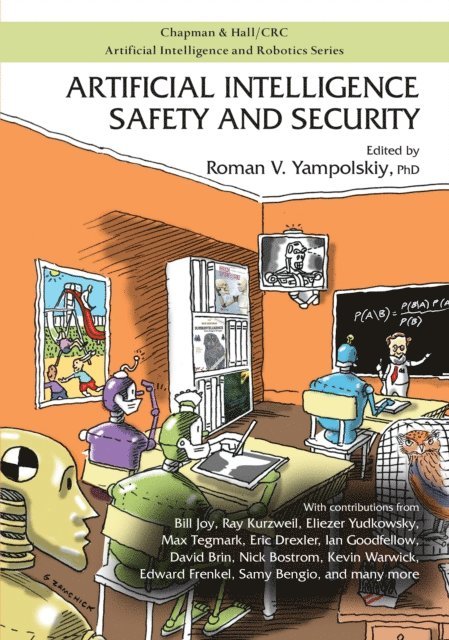
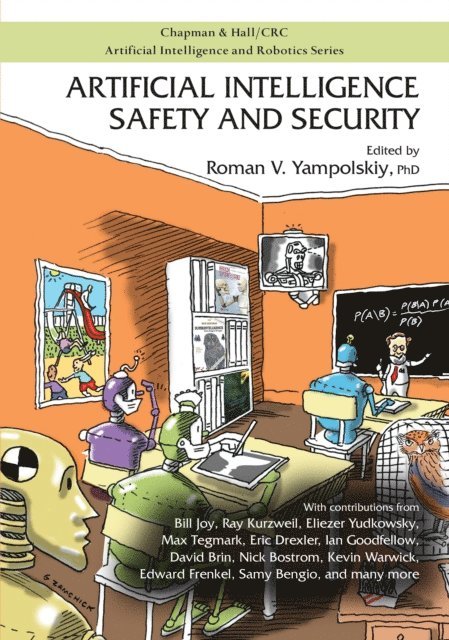
    Artificial Intelligence Safety and Security

    AvRoman V. Yampolskiy

    Häftad, Engelska, 2018

    Del i serien Chapman & Hall/CRC Artificial Intelligence and Robotics Series

    845 kr

    Beställningsvara. Skickas inom 10-15 vardagar. Fri frakt över 249 kr.

    Beskrivning

    The history of robotics and artificial intelligence in many ways is also the history of humanity’s attempts to control such technologies. From the Golem of Prague to the military robots of modernity, the debate continues as to what degree of independence such entities should have and how to make sure that they do not turn on us, its inventors. Numerous recent advancements in all aspects of research, development and deployment of intelligent systems are well publicized but safety and security issues related to AI are rarely addressed. This book is proposed to mitigate this fundamental problem. It is comprised of chapters from leading AI Safety researchers addressing different aspects of the AI control problem as it relates to the development of safe and secure artificial intelligence. The book is the first edited volume dedicated to addressing challenges of constructing safe and secure advanced machine intelligence. The chapters vary in length and technical content from broad interest opinion essays to highly formalized algorithmic approaches to specific problems. All chapters are self-contained and could be read in any order or skipped without a loss of comprehension.

    Produktinformation

    • Utgivningsdatum:2018-08-23
    • Mått:178 x 254 x 25 mm
    • Vikt:850 g
    • Format:Häftad
    • Språk:Engelska
    • Serie:Chapman & Hall/CRC Artificial Intelligence and Robotics Series
    • Antal sidor:444
    • Förlag:Taylor & Francis Inc
    • ISBN:9780815369820

    Utforska kategorier

    • Artificiell intelligens inom Data och IT
    • IT-säkerhet inom Data och IT

    Mer om författaren

    Dr. Roman V. Yampolskiy is a Tenured Associate Professor in the department of Computer Engineering and Computer Science at the Speed School of Engineering, University of Louisville. He is the founding and current director of the Cyber Security Lab and an author of many books including Artificial Superintelligence: a Futuristic Approach. During his tenure at UofL, Dr. Yampolskiy has been recognized as: Distinguished Teaching Professor, Professor of the Year, Faculty Favorite, Top 4 Faculty, Leader in Engineering Education, Top 10 of Online College Professor of the Year, and Outstanding Early Career in Education award winner among many other honors and distinctions. Yampolskiy is a Senior member of IEEE and AGI; Member of Kentucky Academy of Science, former Research Advisor for MIRI and Associate of GCRI. Dr. Yampolskiy’s main areas of interest are AI Safety, Artificial Intelligence, Behavioral Biometrics, Cybersecurity, Genetic Algorithms, and Pattern Recognition. Dr. Yampolskiy is an author of over 150 publications including multiple journal articles and books. His research has been cited by 1000+ scientists and profiled in popular magazines both American and foreign (New Scientist, Poker Magazine, Science World Magazine), dozens of websites (BBC, MSNBC, Yahoo! News), on radio (German National Radio, Swedish National Radio) and TV. Dr. Yampolskiy’s research has been featured 1000+ times in numerous media reports in 30 languages.

    Recensioner i media

    "Artificial intelligence: Safety and Security is a timely and ambitious edited volume. It comprises 28 chapters organized under three distinct themes: security, artificial intelligence and safety. Edited by Roman V. Yampolskiy, the contributions are well integrated and challenge common conceptions. Yampolskiy has assembled a diverse team of leading scholars.In sum, the book provides valuable insight into the cyber ecosystem. It can be read in any order without missing the essence of the subject matter, yet the chapters speak to each other. The chapters provide insight into new research areas and experimental designs. The book is a must-read for computer scientists, security experts, mathematicians, students and individuals who are interested in learning more about the progress of the artificial intelligence field. It will also be of interest to hackers and the intelligence community."-International Affairs, Volume 95, Issue 3, May 2019, Pages 728–729, https://doi.org/10.1093/ia/iiz016"There are those of us who philosophize and debate the finer points surrounding the dangers of artificial intelligence. And then there are those who dare go in the trenches and get their hands dirty by doing the actual work that may just end up making the difference. So if AI turns out to be like the terminator then Prof. Roman Yampolskiy may turn out to be like John Connor – but better. Because instead of fighting by using guns and brawn he is utilizing computer science, human intelligence and code."-Nikola Danaylov (author of Conversations with the Future: 21 Visions for the 21st Century) "Artificial Intelligence Safety and Security is an interesting read to learn about risks associated with the rapid growth of autonomous AI systems around us. While benefits of such systems are going to be enormous, so will be the risks if their power is left unchecked. A skillfully edited volume by my Computer Science and Engineering University of Louisville colleague, Dr. Roman Yampolskiy."-Jacek ZURADA, Ph.D., Candidate for IEEE President, IEEE Life Fellow, Professor of Electrical and Computer Engineering Department, University of Louisville"This amazing and brand-new book with 47 contributors and more than 470 densely packed pages will immediately be recognized as indispensable in the AI safety and AI futurology literature. Among the 28 chapters, the first 11 more or less have the status of modern classics. The remaining 17 are new …"-Olle Häggström, Professor of mathematical statistics at Chalmers University"Yampolskiy (Univ. of Louisville) furnishes readers with a thoughtful discussion of the state of the art regarding the safety and security of artificial intelligence (AI). To fully appreciate this text, readers must read the editor's preface. In it, he lays out the history of AI with a focus on its failures and how these might have been prevented, previewing themes to be explored in depth in the coming 28 chapters, contributed by 46 researchers in the field of AI. [. . . .] This text offers a comprehensive look at an emerging field; it is best suited for specialists."-J. Beidler, emeritus, University of Scranton, Pennsylvania, United States of America

    Innehållsförteckning

    • Preface: Introduction to AI Safety and SecurityAcknowledgmentsEditorContributorsPart I Concerns of LuminariesChapter 1 Why the Future Doesn’t Need UsBill JoyChapter 2 The Deeply Intertwined Promise and Peril of GNRRay KurzweilChapter 3 The Basic AI DrivesStephen M. OmohundroChapter 4 The Ethics of Artificial IntelligenceNick Bostrom and Eliezer YudkowskyChapter 5 Friendly Artificial Intelligence: The Physics ChallengeMax TegmarkChapter 6 MDL Intelligence Distillation: Exploring Strategies for Safe Access to Superintelligent Problem-Solving CapabilitiesK. Eric DrexlerChapter 7 The Value Learning ProblemNate SoaresChapter 8 Adversarial Examples in the Physical WorldAlexey Kurakin, Ian J. Goodfellow, and Samy BengioChapter 9 How Might AI Come About?: Different Approaches and Their Implications for Life in the UniverseDavid Brin Chapter 10 The MADCOM Future: How Artificial Intelligence Will Enhance Computational Propaganda, Reprogram Human Culture, and Threaten Democracy … and What can be Done About ItMatt ChessenChapter 11 Strategic Implications of Openness in AI DevelopmentNick BostromPart II Responses of ScholarsChapter 12 Using Human History, Psychology, and Biology to Make AI Safe for HumansGus BekdashChapter 13 AI Safety: A First-Person PerspectiveEdward FrenkelChapter 14 Strategies for an Unfriendly Oracle AI with Reset ButtonOlle HäggströmChapter 15 Goal Changes in Intelligent AgentsSeth Herd, Stephen J. Read, Randall O’Reilly, and David J. JilkChapter 16 Limits to Verification and Validation of Agentic BehaviorDavid J. JilkChapter 17 Adversarial Machine LearningPhillip Kuznetsov, Riley Edmunds, Ted Xiao, Humza Iqbal, Raul Puri, Noah Golmant, and Shannon ShihChapter 18 Value Alignment via Tractable Preference DistanceAndrea Loreggia, Nicholas Mattei, Francesca Rossi, and K. Brent VenableChapter 19 A Rationally Addicted Artificial SuperintelligenceJames D. MillerChapter 20 On the Security of Robotic Applications Using ROSDavid Portugal, Miguel A. Santos, Samuel Pereira, and Micael S. CouceiroChapter 21 Social Choice and the Value Alignment ProblemMahendra PrasadChapter 22 Disjunctive Scenarios of Catastrophic AI RiskKaj SotalaChapter 23 Offensive Realism and the Insecure Structure of the International System: Artificial Intelligence and Global HegemonyMaurizio TinnirelloChapter 24 Superintelligence and the Future of Governance: On Prioritizing the Control Problem at the End of HistoryPhil TorresChapter 25 Military AI as a Convergent Goal of Self-Improving AIAlexey Turchin and David DenkenbergerChapter 26 A Value-Sensitive Design Approach to Intelligent AgentsSteven Umbrello and Angelo F. De BellisChapter 27 Consequentialism, Deontology, and Artificial Intelligence SafetyMark WalkerChapter 28 Smart Machines ARE a Threat to HumanityKevin WarwickIndex