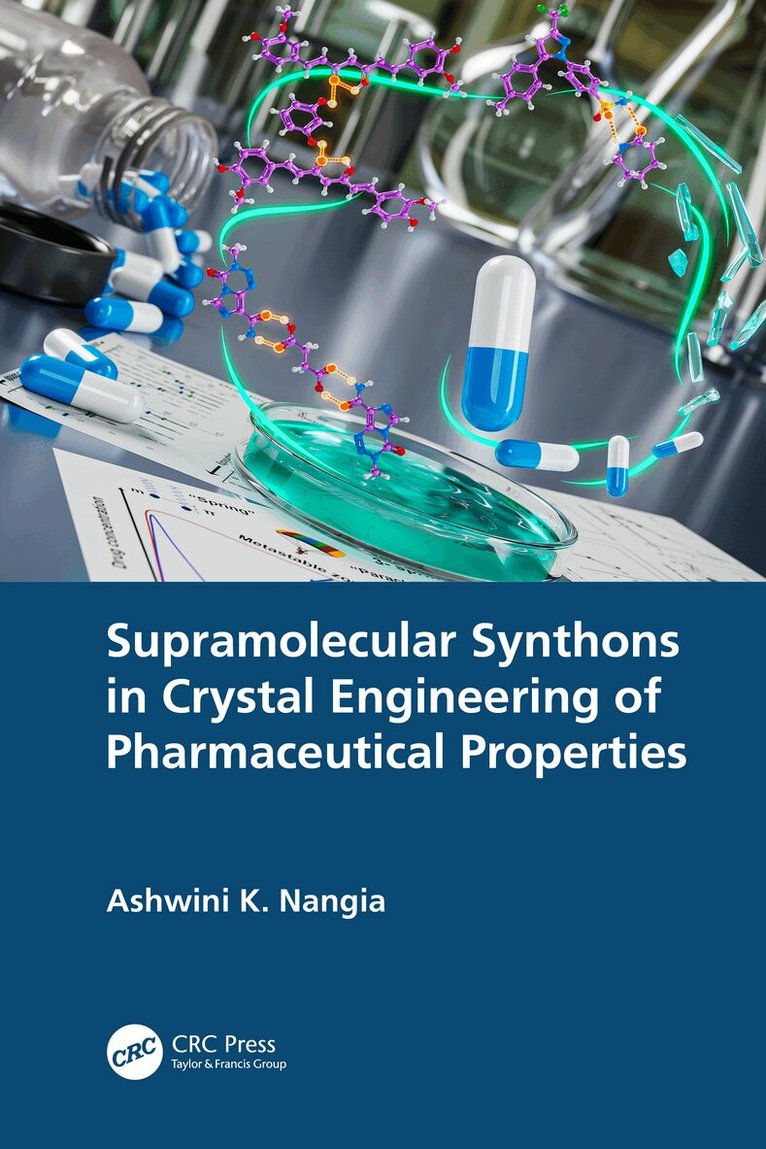
Supramolecular Synthons in Crystal Engineering of Pharmaceutical Properties
Del i serien xx xx
2 736 kr
Beställningsvara. Skickas inom 10-15 vardagar. Fri frakt över 249 kr.
Beskrivning
Produktinformation
- Utgivningsdatum:2024-10-01
- Mått:156 x 234 x 15 mm
- Vikt:453 g
- Format:Inbunden
- Språk:Engelska
- Serie:xx xx
- Antal sidor:182
- Förlag:Taylor & Francis Ltd
- ISBN:9781032196114
Utforska kategorier
Mer om författaren
Ashwini Nangia (born 1960) is a senior professor of chemistry at the University of Hyderabad, India. He completed his MSc from Indian Institute of Technology Kanpur (1983) and PhD from Yale University (1988). He joined the University of Hyderabad in 1989 and was promoted to professor in 2002 and to senior professor in 2019. His research interests in crystal engineering include polymorphs, cocrystals, salts, eutectics, and amorphous forms of drugs and pharmaceuticals. He has authored more than 350 research publications, with over 18,000 citations and an h-index of 70. He is a fellow of the three premier National Science Academies of India and Royal Society of Chemistry, London. He is a recipient of the prestigious JC Bose National Fellowship. He was director of Council of Scientific and Industrial Research–National Chemical Laboratory, Pune from March 2016 to November 2020, during which time he diversified his interests to flow chemistry and process intensification in crystallization.
Recensioner i media
"A continuous flow of ideas, activities, and applications. The author, who has worked with supramolecular synthons for close on three decades, tells the story admirably. This book, full of facts and figures, will be important for researchers in both academic and corporate worlds, for both novitiates and experts."Gautam R. Desiraju, Indian Institute of Science, India"Crystal Engineering is playing an increasingly important role in the development of active pharmaceutical ingredients. Being able to develop methods to prepare co-crystals and supramolecular complexes with desired properties is a key goal. This volume presents beginners in the field and researchers the information needed to work in this important area."Allan S. Myerson, Massachusetts Institute of Technology, USA"Ashwini Nangia’s book on fundamentals and advanced research aspects of an extremely active area of pharmaceutical science, namely that of the design, preparation, characterization, and evaluation of the properties of crystalline forms of active ingredients. Anyone interested in crystal engineering applied to pharmaceutical compounds should read this book."Dario Braga, Università di Bologna and PolyCrystalLine, Italy"The understanding and control of active ingredient solid form in pharmaceutical drug products has never been more important. This timely and useful book takes a holistic approach to crystal structure prediction and control and shows the importance of crystal engineering throughout the pharmaceutical product design and manufacturing process. The book ranges from the fundamental understanding of the organic solid state through modern strategies to screen and control crystal and particle properties and even includes very recent developments in the role generative AI can play in the pharmaceutical space. Nangia is one of the leaders in the development of solid form control strategies and this book is required reading for industry professionals, students, and researchers irrespective of their level of experience in pharmaceutical solids."Jonathan W. Steed, Durham University, UK and Editor-in-Chief, Crystal Growth Design"This book is an excellent primer to introduce students and professionals to the topic of cocrystals, with a nice historical overview, leading to design through supramolecular concepts, property optimization for performance, and scale up of cocrystal syntheses. I found the book to be a very readable compilation and the many excellent examples drive home the considerable progress that has been made in recent decades to translate supramolecular chemistry concepts to real world applications."Susan M. Reutzel-Edens, Eli Lilly and SuRE Pharma Consulting, USA"Prof. Nangia has produced an excellent text for both engaging the interest of and providing early direction to those interested in the emerging area of using crystal engineering to develop improved pharmaceuticals. There is enough meat to provide sound understanding of what has led to the current state-of-the-art and enough projection of how crystal engineering may revolutionize pharmaceuticals to pique interest and provide motivation to dig deeper. It is worth reading for those already working in the field, but I would heartily suggest the book to new investigators looking to make a big scientific impact."Robin D. Rogers, University of Alabama, USA and Founding Editor-in-Chief, Crystal Growth Design
Innehållsförteckning
- Chapter 1 Introduction to Supramolecular Chemistry and Crystal Engineering1.1 Introduction1.2 Organic synthesis1.3 Supramolecular chemistry1.4 Crystal engineering1.5 Hydrogen bonding1.6 Space groups1.7 Summary conclusions1.8 References1.9 Questions and thoughts1.10 Additional readingChapter 2 Crystal Engineering, Supramolecular Synthons, and Cocrystal Design2.1 Introduction2.2 Supramolecular synthons2.3 Crystal engineering of pharmaceutical cocrystals2.3.1 Cocrystals2.3.2 Pharmaceutical cocrystals2.4 Cocrystal design approaches2.4.1 Hydrogen bond synthons2.4.2 ΔpKa rule2.4.3 Computational methods2.4.4 Molecular electrostatic potential surface energy2.4.5 Hansen solubility parameter2.5 Summary conclusions2.6 References2.7 Questions and thoughtsChapter 3 Pharmaceutical Solid-State Forms3.1 Introduction3.2 Pharmaceutical multi-component crystals3.2.1 Drug salts and pharmaceutical cocrystals3.2.2 Pharmaceutical cocrystals via crystal engineering3.2.3 Coamorphous solids3.2.4 Solid solutions and eutectics3.2.5 Ionic liquids3.2.6 Ionic cocrystals3.2.7 Nanocrystalline drugs3.2.8 Supramolecular gels of drugs3.2.9 Salt−cocrystal continuum or hybrid quasi-state of proton3.2.10 Cocrystal polymorphs3.2.11 Ternary and higher organic cocrystals3.3 Summary conclusions3.4 References3.5 Questions and thoughtsChapter 4 Design and Methodology of Pharmaceutical Cocrystals 4.1 Introduction4.2 Complementarity between API and coformer4.3 Preparation methods of cocrystals4.3.1 Spray drying4.3.2 Freeze drying4.3.3 Hot melt extrusion 4.3.4 Rotary evaporator method4.3.5 Vapor-assisted tumbling4.4 Drug−drug cocrystals 4.5 Drug−nutraceutical cocrystals4.6 Ternary and higher order cocrystals4.7 Cocrystals of different stoichiometry4.8 Zwitterionic cocrystals4.9 Halogen-bonded pharmaceutical cocrystals4.10 Characterization methods of cocrystals4.11 Summary conclusions4.12 References4.13 Questions and thoughtsChapter 5 Applications of Pharmaceutical Cocrystals5.1 Introduction5.2 Bioavailability improvement5.3 Hydration stability5.4 Chemical degradation stability5.5 Tableting 5.6 Mechanical properties5.7 Phase diagram and solubility measurements5.8 Permeability and plasma concentration5.9 Spring and Parachute model5.10 Summary conclusions5.11 References5.12 Questions and thoughtsChapter 6 Continuous Manufacturing of Cocrystals and Salts 6.1 Introduction6.2 Batch and flow chemistry6.3 Flow chemistry and pharmaceutical cocrystals manufacturing6.4 Case studies of pharmaceutical cocrystals and salts 6.5 Continuous process technologies6.6 Flow guide for the synthetic chemist6.7 Summary conclusions6.8 References6.9 Questions and thoughtsChapter 7 Commercial Outlook of Pharmaceutical Cocrystals7.1 Introduction7.2 Present status7.3 Patenting and regulatory aspects7.4 Entresto® drug-drug cocrystal salt7.5 Seglentis® US-FDA approval7.6 Summary conclusions7.7 References7.8 Questions and thoughtsChapter 8 Controlling Polymorphism8.1 Introduction8.2 Definition and importance8.3 Polymorphism and cocrystallization8.4 Tailored additives to control crystal size and morphology8.5 Summary conclusions8.6 References8.7 Questions and thoughtsChapter 9 Supramolecular Heterosynthon in High Bioavailability Drugs9.1 Introduction9.2 Common heterosynthons in drugs9.3 Heterosynthon model for high bioavailability drugs9.4 Models for permeability enhancement9.5 Cocrystal drugs beyond the Rule of 59.6 Improving cell penetration by atom replacement9.7 Summary conclusions9.9 Questions and thoughtsChapter 10 Other Applications of Cocrystals10.1 Introduction10.2 Property engineering10.3 Mechanochemistry10.4 Energetic cocrystals10.5 Summary conclusions10.6 References10.7 Questions and thoughtsChapter 11 AI ML ChatGPT in Chemistry11.1 Introduction11.2 Retrosynthetic reaction prediction11.3 Medicinal molecules11.4 MOFs and inorganic materials11.5 Cocrystals11.6 Summary conclusions11.7 References11.8 Questions and thoughtsChapter 12 3D Electron Diffraction12.1 Introduction12.2 Advantages of ED12.3 Resurgence of ED12.4 New pharmaceutical challenges solved by ED12.5 Summary conclusions12.6 References12.7 Questions and thoughtsChapter 13 Challenges, Conclusions, and Future Directions13.1 Introduction13.2 Carboxamide−pyridine-N-oxide heterosynthon13.3 Browsing the literature13.4 Challenges in pharmaceutical cocrystal technology13.5 Conclusions13.6 References13.7 Suggested readingIndex
Mer från samma serie
Feminist Studies
Charlotte Taylor, Hemangini Gupta, Kelly Sharron, Carly Thomsen, Abraham Weil
578 kr
Du kanske också är intresserad av
Feminist Studies
Charlotte Taylor, Hemangini Gupta, Kelly Sharron, Carly Thomsen, Abraham Weil
578 kr
- Signerad!
- -22%