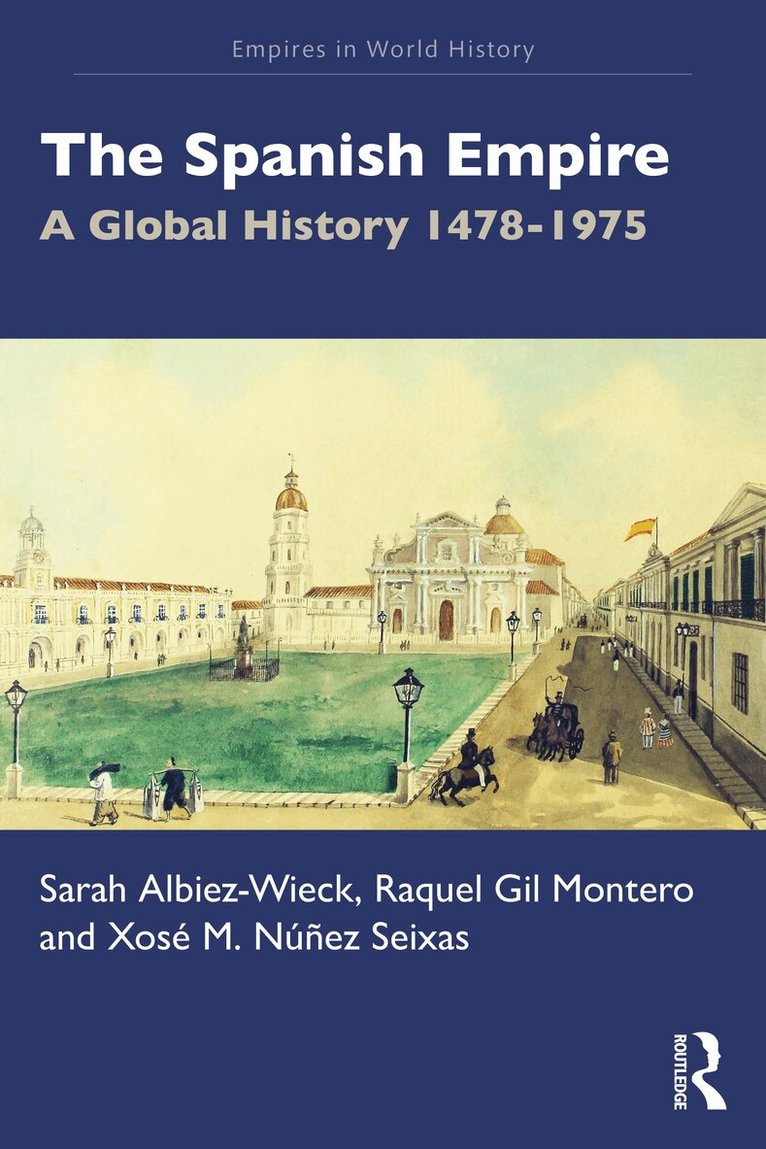
“How does an empire last nearly five hundred years? The Spanish Empire was vast, polycentric, and remarkably long-lived. In this single volume spanning 1478 to 1975, Sarah Albiez-Wieck, Raquel Gil Montero, and Xosé M. Núñez Seixas take up the question through the Spanish case, from the Castilian expansions of the late fifteenth century to the loss of its last African colony in 1975. They examine the motives that drove expansion across the Atlantic and the Pacific, the polycentric arrangements by which so vast a territory was governed, the imperial societies that took shape under Spanish rule, and the imprints left by the early colonial encounters on the social relations of the conquered territories. Through the Bourbon Reforms, the wars of independence, the radical change in what remained of the empire, and its African finale, the book follows the entire arc. Conceived as a readable essay as well as a scholarly synthesis, this important work is addressed to students, historians, and the wider public drawn to global and imperial history.”Stephanie Marie R. Coo, Associate Professor, Department of History, Ateneo de Manila University; Researcher, Centro de Humanidades (CHAM - NOVA FCSH), Universidade Nova de Lisboa.“This is a superb new introduction to the field and its recent debates. By focusing upon shifting conceptions of empire and rule, the authors tell a chronologically longer and geographically broader story than is usually done, to great advantage. Their reach includes not only western Europe and the Americas, but also the Mediterranean, the Philippines, and some African territories, and stretches from the fifteenth to twentieth centuries. Through their thoughtful analysis of polycentric monarchies and empires, they distinguish complex structural changes in law, social history, slavery, economy, and politics coherently and with compelling detail.”Karen Graubart, Professor, Department of History, University of Notre Dame.“With an admirable and fluid narrative, this book more than fulfils its ambitious aim: to offer, for the first time, a global history of the Spanish Empire. The book explores the various forms taken by the Spanish imperial architecture, inhabited by actors who violate, impose, negotiate, resist and adapt to the transformations that have taken place over five centuries. One of the book’s greatest achievements is to condense the treatment of significant long-term issues and present the most up-to-date findings in the field through an accessible narrative. An achievement that is worth celebrating at a time when the most stereotypical disputes over the imperial past are resurfacing.”Marcela Ternavasio, Professor of History, Universidad Nacional del Rosario and researcher at CONICET“This book by Professors Albiez-Wieck, Gil Montero, and Núñez Seixas is one of the most ambitious and successful syntheses of the Spanish Empire from the fifteenth to the twentieth century published in recent years. By bringing Europe, the Americas, Asia, and Africa into a single narrative, the authors reveal both the diversity of imperial experiences and the structures of power that bound them together. Historiographically sophisticated and conceptually coherent, this volume offers a compelling account of how the history of empire was inseparable from the making of modern and contemporary Spain”Antonio Feros, University of Pennsylvania