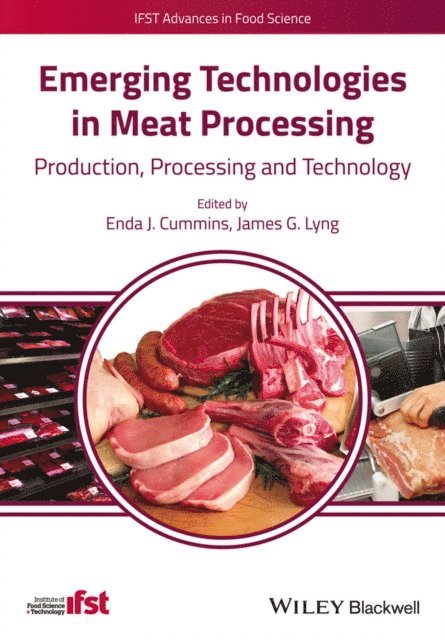
Emerging Technologies in Meat Processing
Production, Processing and Technology
AvEnda J. Cummins,James G. Lyng
Del i serien IFST Advances in Food Science
2 026 kr
Beställningsvara. Skickas inom 11-20 vardagar. Fri frakt över 249 kr.
Beskrivning
Produktinformation
- Utgivningsdatum:2016-12-09
- Mått:173 x 246 x 25 mm
- Vikt:998 g
- Format:Inbunden
- Språk:Engelska
- Serie:IFST Advances in Food Science
- Antal sidor:448
- Förlag:John Wiley and Sons Ltd
- ISBN:9781118350683
Utforska kategorier
Mer om författaren
Dr. Enda Cummins (BAgrSc MEngSc PhD) has worked in University College Dublin since completing his PhD in 2004. He has extensive experience with regard to food processing, food safety and risk assessment and has been involved in the safety evaluation of new technologies for use in the food industry. He has managed a number of research projects in relation to food safety, processing effects and traceability of foodstuffs. He lectures undergraduate and postgraduate courses in Product development, Food Physics (including novel processing and packaging techniques) and also in the area of Food Safety and Quantitative risk assessment. Dr Cummins is also the programme coordinator for the postgraduate Masters programme in Food Engineering (MEngSc) in the College of Engineering within UCD. He has published extensively in the area of food safety, including meat safety and quality aspects.Dr. James Lyng (BAgrSc PhD) is based at University College Dublin, and is a food scientist with extensive experience in the use of novel technologies for processing food and their impact on food quality and also the measurement of physical properties of foods which govern interaction between these technologies and the food product. He obtained his PhD degree in meat processing using high intensity low frequency ultrasound. Since 1997 Dr. Lyng has been a UCD lecturer delivering courses in Food Process Technology, Food Engineering and Food Physics. Dr. Lyng has an extensive range of publications in the measurement of electrical conductivity and dielectric properties which are both physical properties relevant to some of the technologies which will be covered in the proposed book.
Innehållsförteckning
- About the IFST Advances in Food Science Book Series, xiiiList of contributors, xv1 Emerging technologies in meat processing, 1Enda J. Cummins & James G. Lyng1.1 Context and challenges 11.2 Book objective 21.3 Book structure 21.4 Conclusion 5Part I: Novel processing techniques2 Irradiation of meat and meat products, 9Ki Chang Nam, Cheorun Jo & Dong U. Ahn2.1 Summary 92.2 Theory of irradiation of foods 92.3 Irradiation equipment 152.4 Future role for irradiation in the preservation of foods 303 High-pressure processing of meat and meat products, 37Sandrine Guillou, Marion Lerasle, Hélène Simonin & Michel Federighi3.1 Introduction 373.2 Theory of high-pressure preservation and decontamination of foods 383.3 High-pressure applications 553.4 High-pressure equipment 603.5 Future role for high pressure in the preservation and decontamination of foods 854 Electroprocessing of meat and meat products, 103Cristina Arroyo & James G. Lyng4.1 Introduction to electroprocessing technologies 1034.2 Non-thermal electroprocessing of meat 1034.3 Thermal electroprocessing (i.e. electroheating) of meat 1114.4 Future of electroprocessing of meat 1244.5 Equipment suppliers 1245 Application of infrared and light-based technologies to meat and meat products, 131Tatiana Koutchma5.1 Introduction 1315.2 Theory of UV, IR, and high-intensity light pulse preservation of foods 1325.3 Infrared radiation 1335.4 Ultraviolet radiation 1365.5 High-intensity light pulses 1435.6 Future role for UV, IR, and high-intensity light pulses in the preservation of foods 1456 Ultrasound processing applications in the meat industry, 149N.N. Misra, Patrick J. Cullen & Brijesh K. Tiwari6.1 Introduction 1496.2 Fundamentals of ultrasound processing 1506.3 Ultrasound processing equipment 1536.4 Ultrasound for decontamination of meat 1546.5 Applications of ultrasound in meat processing 1556.6 Concluding remarks 1657 Application of hydrodynamic shock wave processing associated with meat and processed meat products, 171James R. Claus7.1 Introduction 1717.2 Applicability of hydrodynamic shock waves on meat and meat products 1757.3 Approaches to the generation of hydrodynamic shock waves, and the theory and mode of action relative to muscle food applications 1757.4 Advantages and disadvantages of hydrodynamic shock wave 1807.5 Case studies: hydrodynamic shock wave treatment of meat products 1857.6 Developmental advances in hydrodynamic shock wave equipment 1937.7 Brief overview of available hydrodynamic shock wave equipment and manufacturers of hydrodynamic shock wave equipment 2038 Robotics in meat processing, 211Kompal Joshi, Tomas Norton, Jesús M. Frías & Brijesh K. Tiwari8.1 Introduction 2118.2 Application of robotics in meat processing 2128.3 Mechatronic and robotic systems in the food industry 2148.4 Case studies 2188.5 Future role for robotics in the processing of meat and meat products 226Part II: Novel Packaging and meat functionality9 Packaging systems and materials used for meat products with particular emphasis on the use of oxygen scavenging systems, 233Malco Cruz-Romero & Joseph P. Kerry9.1 Introduction 2339.2 Case-ready packaging 2359.3 Theory of MAP/oxygen scavenging technology for meat products 2539.4 Future role for novel packaging systems in the preservation of meat 25810 Smart packaging solutions encompassing nanotechnology, 265Maeve Cushen & Enda J. Cummins10.1 Introduction 26510.2 Smart packaging 26610.3 Conclusion 27911 Probiotic functionality in meat, 285Muhammad Issa Khan, Cheorun Jo & Ubaid-ur-Rahman11.1 Introduction 28511.2 Ecology of gastrointestinal tract (GIT) 28611.3 Identification of potential microorganisms 28911.4 Selection of probiotics 29011.5 Probiotic meat products 29411.6 Functionality of probiotics 30311.7 Disease prevention by probiotics 30911.8 Role of probiotics in function food development 31211.9 Conclusion 314Part III: Assessment techniques for meat quality and safety12 Rapid methods for microbial analysis of meat and meat products, 323Agapi Doulgeraki, Efstathios Panagou & George-John Nychas12.1 Introduction 32312.2 Theory of high rapid methods 32512.3 Rapid method tools 33012.4 Future role for rapid methods in foods safety 34013 The use of hyperspectral techniques in evaluating quality and safety of meat and meat products, 345Di Wu & Da-Wen Sun13.1 Introduction 34513.2 Hyperspectral techniques 34713.3 Applications in evaluating quality and safety of meat and meat products 35813.4 Advantages and disadvantages of hyperspectral techniques in meat applications 36713.5 Conclusion 36914 Online meat quality and compositional assessment techniques, 375Kumari Shikha Ojha, Brijesh K. Tiwari, Joseph P. Kerry & Patrick J. Cullen14.1 Summary 37514.2 Introduction 37514.3 In vivo methods of carcass evaluation 37614.4 Post-mortem compositional analysis 38314.5 Conclusions 38615 Meat authenticity, 391Yan Zhao15.1 Introduction 39115.2 Theory of authenticity in the meat industry 39115.3 Authenticity methods 39815.4 Future role for authenticity in food 40216 Regulation and legislative issues, 407Fiona Lalor & Patrick Wall16.1 Introduction 40716.2 Overview of principles of food regulation 40816.3 Food safety regulation within the European Union 41316.4 Meat inspection 41616.5 Marketing challenges: reports of adverse health effects 42116.6 Conclusion 423Index, 427
Du kanske också är intresserad av
Tropical Roots and Tubers
Harish K. Sharma, Nicolas Y. Njintang, Rekha S. Singhal, Pragati Kaushal
2 337 kr
Innovative Technologies in Beverage Processing
Ingrid Aguilo-Aguayo, Ingrid Aguilo-Aguayo, Lucia Plaza
1 429 kr
Ultrasound in Food Processing
Mar Villamiel, José V. García-Pérez, Antonia Montilla, Juan A. Carcel, Jose Benedito
2 337 kr
Herbs, Spices and Medicinal Plants
Mohammad B. Hossain, Mohammad B. Hossain, Nigel P. Brunton, Dilip K. Rai
2 062 kr