• Fri frakt över 249 kr
  • •
  • Snabba leveranser
  • •
  • Billiga böcker
Kundservice

Du är på sajten för privatpersoner.

Företag, bibliotek eller offentlig verksamhet?

Du handlar på classic.bokus.com, där alla dina funktioner finns intakta.
Till classic.bokus.com
Bokus logotyp. Gå till startsidan.
  • Erbjudanden
  • Student
  • Topplistor
  • Barn & ungdom
  • Bokus Play
  • E-böcker
  • Ljudböcker
  • Pocketböcker
  • Spel & pussel

Upp till 25% på utvalda nyheter →

Sidfot

Mina sidor

    Hjälp

    • Kundservice
    • Vanliga frågor och svar
    • Frakt och leverans
    • Retur vid ångerrätt
    • Reklamera vara
    • Betalning
    • Köpvillkor
    • Allmänna villkor
    • Information om webbplatsens tillgänglighet

    Om Bokus

    • Om oss
    • Pressrum
    • För studenter
    • För företag
    • För bibliotek och offentlig verksamhet
    • För leverantörer
    • Hållbarhet

    Populärt

    • Aktuella erbjudanden
    • Presentkort
    • Studentlitteratur
    • Nya böcker
    • Topplistor
    • Signerade böcker
    • Engelska böcker

    Inspiration

    • Boktips
    • BookTok
    • Populära bokserier
    • Barnbokskaraktärer
    • Populära författare
    Logotyp för Bokus
    Följ oss på Facebook (extern länk)Följ oss på Instagram (extern länk)Följ oss på YouTube (extern länk)Följ oss på TikTok (extern länk)
    bokus @ CookiesAnpassa cookiesIntegritetspolicyKöpvillkor
    Till Citymail hemsida (extern länk)Till Budbee hemsida (extern länk)Till Postnord hemsida (extern länk)Till Schenker hemsida (extern länk)Till Early Bird hemsida (extern länk)Till Walleys hemsida (extern länk)
    1. Data och IT
    2. Systemvetenskap och AI

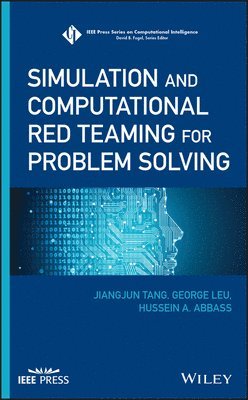
    Simulation and Computational Red Teaming for Problem Solving

    AvJiangjun Tang,George Leu

    Inbunden, Engelska, 2020

    Del i serien IEEE Press Series on Computational Intelligence

    1 639 kr

    Beställningsvara. Skickas inom 5-8 vardagar. Fri frakt över 249 kr.

    Beskrivning

    An authoritative guide to computer simulation grounded in a multi-disciplinary approach for solving complex problemsSimulation and Computational Red Teaming for Problem Solving offers a review of computer simulation that is grounded in a multi-disciplinary approach. The authors present the theoretical foundations of simulation and modeling paradigms from the perspective of an analyst. The book provides the fundamental background information needed for designing and developing consistent and useful simulations. In addition to this basic information, the authors explore several advanced topics.The book’s advanced topics demonstrate how modern artificial intelligence and computational intelligence concepts and techniques can be combined with various simulation paradigms for solving complex and critical problems. Authors examine the concept of Computational Red Teaming to reveal how the combined fundamentals and advanced techniques are used successfully for solving and testing complex real-world problems. This important book:•    Demonstrates how computer simulation and Computational Red Teaming support each other for solving complex problems•    Describes the main approaches to modeling real-world phenomena and embedding these models into computer simulations•    Explores how a number of advanced artificial intelligence and computational intelligence concepts are used in conjunction with the fundamental aspects of simulationWritten for researchers and students in the computational modelling and data analysis fields, Simulation and Computational Red Teaming for Problem Solving covers the foundation and the standard elements of the process of building a simulation and explores the simulation topic with a modern research approach.

    Produktinformation

    • Utgivningsdatum:2020-01-02
    • Mått:150 x 231 x 25 mm
    • Vikt:862 g
    • Format:Inbunden
    • Språk:Engelska
    • Serie:IEEE Press Series on Computational Intelligence
    • Antal sidor:496
    • Förlag:John Wiley & Sons Inc
    • ISBN:9781119527176

    Utforska kategorier

    • Systemvetenskap och AI inom Data och IT
    • Artificiell intelligens inom Data och IT
    • Maskinteknik och material inom Naturvetenskap och teknik

    Mer om författaren

    JIANGJUN TANG, PHD, is a Lecturer at the School of Engineering and Information Technology at the University of New South Wales Canberra, Australia. GEORGE LEU, PHD, is a Senior Research Associate at the School of Engineering and Information Technology at the University of New South Wales Canberra, Australia. HUSSEIN A. ABBASS, PHD, is a Professor at the School of Engineering and Information Technology at the University of New South Wales Canberra, Australia.

    Innehållsförteckning

    • Preface xiList of Figures xvList of Tables xxvPart I On Problem Solving, Computational Red Teaming, and Simulation 11. Problem Solving, Simulation, and Computational Red Teaming 31.1 Introduction 31.2 Problem Solving 41.3 Computational Red Teaming and Self-‘Verification and Validation’ 82. Introduction to Fundamentals of Simulation 112.1 Introduction 112.2 System 142.3 Concepts in Simulation 172.4 Simulation Types 212.5 Tools for Simulation 232.6 Conclusion 24Part II Before Simulation Starts 253. The Simulation Process 273.1 Introduction 273.2 Define the System and its Environment 273.3 Build a Model 293.4 Encode a Simulator 303.5 Design Sampling Mechanisms 323.6 Run Simulator Under Different Samples 333.7 Summarise Results 333.8 Make a Recommendation 343.9 An Evolutionary Approach 353.10 A Battle Simulation by Lanchester Square Law 354. Simulation Worldview and Conflict Resolution 574.1 Simulation Worldview 574.2 Simultaneous Events and Conflicts in Simulation 644.3 Priority Queue and Binary Heap 684.4 Conclusion 725. The Language of Abstraction and Representation 735.1 Introduction 735.2 Informal Representation 755.3 Semi-formal Representation 765.4 Formal Representation 825.5 Finite-state Machine 865.6 Ant in Maze Modelled by Finite-state Machine 895.7 Conclusion 996. Experimental Design 1016.1 Introduction 1016.2 Factor Screening 1036.3 Metamodel and Response Surface 1136.4 Input Sampling 1166.5 Output Analysis 1176.6 Conclusion 120Part III Simulation Methodologies 1217. Discrete Event Simulation 1237.1 Discrete Event Systems 1237.2 Discrete Event Simulation 1267.3 Conclusion 1428. Discrete Time Simulation 1438.1 Introduction 1438.2 Discrete Time System and Modelling 1458.3 Sample Path 1488.4 Discrete Time Simulation and Discrete Event Simulation 1498.5 A Case Study: Car-following Model 1518.6 Conclusion 1549. Continuous Simulation 1579.1 Continuous System 1579.2 Continuous Simulation 1599.3 Numerical Solution Techniques for Continuous Simulation 1649.4 System Dynamics Approach 1729.5 Combined Discrete–continuous Simulation 1749.6 Conclusion 17610. Agent-based Simulation 17910.1 Introduction 17910.2 Agent-based Simulation 18110.3 Examples of Agent-based Simulation 18510.4 Conclusion 194Part IV Simulation and Computational Red Teaming Systems 19711. Knowledge Acquisition 19911.1 Introduction 19911.2 Agent-enabled Knowledge Acquisition: Core Processes 20211.3 Human Agents 20311.4 Human-inspired Agents 20811.5 Machine Agents 21111.6 Summary Discussion and Perspectives on Knowledge Acquisition 21512. Computational Intelligence 21912.1 Introduction 21912.2 Evolutionary Computation 22312.3 Artificial Neural Networks 23212.4 Conclusion 23913. Computational Red Teaming 24113.1 Introduction 24113.2 Computational Red Teaming: The Challenge Loop 24213.3 Computational Red Teaming Objects 24313.4 Computational Red Teaming Purposes 24413.5 Objectives of Red Teaming Exercises in Computational Red Teaming Purposes 24513.6 Discovering Biases 24613.7 Computational Red Teaming Lifecycle: A Systematic Approach to Red Teaming Exercises 24713.8 Conclusion 251Part V Simulation and Computational Red Teaming Applications 25314. Computational Red Teaming for Battlefield Management 25514.1 Introduction 25514.2 Battlefield Management Simulation 25614.3 Conclusion 26115. Computational Red Teaming for Air Traffic Management 26315.1 Introduction 26315.2 Air Traffic Simulation 26315.3 A Human-in-the-loop Application 27015.4 Conclusion 27116. Computational Red Teaming Application for Skill-based Performance Assessment 27316.1 Introduction 27316.2 Cognitive Task Analysis-based Skill Modelling and Assessment Methodology 27416.3 Sudoku and Human Players 27616.4 Sudoku and Computational Solvers 28016.5 The Proposed Skill-based Computational Solver 28316.6 Discussion of Simulation Results 29316.7 Conclusions 30017. Computational Red Teaming for Driver Assessment 30117.1 Introduction 30117.2 Background on Cognitive Agents 30317.3 The Society of Mind Agent 30617.4 Society of Mind Agents in an Artificial Environment 31217.5 Case Study 32517.6 Conclusion 33018. Computational Red Teaming for Trusted Autonomous Systems 33318.1 Introduction 33318.2 Trust for Influence and Shaping 33418.3 The Model 33518.4 Experiment Design and Parameter Settings 34218.5 Results and Discussion 34418.6 Conclusion 347A. Probability and Statistics in Simulation 349A.1 Foundation of Probability and Statistics 349A.2 Useful Distributions 369A.3 Mathematical Characteristics of Random Variables 390A.4 Conclusion 396B Sampling and Random Numbers 397B.1 Introduction 397B.2 Random Number Generator 400B.3 Testing Random Number Generators 408B.4 Approaches to Generating Random Variates 413B.5 Generating Random Variates 416B.6 Monte Carlo Method 423B.7 Conclusion 432Bibliography 435Index 459