• Fri frakt över 249 kr
  • •
  • Snabba leveranser
  • •
  • Billiga böcker
Kundservice

Du är på sajten för privatpersoner.

Företag, bibliotek eller offentlig verksamhet?

Du handlar på classic.bokus.com, där alla dina funktioner finns intakta.
Till classic.bokus.com
Bokus logotyp. Gå till startsidan.
  • Erbjudanden
  • Student
  • Topplistor
  • Barn & ungdom
  • Bokus Play
  • E-böcker
  • Ljudböcker
  • Pocketböcker
  • Spel & pussel

Upp till 25% på utvalda nyheter →

Sidfot

Mina sidor

    Hjälp

    • Kundservice
    • Vanliga frågor och svar
    • Frakt och leverans
    • Retur vid ångerrätt
    • Reklamera vara
    • Betalning
    • Köpvillkor
    • Allmänna villkor
    • Information om webbplatsens tillgänglighet

    Om Bokus

    • Om oss
    • Pressrum
    • För studenter
    • För företag
    • För bibliotek och offentlig verksamhet
    • För leverantörer
    • Hållbarhet

    Populärt

    • Aktuella erbjudanden
    • Presentkort
    • Studentlitteratur
    • Nya böcker
    • Topplistor
    • Signerade böcker
    • Engelska böcker

    Inspiration

    • Boktips
    • BookTok
    • Populära bokserier
    • Barnbokskaraktärer
    • Populära författare
    Logotyp för Bokus
    Följ oss på Facebook (extern länk)Följ oss på Instagram (extern länk)Följ oss på YouTube (extern länk)Följ oss på TikTok (extern länk)
    bokus @ CookiesAnpassa cookiesIntegritetspolicyKöpvillkor
    Till Citymail hemsida (extern länk)Till Budbee hemsida (extern länk)Till Postnord hemsida (extern länk)Till Schenker hemsida (extern länk)Till Early Bird hemsida (extern länk)Till Walleys hemsida (extern länk)
    1. Data och IT
    2. Systemvetenskap och AI
    3. Artificiell intelligens

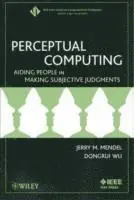
    Perceptual Computing

    Aiding People in Making Subjective Judgments

    AvJerry Mendel,Dongrui Wu

    Häftad, Engelska, 2010

    Del 13 i serien IEEE Press Series on Computational Intelligence

    1 402 kr

    Beställningsvara. Skickas inom 5-8 vardagar. Fri frakt över 249 kr.

    Beskrivning

    Explains for the first time how "computing with words" can aid in making subjective judgments Lotfi Zadeh, the father of fuzzy logic, coined the phrase "computing with words" (CWW) to describe a methodology in which the objects of computation are words and propositions drawn from a natural language. Perceptual Computing explains how to implement CWW to aid in the important area of making subjective judgments, using a methodology that leads to an interactive device—a "Perceptual Computer"—that propagates random and linguistic uncertainties into the subjective judgment in a way that can be modeled and observed by the judgment maker.This book focuses on the three components of a Perceptual Computer—encoder, CWW engines, and decoder—and then provides detailed applications for each. It uses interval type-2 fuzzy sets (IT2 FSs) and fuzzy logic as the mathematical vehicle for perceptual computing, because such fuzzy sets can model first-order linguistic uncertainties whereas the usual kind of fuzzy sets cannot. Drawing upon the work on subjective judgments that Jerry Mendel and his students completed over the past decade, Perceptual Computing shows readers how to: Map word-data with its inherent uncertainties into an IT2 FS that captures these uncertainties Use uncertainty measures to quantify linguistic uncertainties Compare IT2 FSs by using similarity and rank Compute the subsethood of one IT2 FS in another such set Aggregate disparate data, ranging from numbers to uniformly weighted intervals to nonuniformly weighted intervals to words Aggregate multiple-fired IF-THEN rules so that the integrity of word IT2 FS models is preserved Free MATLAB-based software is also available online so readers can apply the methodology of perceptual computing immediately, and even try to improve upon it. Perceptual Computing is an important go-to for researchers and students in the fields of artificial intelligence and fuzzy logic, as well as for operations researchers, decision makers, psychologists, computer scientists, and computational intelligence experts.

    Produktinformation

    • Utgivningsdatum:2010-05-18
    • Mått:158 x 236 x 17 mm
    • Vikt:499 g
    • Format:Häftad
    • Språk:Engelska
    • Serie:IEEE Press Series on Computational Intelligence
    • Antal sidor:336
    • Förlag:John Wiley & Sons Inc
    • ISBN:9780470478769

    Utforska kategorier

    • Artificiell intelligens inom Data och IT

    Mer om författaren

    Jerry M. Mendel is Professor of Electrical Engineering at the University of Southern California. A Life Fellow of the IEEE and a Distinguished Member of the IEEE Control Systems Society, Mendel is also the recipient of many awards for his diverse research, including the IEEE Centennial Medal, the Fuzzy Systems Pioneer Award from the IEEE Computational Intelligence Society, and the IEEE Third Millennium Medal. Dongrui Wu is a Postdoctoral Research Associate at the University of Southern California, where he recently obtained his PhD in electrical engineering.

    Innehållsförteckning

    • Preface. 1 Introduction.1.1 Perceptual Computing.1.2 Examples.1.3 Historical Origins of Perceptual Computing.1.4 How to Validate the Perceptual Computer.1.5 The Choice of Fuzzy Set Models for the Per-C.1.6 Keeping the Per-C as Simple as Possible.1.7 Coverage of the Book.1.8 High-Level Synopses of Technical Details.References.2 Interval Type-2 Fuzzy Sets.2.1 A Brief Review of Type-1 Fuzzy Sets.2.2 Introduction to Interval Type-2 Fuzzy Sets.2.3 Definitions.2.4 Wavy-Slice Representation Theorem.2.5 Set-Theoretic Operations.2.6 Centroid of an IT2 FS.2.7 KM Algorithms.2.8 Cardinality and Average Cardinality of an IT2 FS.2.9 Final Remark.Appendix 2A. Derivation of the Union of Two IT2 FSs.Appendix 2B. Enhanced KM (EKM) Algorithms.References.3 Encoding: From a Word to a Model—The Codebook.3.1 Introduction.3.2 Person FOU Approach for a Group of Subjects.3.3 Collecting Interval End-Point Data.3.4 Interval End-Points Approach.3.5 Interval Approach.3.6 Hedges.Appendix 3A. Methods for Eliciting T1 MF Information From Subjects.Appendix 3B. Derivation of Reasonable Interval Test.References.4 Decoding: From FOUs to a Recommendation.4.1 Introduction.4.2 Similarity Measure Used as a Decoder.4.3 Ranking Method Used as a Decoder.4.4 Classifier Used as a Decoder.5 Novel Weighted Averages as a CWW Engine.5.1 Introduction.5.2 Novel Weighted Averages.5.3 Interval Weighted Average.5.4 Fuzzy Weighted Average.5.5 Linguistic Weighted Average.5.6 A Special Case of the LWA.5.7 Fuzzy Extensions of Ordered Weighted Averages.6 IF–THEN Rules as a CWW Engine—Perceptual Reasoning.6.1 Introduction.6.2 A Brief Overview of Interval Type-2 Fuzzy Logic Systems.6.3 Perceptual Reasoning: Computations.6.4 Perceptual Reasoning: Properties.7 Assisting in Making Investment Choices—Investment Judgment Advisor (IJA).7.1 Introduction.7.2 Encoder for the IJA.7.3 Reduction of the Codebooks to User-Friendly Codebooks.7.4 CWW Engine for the IJA.7.5 Decoder for the IJA.7.6 Examples.7.7 Interactive Software for the IJA.7.8 Conclusions.References.8 Assisting in Making Social Judgments—Social Judgment Advisor (SJA).8.1 Introduction.8.2 Design an SJA.8.3 Using an SJA.8.4 Discussion.8.5 Conclusions.References.9 Assisting in Hierarchical Decision Making—Procurement Judgment Advisor (PJA).9.1 Introduction.9.2 Missile Evaluation Problem Statement.9.3 Per-C for Missile Evaluation: Design.9.4 Per-C for Missile Evaluation: Examples.9.5 Comparison with Previous Approaches.9.6 Conclusions.Appendix 9A: Some Hierarchical Multicriteria Decision-Making Applications.References.10 Assisting in Hierarchical and Distributed Decision Making— Journal Publication Judgment Advisor (JPJA)/10.1 Introduction.10.2 The Journal Publication Judgment Advisor (JPJA).10.3 Per-C for the JPJA.10.4 Examples.10.4.5 Complete Reviews.10.5 Conclusions.Reference.11 Conclusions.11.1 Perceptual Computing Methodology.11.2 Proposed Guidelines for Calling Something CWW.Index.