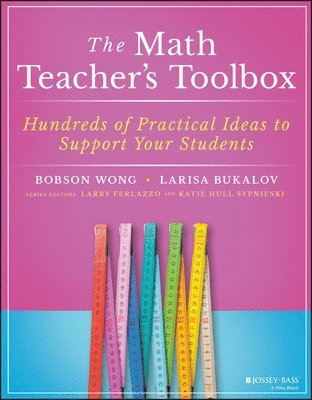
Math Teacher's Toolbox
Hundreds of Practical Ideas to Support Your Students
Del i serien Teacher's Toolbox Series
272 kr
Beställningsvara. Skickas inom 7-10 vardagar. Fri frakt över 249 kr.
Beskrivning
Produktinformation
- Utgivningsdatum:2020-06-18
- Mått:216 x 272 x 33 mm
- Vikt:1 270 g
- Format:Häftad
- Språk:Engelska
- Serie:Teacher's Toolbox Series
- Antal sidor:560
- Förlag:John Wiley & Sons Inc
- ISBN:9781119573296
Utforska kategorier
Mer om författaren
BOBSON WONG is a three-time recipient of the Math for America Master Teacher Fellowship, a New York State Master Teacher, and a member of the Advisory Council of the National Museum of Mathematics. He has served on New York State's Common Core Mathematics Standards Review Committee, the United Federation of Teachers' Common Core Standards Task Force, and as an Educational Specialist for the New York State Education Department.LARISA BUKALOV is a four-time recipient of the Math for America Master Teacher fellowship and a recipient of Queens College's Excellence in Mathematics Award for promoting mathematics teaching as a profession. She has taught all levels of math, coached the school's math team, and created a math research program for students. As part of her work with Math for America, Larisa has run several professional development sessions for teachers.LARRY FERLAZZO teaches English, Social Studies, and International Baccalaureate classes to English Language Learners and others at Luther Burbank High School in Sacramento, California. He is the author and co-author of nine books, including The ELL Teacher's Toolbox, and writes a weekly teacher advice column for Education Week Teacher. He is the recipient of the Ford Foundation's Leadership for a Changing World Award and winner of the International Reading Association Award for Technology and Reading.KATIE HULL SYPNIESKI has taught English language learners and others at the secondary level for over twenty years. She teaches middle school English Language Arts and Social Studies at Fern Bacon Middle School in Sacramento, California, and leads professional development for educators as a consultant with the Area 3 Writing Project at the University of California, Davis. She is co-author of several books including The ELL Teacher's Toolbox.
Innehållsförteckning
- List of Tables xixAbout the Authors xxiAbout the Editors xxiiiAcknowledgments xxvLetter from the Editors xxviiIntroduction 1Our Beliefs about Teaching Math 2Structure of This Book 3Why Good Math Teaching Matters 4I Basic Strategies 51. Motivating Students 7What is It? 7Why We Like It 8Supporting Research 8Common Core Connections 9Application 10Nurturing Student Confidence 10Motivating Through Math 11Rewards 14Motivating Through Popular Culture 15Motivating English Language Learners and Students with Learning Differences 16Student Handouts and Examples 18What Could Go Wrong 18Using Fear to Motivate 18Stereotype Threat 19“Why Do We Need to Know This?” 19Misreading Students 20Limitations to Motivation 21Technology Connections 21Figures 22Figure 1.1 Pattern Blocks 22Figure 1.2 Rotational Symmetry 23Figure 1.3 Exponential Growth 24Figure 1.4 Identify a Void 262. Culturally Responsive Teaching 27What is It? 27Why We Like It 28Supporting Research 28Common Core Connections 29Application 30Self-Reflection 30Building a Collaborative Learning Partnership 32What Could Go Wrong 36“Color-Blind” Teaching 36Good Intentions 37Finding the Right Time or Place 38Technology Connections 383. Teaching Math as a Language 41What is it? 41Why We Like It 41Supporting Research 42Common Core Connections 42Application 42Eliciting the Need for Mathematical Language 42Introducing Symbols and Terms 43Translating Between Symbols and Words 45Making Connections Between Math and English 46Examples of Confusing Mathematical Language 46Encouraging Mathematical Precision 48Vocabulary Charts and Flash Cards 49Visual and Verbal Aids 51Word Walls and Anchor Charts 52Student Handouts and Examples 53What Could Go Wrong 53Not Treating Math as a Language 53Math as a “Bag of Tricks” 54Technology Connections 55Figures 57Figure 3.1 Concept Attainment 57Figure 3.2 Words and Symbols Chart 58Figure 3.3 Why the Word “Height” is Confusing 58Figure 3.4 Draw a Picture 59Figure 3.5 Functions Anchor Chart 60Figure 3.6 Polynomials Anchor Chart 61Figure 3.7 Why the Formula a2 + b2 = c2 is Confusing 614. Promoting Mathematical Communication 63What is It? 63Why We Like It 63Supporting Research 64Common Core Connections 64Application 64Open-Ended Questions 64Guiding Students in Conversation 71Four-Step Thinking Process 74Mathematical Writing 79Differentiating for ELLs and Students with Learning Differences 87What Could Go Wrong 87Dealing with Student Mistakes 87Dealing with Teacher Mistakes 88Problems in Discourse 88Finding the Time 89Student Handouts and Examples 89Technology Connections 89Attribution 90Figures 91Figure 4.1 Algebra Tiles Activity 91Figure 4.2 Which One Doesn’t Belong? 92Figure 4.3 Error Analysis 93Figure 4.4 Lesson Summary 955. Making Mathematical Connections 97What is It? 97Why We Like It 97Supporting Research 98Common Core Connections 98Application 98Equivalence 99Proportionality 101Functions 102Variability 104Differentiating for ELLs and Students with Learning Differences 107Student Handouts and Examples 108What Could Go Wrong 108Technology Connections 109Figures 111Figure 5.1 Addition and Subtraction of Polynomials 111Figure 5.2 Multiplication with the Area Model 112Figure 5.3 Division with the Area Model 114Figure 5.4 Completing the Square 115Figure 5.5 Determining the Center and Radius of a Circle 115Figure 5.6 Why (a + b)2 ≠ a2 + b2 115Figure 5.7 Ratios and Similarity 116Figure 5.8 Areas of Similar Polygons 117Figure 5.9 Volumes of Similar Solids 118Figure 5.10 Arc Length and Sector 119Figure 5.11 Proportional Reasoning in Circles 120Figure 5.12 Four Views of a Function 120Figure 5.13 Rate of Change 121Figure 5.14 Characteristics of Polynomial Functions 123Figure 5.15 Even and Odd Polynomial Functions 124Figure 5.16 Why f(x) = sin (x) is Odd and g(x) = cos (x) is Even 126Figure 5.17 Linear Regression 127Figure 5.18 Long-Run Relative Frequency 129Figure 5.19 Two-Way Tables 131Figure 5.20 Conditional Probability 133II How to Plan 1356. How to Plan Units 137What is It? 137Why We Like It 137Supporting Research 138Common Core Connections 138Application 139Getting Started 139Making Connections Between Big Ideas 139Developing a Logical Sequence 140Organizing Topics and Problems 141Summarizing the Unit Plan 141Being Flexible 141Developing Students’ Social and Emotional Learning 141Incorporating Students’ Cultures 142Differentiating for ELLs and Students with Learning Differences 143Student Handouts and Examples 143What Could Go Wrong 143Technology Connections 145Figures 145Figure 6.1 Unit Plan: List of Skills 146Figure 6.2 Unit Plan: Concept Map 147Figure 6.3 Unit Plan: Sequence of Lessons 148Figure 6.4 Sample Unit Plan 1497. How to Plan Lessons 151What is It? 151Why We Like It 151Supporting Research 152Common Core Connections 152Application 152Defining the Lesson’s Scope 152Introductory Activity 153Presenting New Material Through Guided Questions 154Practice 155Differentiating for ELLs and Students with Learning Differences 155Summary Activity 156Student Handouts and Examples 157What Could Go Wrong 157Technology Connections 159Figures 162Figure 7.1 Do Now Problem 162Figure 7.2 Lesson Plan: Standard Deviation 162Figure 7.3 Lesson Plan: Slope-Intercept Form 166Figure 7.4 Revised Baseball Field Word Problem 1688. How to Plan Homework 169What is It? 169Why We Like It 169Supporting Research 169Common Core Connections 170Application 170Sources 171Homework Format 171Homework as Practice 172Homework as Discovery 173Homework as Transfer 173Discussing Homework 174Collecting Homework 175Grading Homework 176Differentiating for ELLs and Students with Learning Differences 177Student Handouts and Examples 178What Could Go Wrong 178Students Who Don’t Do Homework 178Mismanaging Class Time 179Homework Review Challenges 179Choosing the Wrong Problems 180Technology Connections 180Figures 183Figure 8.1 Homework as Practice 183Figure 8.2 Homework as Discovery—Ratios 184Figure 8.3 Homework as Discovery—Mean Proportional Theorem 185Figure 8.4 Homework as Discovery—Parabolas 186Figure 8.5 Homework as Transfer—Similarity 187Figure 8.6 Homework as Transfer—Bank Accounts 1889. How to Plan Tests and Quizzes 189What is It? 189Why We Like It 189Supporting Research 190Common Core Connections 190Application 190Types of Questions 190Test Format 193Quiz Format 196Reviewing for Assessments 196Creating Scoring Guidelines for Assessments 199Grading Assessments 202Analyzing Test Results 203Returning Tests 204Differentiating for ELLs and Students with Learning Differences 207Alternate Forms of Assessment 208Student Handouts and Examples 208What Could Go Wrong 208Poor Scheduling and Preparation 209Assessments as Classroom Management 210Poorly Chosen Questions 210Mistakes on Assessments 211Student Cheating 212Different Versions of Tests 213Grading and Returning Assessments 214Test Retakes and Test Corrections 215Technology Connections 215Test Questions, Answers, and Scoring Guidelines 215Test Review 216Test Analysis 216Figures 217Figure 9.1 Algebra I Test 217Figure 9.2 Precalculus Test 220Figure 9.3 Quiz 224Figure 9.4 Creating Scoring Guidelines 225Figure 9.5 Blank Test Corrections Sheet 226Figure 9.6 Completed Test Corrections Sheet 228Figure 9.7 Test Reflection Form 22910. How to Develop an Effective Grading Policy 231What is It? 231Why We Like It 232Supporting Research 232Common Core Connections 232Application 232Standards-Based Grading 232Minimum Grading Policy 234Point Accumulation System for Grading 236Differentiating for ELLs and Students with Learning Differences 237More Than Just a Grade 238What Could Go Wrong 239Student Handouts and Examples 240Technology Connections 240Figures 241Figure 10.1 Grade Calculation Sheet 241Figure 10.2 Completed Grade Calculation Sheet 242III Building Relationships 24311. Building a Productive Classroom Environment 245What is It? 245Why We Like It 245Supporting Research 245Common Core Connections 246Application 246Making a Good First Impression 246Learning Names 248Getting to Know Students 248Classroom Organization 249Classroom Rules and Routines 250Course Descriptions 252Soliciting Student Opinion 253Taking Notes 254What Could Go Wrong 257Classroom Tone 257Mishandling the Teacher–Student Relationship 258Taking Notes 259Student Handouts and Examples 259Technology Connections 259Classroom Environment 259Student Surveys 260Note-Taking 260Figures 261Figure 11.1 Student Information Sheet 261Figure 11.2 Course Description 263Figure 11.3 Brief Handout 265Figure 11.4 Full-Page Handout 266Figure 11.5 Annotated Work 268Figure 11.6 Double-Entry Journal 26912. Building Relationships with Parents 271What is It? 271Why We Like It 271Supporting Research 272Common Core Connections 272Application 272Communicating with Parents 272Addressing Parents’ Math Anxiety 273Parent–Teacher Conferences 277Home Visits 277Working with Parents of Culturally Diverse Students 278Working with Parents of Students with Learning Differences 279What Could Go Wrong 280Student Handouts and Examples 281Technology Connections 281Figures 282Figure 12.1 Parent Communication Script 282Figure 12.2 Parent Communication Log 28313. Collaborating with Other Teachers 285What is It? 285Why We Like It 285Supporting Research 286Common Core Connections 286Application 286Discussing Values 287Planning with Other Math Teachers 288Interdisciplinary Collaboration 288Observing Other Teachers 289Co-Teaching 291Mentoring 294Lesson Study 294Professional Learning Community 295What Could Go Wrong 297Lack of Trust 297Reinforcing Negative Stereotypes 297Lack of Colleagues 297Lack of Time 298Technology Connections 298IV Enhancing Lessons 30114. Differentiating Instruction 303What is It? 303Why We Like It 303Supporting Research 304Common Core Connections 305Application 305Differentiation by Content 305Differentiation by Process 313Differentiation by Product 315Differentiation by Affect 320What Could Go Wrong 320Student Handouts and Examples 321Technology Connections 321Figures 323Figure 14.1 Tiered Lesson—Literal Equations 323Figure 14.2 Tiered Lesson—Midpoint 325Figure 14.3 Curriculum Compacting—Coordinate Geometry 328Figure 14.4 Tiered Test Questions 331Figure 14.5 Review Sheet 331Figure 14.6 Fill-In Review Sheet 332Figure 14.7 Review Booklet 33315. Differentiating for Students with Unique Needs 335What is It? 335Why We Like It 336Supporting Research 336Common Core Connections 337Application 337Strengths and Challenges of Students with Unique Needs 337Techniques to Support Students with Unique Needs 340What Could Go Wrong 348Student Handouts and Examples 349Technology Connections 349Figures 351Figure 15.1 Frayer Model (Blank) 351Figure 15.2 Frayer Model—Perpendicular Bisector 352Figure 15.3 Concept Map 35216. Project-Based Learning 353What is It? 353Why We Like It 353Supporting Research 354Common Core Connections 355Application 355Open-Ended Classwork Problems 355Open-Ended Homework Problems 357Projects 358What Could Go Wrong 367Student Handouts and Examples 368Technology Connections 368Figures 369Figure 16.1 Discovering Pi 369Figure 16.2 Area of a Circle 370Figure 16.3 Point Lattice Assignment 371Figure 16.4 Paint a Room 374Figure 16.5 Project—Bus Redesign Plan 37517. Cooperative Learning 379What is It? 379Why We Like It 380Supporting Research 380Common Core Connections 381Application 381General Techniques 381Differentiating for Students with Unique Needs 384Examples 387What Could Go Wrong 398Student Handouts and Examples 399Technology Connections 400Figures 401Figure 17.1 Jigsaw as Practice 401Figure 17.2 Jigsaw as Discovery 402Figure 17.3 Factoring Station 403Figure 17.4 Peer Editing 40418. Formative Assessment 405What is It? 405Why We Like It 405Supporting Research 406Common Core Connections 406Application 406Asking the Right Questions 407Eliciting Student Responses 409Responding to Student Answers 412Other Methods of Formative Assessment 412Differentiating Formative Assessment 413What Could Go Wrong 414Technology Connections 41519. Using Technology 417What is It? 417Why We Like It 417Supporting Research 418Common Core Connections 418Application 418Classroom Organization 418Mathematical Content 422Using Technology for Culturally Responsive Teaching 425Using Technology to Differentiate Instruction 425What Could Go Wrong 425Student Handouts and Examples 427Technology Connections 428Figures 429Figure 19.1 Simulation of 1,000 Coin Flips 429Figure 19.2 Transformations of Functions 429Figure 19.3 Centroid of a Triangle 431Figure 19.4 Two Views of a Graph Using Technology 43220. Ending the School Year 433What is It? 433Why We Like It 433Supporting Research 433Common Core Connections 434Application 434Review 434Reflection 438Recognition 439Maintaining Relationships with Students 440Differentiating Year-End Activities 440What Could Go Wrong 441Year-End Fatigue 441“What Can I Do to Pass?” 441Running Out of Time 442Technology Connections 443Appendix A: The Math Teacher’s Toolbox Technology Links 445References 461Index 515
Mer från samma serie
Science Teacher's Toolbox
Tara C. Dale, Mandi S. White, Larry Ferlazzo, Katie Hull Sypnieski
265 kr
Social Studies Teacher's Toolbox
Elisabeth Johnson, Evelyn Ramos, Larry Ferlazzo, Katie Hull Sypnieski
265 kr
- Nyhet
Du kanske också är intresserad av
Social Studies Teacher's Toolbox
Elisabeth Johnson, Evelyn Ramos, Larry Ferlazzo, Katie Hull Sypnieski
265 kr
- Nyhet
Science Teacher's Toolbox
Tara C. Dale, Mandi S. White, Larry Ferlazzo, Katie Hull Sypnieski
265 kr
Navigating the Common Core with English Language Learners
Larry Ferlazzo, Katie Hull Sypnieski
229 kr